
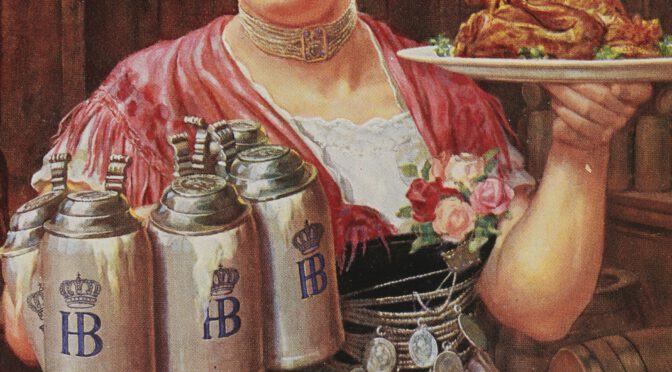
In December 1949, the city administration of Munich filed criminal charges against the second brewmaster of Hofbräuhaus, Heribert Kraus. The alleged crime? Hofbräuhaus sold Märzen during Oktoberfest with less than the minimum 13°P original gravity, which according to the city administration violated food law.
During the investigation, it was found out that Hofbräuhaus had produced its Märzen not by brewing dedicated batches, but rather by blending 12°P beer with 16°P and 18°P export beers. Due to the error margins in that process, some of the beer had a calculated OG of slightly less than 13°P.
In February 1950, Heribert Kraus was put on leave due to the open investigation after he had requested so, the Bavarian finance ministry announced. What added to the political sensitivity was that Heribert Kraus was the son of Bavarian finance minister Dr. Hans Kraus, who at the time had announced that he would step down, but was still officially in charge. Minister Kraus officially stepped down due to health reasons, but was also indirectly involved in the “Blum affair”, in which he was accused of favouritism in making his son brewmaster of the state-owned Hofbräuhaus. Ironically, son Heribert uncovered this affair in which 790,000 DM and building material were provided by Hofbräuhaus for the reconstruction of the “Royal” hotel in Stuttgart, which had been the main destination for Hofbräuhaus in South West Germany prior to World War 2.
When the case about the adulterated beer went to trial, it was not only Heribert Kraus who was accused, but also Hofbräuhaus deputy technical director August Ott. In total, they were alleged to have served 5,876 hectolitres of Märzenbier below the typical OG range of 13-14°P. The prosecutors claimed that this was in violation of food law and a deception of consumers, while the defendants said that it was common to call blended beers below the minimum OG “Märzenbier” as long as they had a “Viennese colour”, and that an error margin of about ±0.5°P was unavoidable.
In June 1950, both Heribert Kraus and August Ott were found guilty of selling adulterated beer below the minimum OG, thus deceiving consumers, and were fined to pay DM 800 and DM 200 each. Their defence, though unsuccessful, was that Märzen was defined by its alcohol content, colour and wholesomeness, while prosecutors pointed out that consumers didn’t want to be served blended beer, no matter how good it tasted.
Effectively, the court in this verdict clarified that Märzen, at least in Bavaria, was defined by its original gravity between 13 and 14°P, not by its colour or alcohol content.