“But Andreas, you only just published your latest book, why are you working on something new already?” you may ask. Well, I’ve been itching to work on this for a while, in fact even before I started on my previous book, but never quite had the motivation to actually start work on it.
So here it is: my next big project is a second edition of my first “proper” book, Historic German and Austrian Beers for the Home Brewer. I think it’s a good book, and as a good friend of mine said, because it’s a history book, it’s not going to be outdated anytime soon, but looking back the eight years since I first published it, I think I can do better.
After all, it was my first proper book, and I was relatively inexperienced about what was involved in writing, editing and publishing a book. One of my big surprises was that even though I had planned this as an e-book only release, people immediately called for a print edition. There were only a few weeks between me initially releasing it as an e-book and us going on a big holiday (3 weeks in New Zealand), and I wanted to use the momentum and get the print version out before we were flying away, so it all felt a bit rushed, but was fine in the end.
In these eight years, I also learned a lot: I think my writing style got slightly better (though it still feels very technical to me, but that’s virtually all the writing that I do outside of beer writing, and that is technical documentation for the software that I develop in my day job), I also managed to get better at researching the history of beer styles, and I found many more legit sources for historic and extinct beer styles.
So that’s what you can expect from the second edition of Historic German and Austrian Beers for the Home Brewer:
More beer styles: Kölsch, Lichtenhainer, Düsseldorfer, Dortmunder Adambier, German Porter, Breslauer Schöps, and probably even more.
More recipes, both for beer styles that were already in the first edition and for newly added styles.
More history: my intention is to give even more historic background to each of the styles in the book.
More technical background: two of the great challenges of reproducing historic beers are the raw materials and the exact brewing methods used. This is something I already worked on in my previous book (if you want to learn how to make a reasonable approximation of a historic air-dried malt, go get it!), and definitely something I want to expand on. The same goes for historic brewing methods and document more of the nitty-gritty details in the original sources and to what extent we can translate that to homebrewing.
More accurate homebrewing recipes: going back, I realised that some of the conversions and translations of historic recipes to modern techniques and homebrew-sized amounts may not have been totally accurate or quite complete. I’m not saying the first edition is fundamentally wrong, but I will re-examine all historic sources and re-convert all existing recipes to make sure no details are missing.
I have no intention of rushing this project, but I do want to get it right. So I currently aim for releasing the second edition in 2028, roughly for the book’s 10th anniversary since its initial publication.
I also want to occasionally share findings that I make along the way here, so I’ll occasionally post about beer styles or historic recipes just as a bit of a teaser.
I started this new project literal days after the previous book’s release, and have actually come across quite a few interesting sources and lots of details and even recipes that I had not been aware of before. So naturally, I am quite excited to go back to the roots of my beer book writing and document all the barely documented, often extinct historic beers.
Today I can proudly announce that I just published my new book, Bavarian White Beer. Very much in the spirit of my previous book about Vienna Lager, my intention was to find out as much as possible about Bavarian White Beer, the beers people more commonly know as Bavarian Weissbier, Weizenbier or Hefeweizen, first from a historic perspective: how did the beer style get popular? How did it develop over time? What were the important locations and historic events during all of that? How did it survive to this day?
I then looked into the historic brewing literature to see what we can learn about the style there. This is also where the title for the book came from: I very quickly realised that even though the style’s history is also closely connected to the use of wheat malt in brewing, using wheat was far from obligatory, and plenty of examples of white beer using just barley malt were also brewed. This is why I don’t like using names involving only wheat when talking about the breadth of historic beers in that tradition.
And since my focus of previous books of mine has also been on brewing in general, I also took a look at the latest science and state-of-the-art technology and processes that are used to brew great Bavarian(-style) white beer in all its forms. This is of course complemented by a collection of homebrew recipes that cover the variety of historic and modern styles and variations: classic banana-forward Hefeweizen, oak-smoked wheat beer (a Bavarian-style wheat beer loosely inspired by early historic descriptions), historic Kelheim wheat beer from 100% wheat malt, Hefeweizen brewed on a Burton Union set (and what the Burton Union has to do with brewing wheat beer), modern hoppy wheat beer, and three homebrew versions of commercial beers: Skeleton Key & Goldfinger’s Bavarian Breeze, a beer that I was able to try at Goldfinger’s taproom in 2024, then the award-winning Live Oak Primus Weizenbock, and finally Sapwood Cellar’s Exaggerated Truth, a hazy IPA recipe that demonstrates how Bavarian wheat beer yeast can be used to add more complex fruity flavours to hoppy beers. Homebrewers can even learn how to malt their own wheat and make historically accurate air-dried wheat malt at home.
In terms of what’s covered, this is the most detailed brewing and history book solely dedicated to Bavarian white beer. You can buy it on Amazon as paperback or e-book. Visit waizenbier.de for more information. It has all the links to all the Amazon stores, and you can get an overview what to expect through the book’s table of contents.
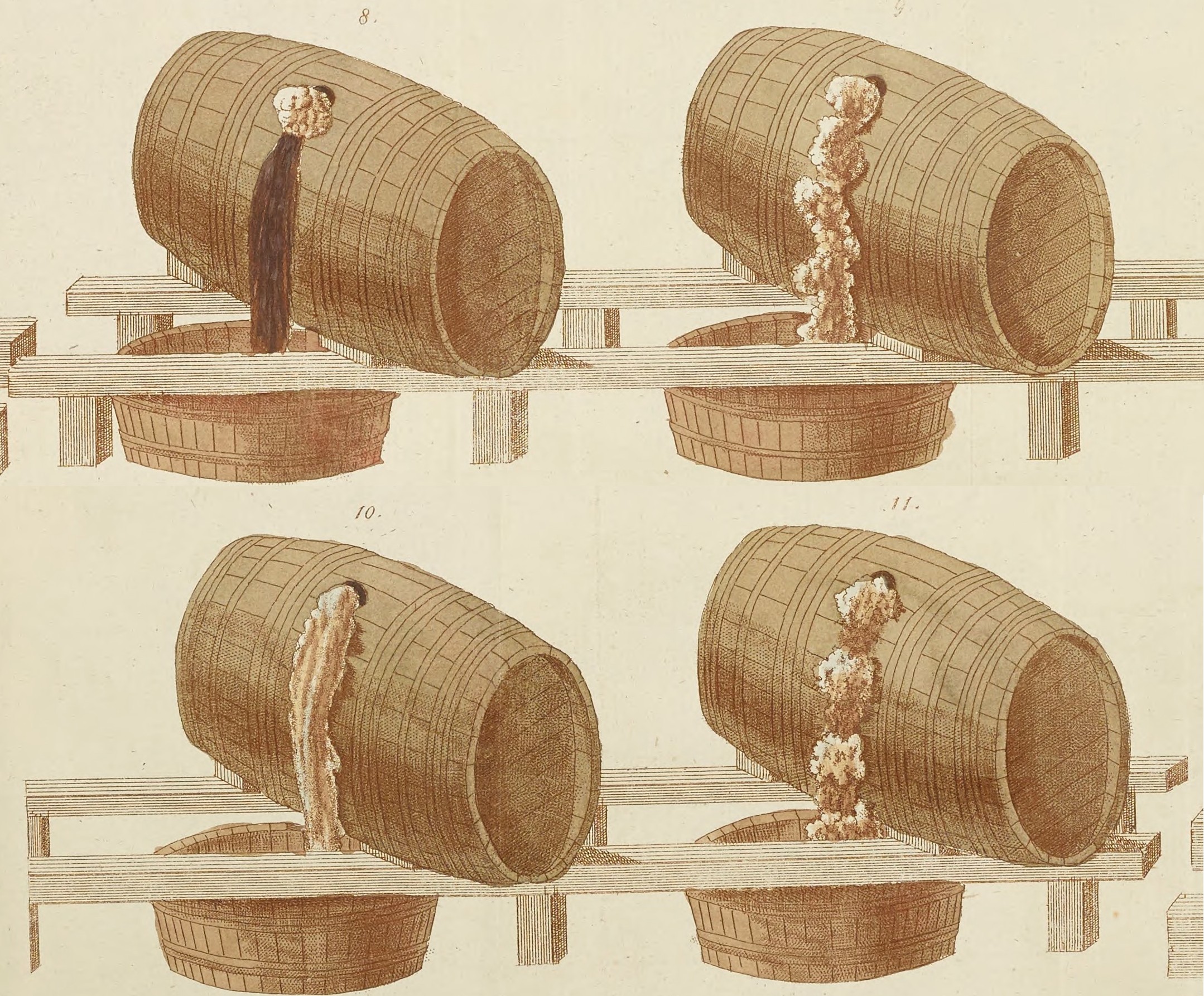
An 1827 illustration showing wooden casks expelling foam during fermentation, so-called Spundgärung, which was common for top-fermented beers at the time.
What inspired me to look into this whole topic was actually another beer writer getting in touch with me. In early 2023, Jonny Garrett approached me with very specific history questions about the Degenberger family for a book he was working on then, The Meaning of Beer. The Degenbergers were a noble family from Bavaria who were very closely involved in the early development of white beer, in particular in Lower Bavaria. I couldn’t answer some of the questions, so I had to visit a specialised library to see what existing literature there was about the Degenbergers and the beginning of the Bavarian white beer monopoly. And just that got me down a rabbit hole about a nowadays very popular beer style that had already been popular in Bavaria from the 16th to the late 18th century.
And while some literature about it was around, it was either about super specific aspects of this whole history or just more general brewing literature. I realised that no book just focusing on this style existed that explained both history and brewing science to the level of detail that I would have liked to have. So I sat down and wrote that book myself.
While the idea had been in my head since 2023, it took me until June 2025 to actually start the work on it, and in the roughly 12 months since then, I managed to write a book pretty much how I wanted it to be. I have not been able to answer every single question about the style that there is, but I was able to dispel quite a few myths and unearth surprising historic details along the way, and overall, it covers all its important history, from its early establishment as a beer style in the 15th and 16th century all the way to the 21st century.
While writing the book, I noticed an interesting 80:20 effect, or at least something like it: in the first 2.5 months of working on the book, I wrote roughly 60% of the final text, while for the remaining 40%, it took me another 8 months, most of which was researching a lot of tiny details and very particular aspects of the history and brewing science of Bavarian white beer. The remaining time was proof-reading, incorporating corrections from reviewers, and technical things like fixing the layout, finding and adding images, and just sorting out all the tiny details to get everything ready for self-publishing both as a printed paperback book and as an e-book.
At this point, I also have to say many thanks to the people who were willing to review my manuscript and give me valuable feedback on it: Brian Alberts, Dave Carpenter and Ben Palmer. Their feedback greatly helped me improve the bits and pieces that just weren’t quite there yet.
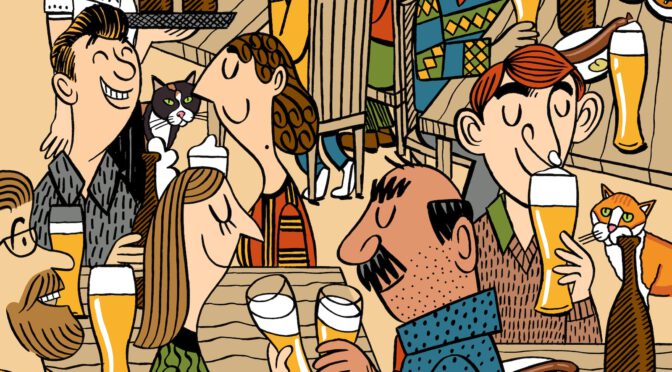
I’m also saying thanks to David Bailey, who created the colourful, happy-looking cover image of a beer hall full of people enjoying Bavarian wheat beer, snacks, and each other’s company. I’ve known David’s work mainly through Pellicle Magazine, and always loved his style, so I was very happy when he agreed to draw the book cover.
One thing that I rediscovered while writing this book was how much I actually liked Hefeweizen. The beer style as such was quite formative for me because it was the only truly different beer on offer back when I was 17, 18 years old, compared to all the Austrian Märzen (which is really just a slightly more bitter Helles). As part of my work on the book, I also reacquainted myself with the style, and drank all the ones I could find, no matter whether on draught or from bottles. I realised how good the beer style actually is, and how much complexity there can be to it, and it somewhat made me understand why the beer must have been popular when the alternative would have been darker, slightly smokey lager beers.
As part of sampling all this Bavarian wheat beer, I also ventured into territories I hadn’t explored much before, and also realised that Kristallweizen (basically a clear, filtrated version with slightly more bitterness) can be excellent, even when it’s probably one of the least fashionable beer styles around right now.
So yeah, I hope the book can also increase the interest in this quite unique beer style, get more people to homebrew Bavarian white beer, and learn something about the beer’s history along the way! So please buy my book (all the information is on waizenbier.de), and don’t hesitate to get in touch if you have any further questions about the topic.
“Why waizenbier.de?”, you may wonder. Well, the story behind that is that I like vanity domains to promote books. What would be spelled “Weizenbier” in modern German actually wasn’t standardised until the German Orthographic Conference of 1901, and in particular the spelling “Waizenbier” was nearly as common between the 1760s and the late 19th century. The very first time G. Schneider & Sohn served their beer at Oktoberfest in 1895, they advertised their stall (it was likely more like a wooden hut) as “Waizenbierbude”, and that was very much my inspiration.
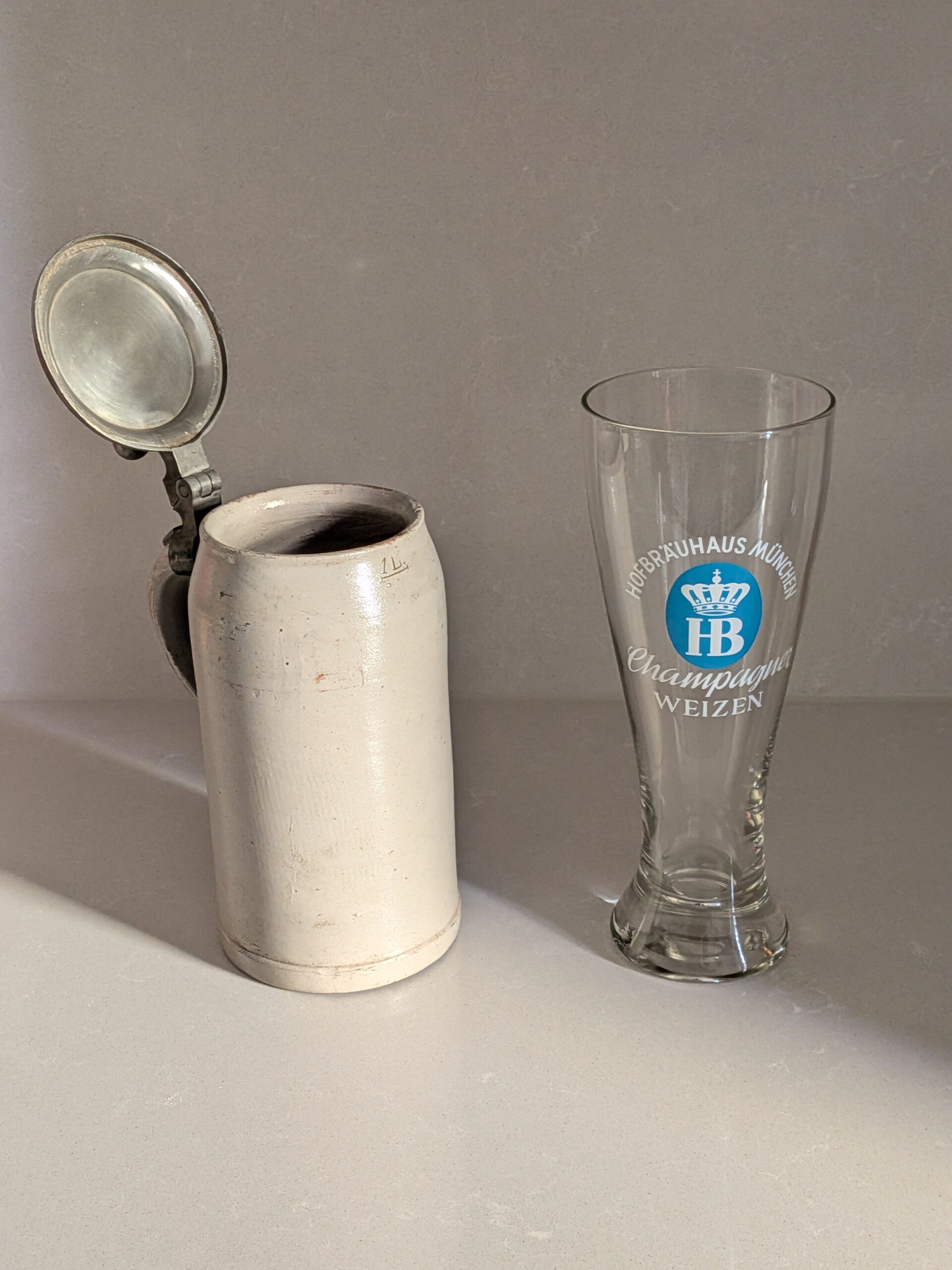
A historic stoneware mug with a tin lid (ca. 1900) from which white beer would have been drunk out of, and a wheat beer glass (ca. 1960) with Hofbräuhaus München Champagner Weizen branding.
Today, I am publishing my new book titled “Vienna Lager”. It’s the result of 1.5 year of intense research about the history of the Vienna Lager beer style and its current state. And of course, how to brew it.
I consider this to be my greatest work so far, and I’m absolutely proud about the result. I achieved everything I wanted to achieve in this book: first, I managed to put together the history of Vienna Lager in Austria from its very beginning in the late 1830’s until its demise after World War I in great detail, all embedded in the history of its inventor, Anton Dreher, and his brewery in Klein-Schwechat near Vienna. Second, I was able to shed more light on the supposed survival of Vienna Lager in Mexico. My research very quickly showed that it wasn’t Mexico that was big in brewing Vienna Lager, it was the United States! This is something many will be surprised about, but Vienna Lager was a fairly popular style in the US, and even survived Prohibition to a certain extent, until it made it into the canon of classic beer style as we know it nowadays. And third, I could reconstruct how Vienna Lager was brewed, from the ingredients to the brewing process, fermentation and lagering. I have previously discussed elements of this here in my blog, but in this book, I can finally present all the sources that corroborate even the tiniest detail about historic Vienna Lager brewing.
So today, I’m releasing the book both as printed book and e-book, exclusively on Amazon. You can find more information about the book including links to Amazon on vienna-lager.com.
As with my previous book, I tried to keep the price moderate to make it affordable for everyone. While “Vienna Lager” is more extensive compared to my previous book, I deliberately decided to keep the price for the e-book the same. As for the print-of-demand book, I had to slightly increase the price to offset the increased printing costs. For every book sold, I roughly get the same amount of royalties, no matter which media. I think this is fair, as I’m happy with the individual royalties that I earn, while being able to keep the costs down for interested readers. Ultimately, we have to face the hard truth: there is not a whole lot of money to be made as an author in a niche topic such as beer history and home-brewing. And that’s not my reason why I decided to write about historic, extinct German beers or Vienna Lager in the first place: instead, I wanted to let everyone know about everything I’ve been able to find out about these beer styles. Which brings me to my next point…
The history about Vienna Lager, as communicated in many works in the general beer history and craft beer sphere, has not been of great quality up to now. I’m not going to name names, but some books are outright works of fiction, while others suffer from something that’s called the Woozle effect. I didn’t know the term until a few months ago, but it’s what I had observed for quite a while: unsourced claims or historic stories frequently get cited even when they lack any historic factuality. The existence of citations creates an illusion of authority, which in turn gives credence to these claims, and generates even more citations which in turns boost the illusion of authority, and the spiral continues. The more citations are found or the same historic-sounding story is encountered, the more it seems like it’s true. The historic narrative around Vienna Lager is certainly not unique (IPA and Porter for example have long suffered from similar problems, and despite beer historians like Martyn Cornell, Ron Pattinson and others trying to correct them, they still cling on), but it’s the topic that I’ve researched fairly extensively for 1.5 years and that is now closest to my heart.
So this is my attempt to correct the narratives, and ironically, the real history of Vienna Lager is much more exciting. There is just so much we got wrong that got perpetuated over the years. Probably the most prominent example is the narrative that Vienna Lager supposedly survived into the 20th century due to Mexican brewing tradition. You often find stories of some unnamed Austrian brewers or German or Swiss brewers like Santiago Graf or Emil Dercher who supposedly went to Mexico (the Austrian brewers are often associated with Mexican King Maximilian, who, as a Habsburger and younger brother of the Austrian Emperor, was of Austrian descent) and started brewing Vienna Lager there. From everything I could gather, none of that was true. While brewers like Dercher and Graf definitely existed and (especially in the case of Santiago Graf) had great influence on brewing in Mexico, their connection with Vienna Lager is very doubtful.
But the real truth behind is actually much more interesting: up to the 1880’s, beer in Mexico was an imported niche product mostly enjoyed by expats or rich European immigrants. Most alcohol consumed at the time was agave-based, either just fermented (pulque) or distilled (mezcal). The first brewers didn’t have the conditions to brew cold-fermented lager beers, either, but instead brewed top-fermented beers from locally sourced ingredients such as sun-dried barley malt and unrefined cane sugar known as piloncillo. There are exceptions to it, like one German brewer allegedly building a small lager brewery including lagering cellars on the slopes of mount Popocatépetl, but lager brewing was only a necessity introduced the fight back American imported beer that came into the country after Mexico and the United States were better connected by railroad. That’s the kind of history of early Mexican beer that I actually find more interesting, and which in my opinion should be researched more thoroughly as it makes for a much better topic than just the narrative of Vienna Lager in Mexico.
But enough spoilers.
And there is one more thing I want to emphasize: I can’t even blame any of the writers that perpetuated any of the stories that we’ve previously heard about Vienna Lager that turned out to be not quite true. That’s what used to be the only material accessible to English speakers, and even for German speakers, there wasn’t a whole lot of stuff around (by now, the situation has slightly improved; in particular the history of brewing in Vienna independent of Vienna Lager is really well-researched and well-presented). In that sense, I very much recognize my privilege in being a native German speaker with sufficient proficiency in English that allowed me to research the topic based on original sources and to communicate my research results to a wider audience in English.
Of course, I wouldn’t have been able to complete my work without the help of many other people. In particular, I’d like to thank my wife Louise for supporting me in writing my book and for her tolerance of my obsession with the whole topic. I’d also like to thank everyone who inspired me to write this book, who provided me with interesting source material, or who supported me by giving me lots and lots of valuable feedback: Boak & Bailey, Ron Pattinson, Gary Gillman, Geoff Latham, Jeff Alworth, Joe Stange, Johannes Kugler, Michael Williams, Michelle Humphrey, Sven Förster, Michaela Knör, Glen and Julie, Doug Hoverson, Stan Hieronymus, Dave Carpenter, Mark Dredge, Natalya Watson and Benedikt Koch. A big Thank You to all of you!
Here are some of the online resources that I used for my research:
A few more geeky details: I wrote the book using Visual Studio Code in Markdown format, and used pandoc with custom templates to render it into epub as well as a print-ready PDF (via LaTeX). When all the dust has settled, I intend to publish a whole template to produce books for self-publication in the same way I did it for my last two books. The book cover design is self-made: as background image, I used a historic map of Vienna from 1875, while the book title itself was inspired by Vienna’s iconic street signs and made possible by the Wiener Norm font which is freely available under a Creative Commons license.
“OK, great, what’s next?” some of you may ask, and to be honest, I don’t know yet. Originally, I had planned a lot more around the launch of this book, but due to The Event that has plagued us since at least March 2020, and the necessary precautions due to it, much of that simply has not been possible. I hope to be able to do something like a proper launch event at a later time, and will announce this accordingly in case it will actually be possible in the near future.
If you think the topic of my new book is interesting and more people deserve to know about it, please spread the word and tell people about it. If you have a blog, write about, if you have a beery podcast, feel free to get in touch with me and I’ll happily talk about Vienna Lager with you.
For now, enjoy the book, enjoy Vienna Lager, if you’re a home-brewer, or even a pro brewer, go and brew some. Cheers!