
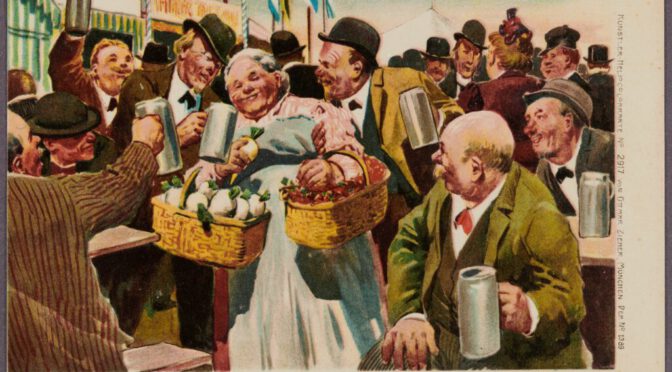
As I showed in my previous blog post, Oktoberfest didn’t feature massive tents, only moderate stalls. From the 1888 Bayerische Gastwirths-Zeitung we learn that the maximum measurements that year were 4.4m height, 7.3m width and 10m length. Compared to nowadays, very small in size.
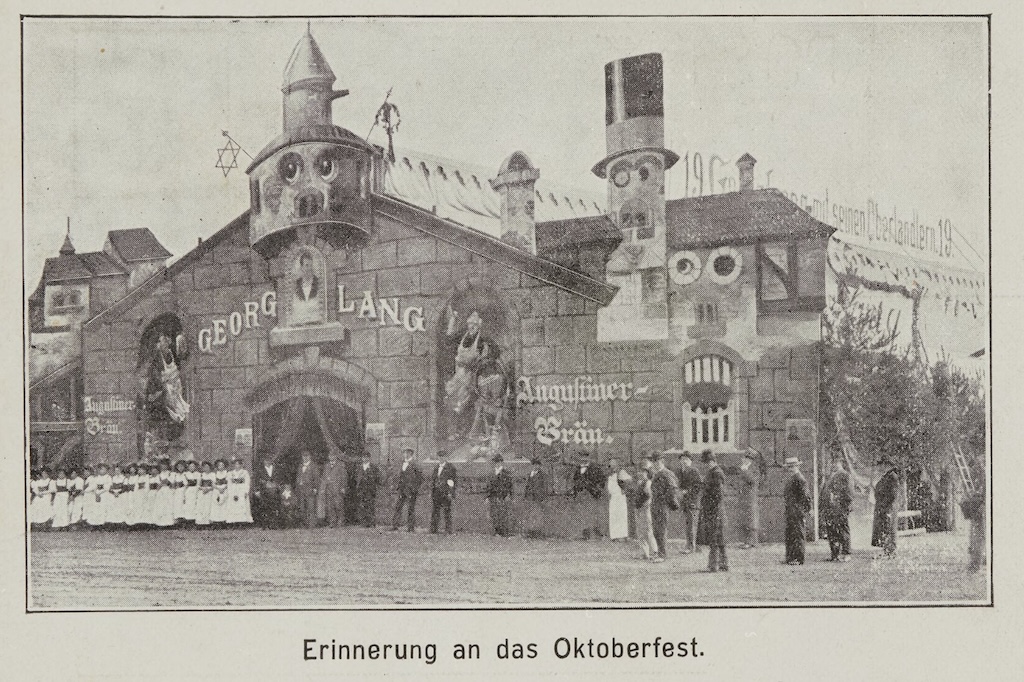
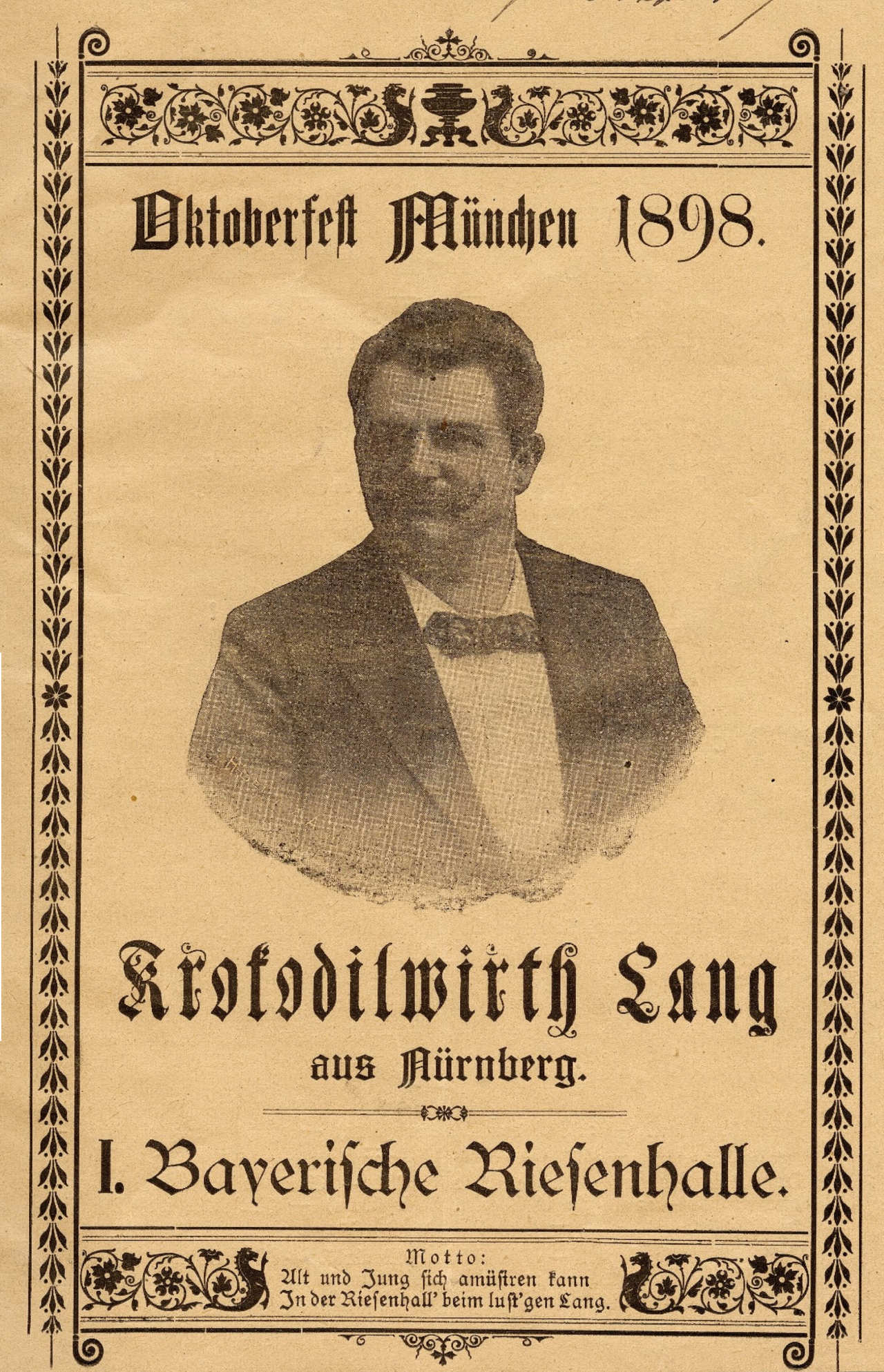
This changed in 1898, when Georg Lang managed to establish the very first Riesenhalle at Oktoberfest, to the displeasure of the other traditional Oktoberfest restaurateurs. Interestingly, the 1898 issues of the Bayerische Gastwirths-Zeitung give a lot of insight into how the whole scandal unfolded in detail, and what the fallout of it was.
Like every year, the Oktoberfest stalls were all auctioned off by the city of Munich, on 10th August 1898 at 3pm at Circus Bavaria (page 256).
On 14th August, the auction winners were published in Gastwirths-Zeitung (page 264). 3 stalls went to Löwenbräu, 1 to Zacherlbräu, 2 to Augustiner, 2 to Pschorrbräu, 2 to Spatenbräu, 1 to Dreher, 2 to Hackerbräu, 1 to Salvatorbrauerei, 1 to Eberlbräu, 1 to Thomasbräu, 1 to Kochelbräu, 2 to Bürgerliches Bräuhaus, 1 to Unionsbräu, and 5 to Münchner Kindl Brauerei.
On 28th August, Gastwirths-Zeitung reported (page 282) that 5 restaurateurs had applied for a permit to combine their stalls into a single large tent, to be able to serve the same beer together, Münchner Kindl. This request was denied.
On 4th September, it was reported (page 288) that the 5 petitioners from the week before had submitted a complaint that they’d have financial damages if they had to run the 5 stalls themselves instead of combining them into a single tent. They claimed that administrative counsellor (Verwaltungsrat) Nagler had promised them that the magistrate would grant a permit for combining their stalls, and that it was the reason why they even took part in the auction in the first place. They were nevertheless willing to compromise by combining their 5 stalls into 2 large stalls that are separated by a wide passageway. Counsellor Nagler denied any kind of promise and said that he had only mentioned that it depended on the magistrate’s decision.
At the same time, Nagler found it strange that the other restaurateurs did not want to bid on the stalls that had gone to Münchner Kindl Brauerei, but now that there were rumours that the 5 restaurateurs were just strawmen of the brewery and that the whole operation should be handed off to someone entirely else, they suddenly started complaining. Counsellor Heindl in the meanwhile pointed out that the change to 2 large stalls on the site of the 5 stalls was against the rules of the auction. Nagler also insisted that if he had known that a “stranger”, Georg Lang from Nuremberg, would get involved, he would have entirely been against it from the beginning, especially since the rules of the auction stated that only someone with a local licence to trade could successfully bid on a stall, and Lang did not have such a licence.
Counsellor Hübler interjected and asked why Dreher then had gotten a stall. Nagler replied that Dreher at least owned a beer hall in Munich, and that it was not the brewery, but rather the tenant restaurateur at Dreher’s beer hall who would operate the Dreher stall at Oktoberfest.
In the end, it was decided that the 5 restaurateurs got the permit for 2 large stalls, with only one vote against it by counsellor Heindl.
In the same issue (page 290), it was announced that Georg Lang, restaurateur of “zum Krokodil” in Nuremberg would “visit” the Oktoberfest together with his house band, and that he would take over managing the stalls that were provided by “a local brewery”.
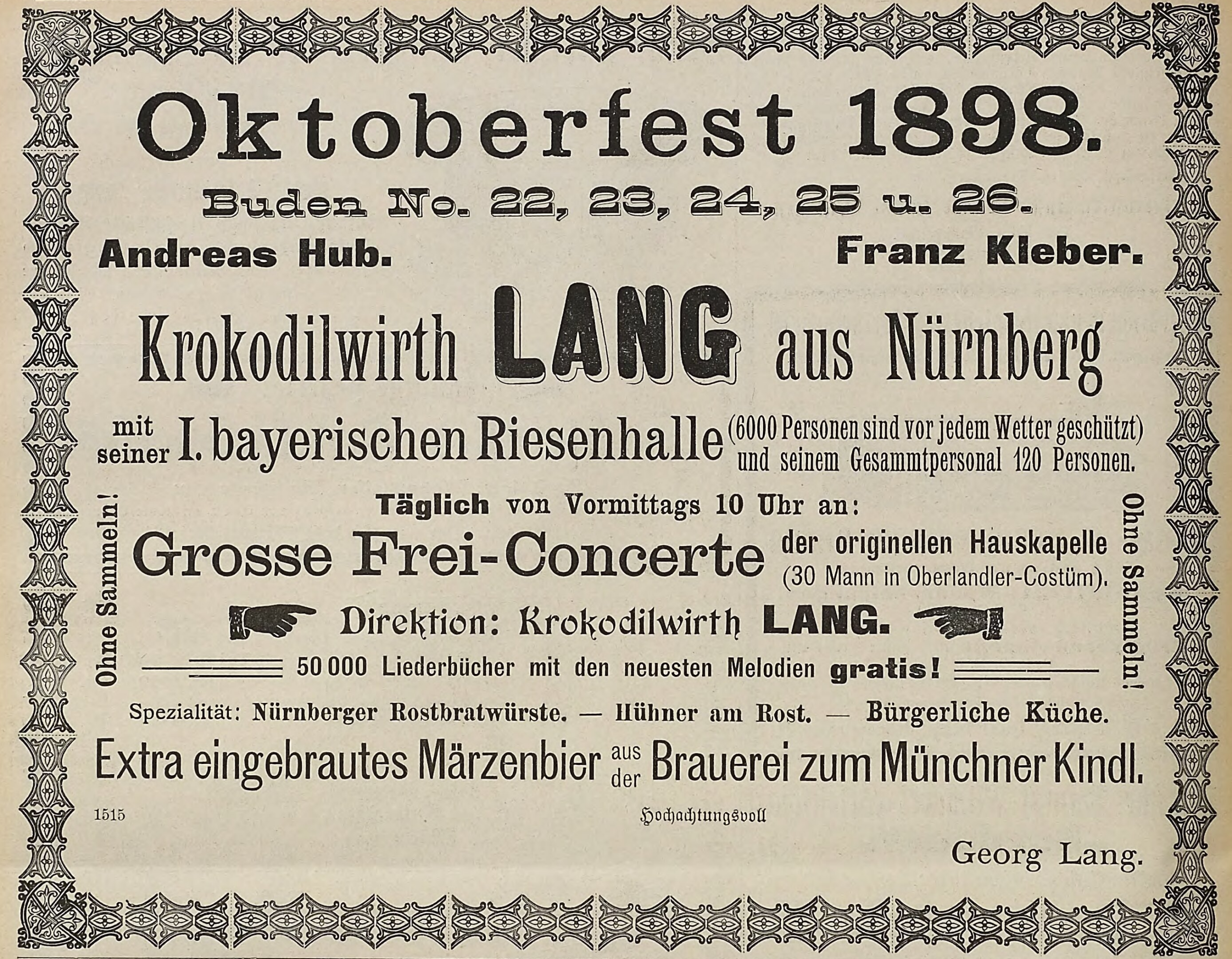
On 25th September (pages 314, 316) it was announced both as an ad and in a dedicated article that Georg Lang would officially operate a Riesenhalle, a giant hall with enough space for 6,000 guests, served by a total of 120 personnel, and entertained by his 30 musician house band. A total of 50,000 song books were printed and handed out for free to the guests. The ad even reveals that the giant tent span over the spaces of the stalls 22, 23, 24, 25 and 26, exactly the 5 that had been won by strawmen of Münchner Kindl Brauerei.
A few weeks after the Oktoberfest, on 23rd October, the Wiesn restaurateurs formed a commission consisting of 3 of their peers, namely Ludwig Blößl (no. 10, Augustiner), Josef Fendt (no. 17, Unionsbräu) and Alois Wohlmuth (no. 19, Pschorrbräu), accompanied by a lawyer, to pursue the case they thought they had against the city (page 346). The plan was to initially try to find a way to settle with the city magistrate of Munich, but if that didn’t bring an acceptable result, they planned to sue for damages of an estimated 10,000 to 15,000 Mark (for comparison: the city’s total earnings from auctioning off all stalls were 37,500 Mark in 1898).
This was not very successful: the restaurateurs indeed went to court and sued for damages of 15,690 Mark, which was rejected on 24th April 1899. The Wiesn restaurateurs appealed, but also in appellate court in December that year, their appeal was rejected and they had to bear all court costs.
In the end, the big tents were here to stay, and they changed the Oktoberfest to what it is nowadays. But at the time, the whole thing was a big scandal for the Munich restaurateurs, while the Münchner seemed to have liked it.
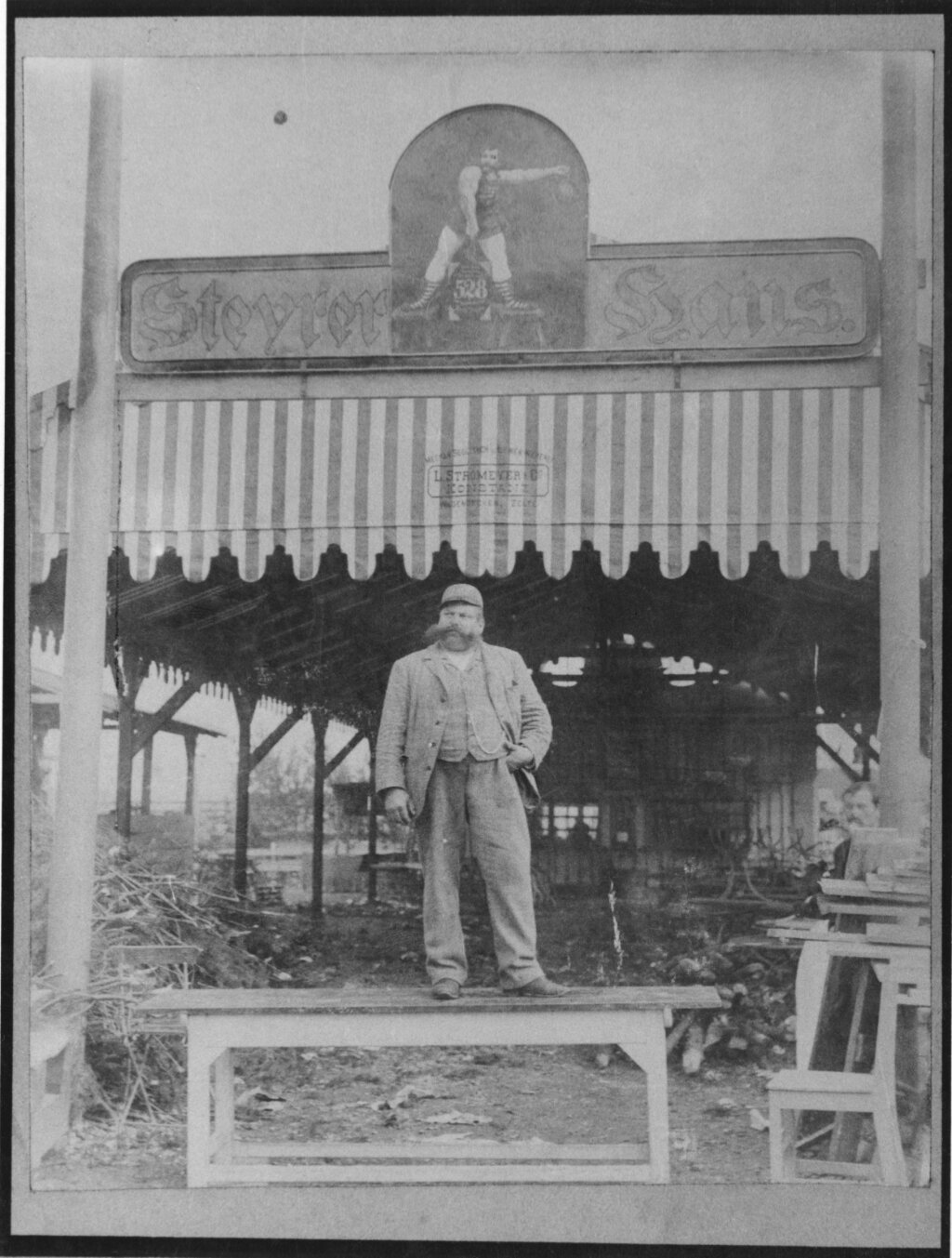
By 1900, Lang was fully accepted in Munich: that year, the Oktoberfest restaurateurs founded their own association of Wiesn restaurateurs, and unanimously elected Georg Lang to be their first chairman. Counsellor Nagler was made honorary president, while the illustrious Steyrer Hans became secretary.
Georg Lang died on 4th October 1904, just 38 years old, from bowel cancer.
Seems like a classic case of not asking for permission and ask for forgiveness later (or in this case go to court and win)