This is going to be my last Oktoberfest post for a while, I swear! But I got some good stuff: I stumbled upon Schmankerl Time Machine, a project of Digital Humanities Virtual Laboratory at Munich University from a few years ago to digitise historic restaurant menus from Munich, from 1855 until the 1980s, and make them available online. This of course also contains menus of some of the Oktoberfest tents, which also mentioned beer types, and I quickly wanted to list.
Bräu-Rosl lists all the Pschorr beers on their 1965 menu (Edel-Hell, Export-Dunkel, Märzen, Bock, Stern-Weiße, Animator, St. Hubertus, Pschorr-Malz-Bier), but I don’t think all of those were actually sold there. The menu does have two beer names at the very top, though, Bräurosl-Wiesn-Märzen and Pschorr-Edel-Hell, so I assume that’s what was actually served. Hacker-Pschorr (in 1965, Hacker and Pschorr hadn’t merged yet) nowadays still serve an Edel-Hell from wooden cask at some of their beer halls.
The menu the same year at Fischer Vroni contains lots of advertising , including one for Augustiner Brauerei, listing some of the beers: Export-Bier dunkel, Edelstoff hell, heller Augustiner-Bock, St. Augustin-Maximator, and Oktoberfest-Märzenbier. Augustiner was served at the Augustiner Festhalle and Fischer Vroni, but it’s not clear which exact beers. So this did not give us much insight beyond the general Augustiner portfolio at the time.
Hippodrom in turn had two beers on their menu: Spatenbräu helles Wiesenbier, and Spatenbräu Champagner Weißbier. The latter would nowadays be called Kristallweizen, but this was 1965, before PGI and PDO, around the time when French winemakers only started complaining about the misuse of what they thought exclusively described sparkling wine from the Champagne region.
Hofbräuhaus only started participating at Oktoberfest in 1955. Ten years later, they served two beers: helles Festbier and Wies’n Märzen.
Löwenbräu served two beers in 1961: Wies’n Märzen and Export hell. They also have a bold warning text on their menu that if your Maß was under-poured, you’re kindly asked to have it properly filled up to the line. I’m not sure that would have been exactly popular with the waitresses.
Ochsen Braterei in 1965 unfortunately only had the logos of two brands on their menu, Paulaner and Thomasbräu, but in reality both of them were brewed by the same brewery. So maybe they had beers of both brands? I can’t say for sure.
Winzerer Fähndl, also known as the Paulaner-Thomasbräu-Festhalle, made this a bit clearer: they at least mention concrete beers next to both brands’ logos, namely Paulaner Märzen and Thomasbräu Hell-Urtyp.
And that’s it. Far from all the breweries or tents at Oktoberfest at the time, but we still see a general trend: a lot of them served more than just one beer, quite often both a Märzen and a Helles Export or Festbier. In the case of Hippodrom, wheat beer was also served. All very different from Oktoberfest nowadays.
As I showed in my previous blog post, Oktoberfest didn’t feature massive tents, only moderate stalls. From the 1888 Bayerische Gastwirths-Zeitung we learn that the maximum measurements that year were 4.4m height, 7.3m width and 10m length. Compared to nowadays, very small in size.
This changed in 1898, when Georg Lang managed to establish the very first Riesenhalle at Oktoberfest, to the displeasure of the other traditional Oktoberfest restaurateurs. Interestingly, the 1898 issues of the Bayerische Gastwirths-Zeitung give a lot of insight into how the whole scandal unfolded in detail, and what the fallout of it was.
Like every year, the Oktoberfest stalls were all auctioned off by the city of Munich, on 10th August 1898 at 3pm at Circus Bavaria (page 256).
On 14th August, the auction winners were published in Gastwirths-Zeitung (page 264). 3 stalls went to Löwenbräu, 1 to Zacherlbräu, 2 to Augustiner, 2 to Pschorrbräu, 2 to Spatenbräu, 1 to Dreher, 2 to Hackerbräu, 1 to Salvatorbrauerei, 1 to Eberlbräu, 1 to Thomasbräu, 1 to Kochelbräu, 2 to Bürgerliches Bräuhaus, 1 to Unionsbräu, and 5 to Münchner Kindl Brauerei.
On 28th August, Gastwirths-Zeitung reported (page 282) that 5 restaurateurs had applied for a permit to combine their stalls into a single large tent, to be able to serve the same beer together, Münchner Kindl. This request was denied.
On 4th September, it was reported (page 288) that the 5 petitioners from the week before had submitted a complaint that they’d have financial damages if they had to run the 5 stalls themselves instead of combining them into a single tent. They claimed that administrative counsellor (Verwaltungsrat) Nagler had promised them that the magistrate would grant a permit for combining their stalls, and that it was the reason why they even took part in the auction in the first place. They were nevertheless willing to compromise by combining their 5 stalls into 2 large stalls that are separated by a wide passageway. Counsellor Nagler denied any kind of promise and said that he had only mentioned that it depended on the magistrate’s decision.
At the same time, Nagler found it strange that the other restaurateurs did not want to bid on the stalls that had gone to Münchner Kindl Brauerei, but now that there were rumours that the 5 restaurateurs were just strawmen of the brewery and that the whole operation should be handed off to someone entirely else, they suddenly started complaining. Counsellor Heindl in the meanwhile pointed out that the change to 2 large stalls on the site of the 5 stalls was against the rules of the auction. Nagler also insisted that if he had known that a “stranger”, Georg Lang from Nuremberg, would get involved, he would have entirely been against it from the beginning, especially since the rules of the auction stated that only someone with a local licence to trade could successfully bid on a stall, and Lang did not have such a licence.
Counsellor Hübler interjected and asked why Dreher then had gotten a stall. Nagler replied that Dreher at least owned a beer hall in Munich, and that it was not the brewery, but rather the tenant restaurateur at Dreher’s beer hall who would operate the Dreher stall at Oktoberfest.
In the end, it was decided that the 5 restaurateurs got the permit for 2 large stalls, with only one vote against it by counsellor Heindl.
In the same issue (page 290), it was announced that Georg Lang, restaurateur of “zum Krokodil” in Nuremberg would “visit” the Oktoberfest together with his house band, and that he would take over managing the stalls that were provided by “a local brewery”.
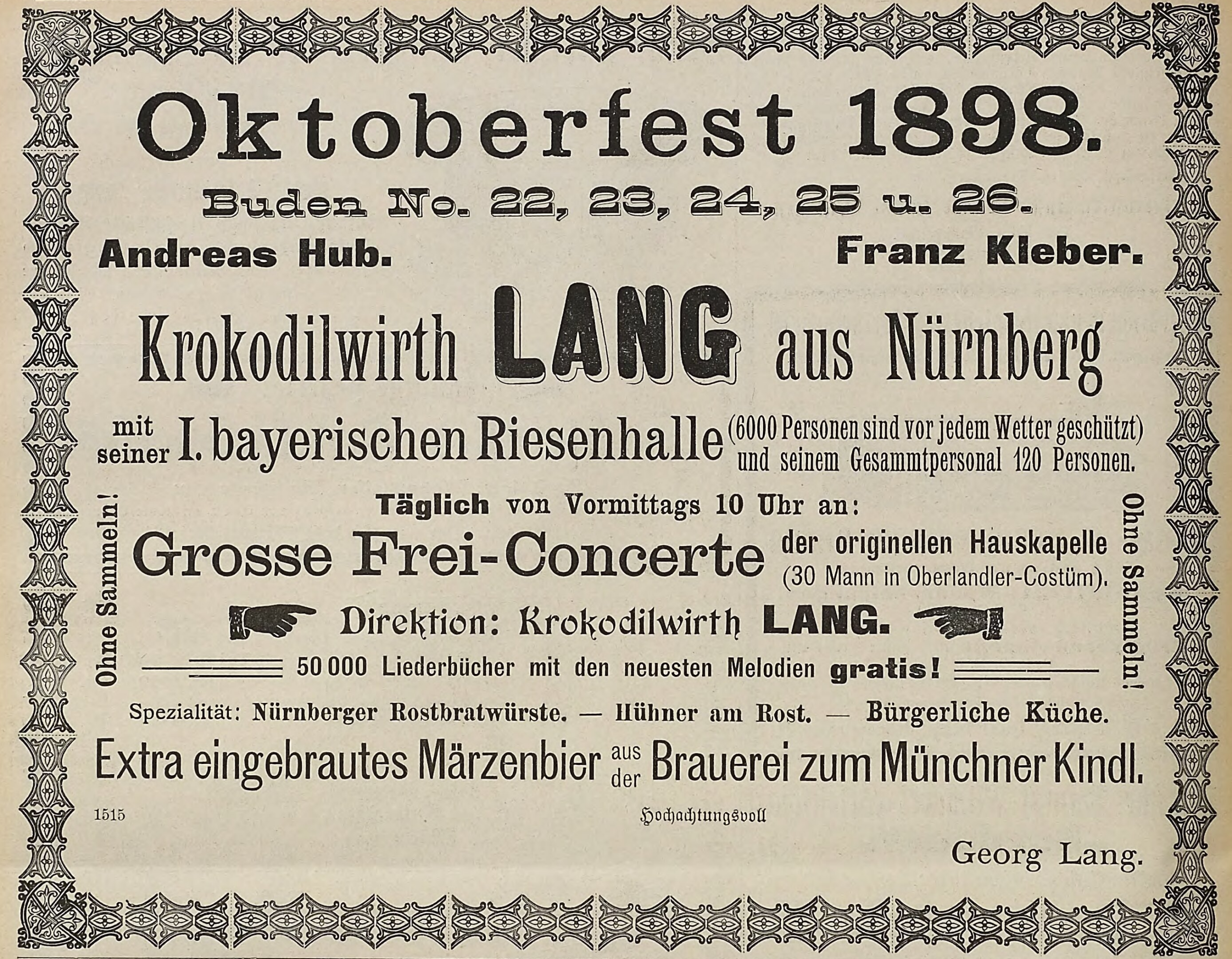
On 25th September (pages 314, 316) it was announced both as an ad and in a dedicated article that Georg Lang would officially operate a Riesenhalle, a giant hall with enough space for 6,000 guests, served by a total of 120 personnel, and entertained by his 30 musician house band. A total of 50,000 song books were printed and handed out for free to the guests. The ad even reveals that the giant tent span over the spaces of the stalls 22, 23, 24, 25 and 26, exactly the 5 that had been won by strawmen of Münchner Kindl Brauerei.
Half-page ad for Georg Lang’s “first Bavarian giant hall” at Oktoberfest 1898, advertising the tent size, free concerts, the free song books, and food and drink: Nuremberg sausages, grilled chicken, traditional cuisine, accompanied by “specially brewed Märzenbier” from Münchner Kindl brewery. The ad also contains the names of two strawmen, Andreas Hub (stall 24) and Franz Kleber (stall 25).
A few weeks after the Oktoberfest, on 23rd October, the Wiesn restaurateurs formed a commission consisting of 3 of their peers, namely Ludwig Blößl (no. 10, Augustiner), Josef Fendt (no. 17, Unionsbräu) and Alois Wohlmuth (no. 19, Pschorrbräu), accompanied by a lawyer, to pursue the case they thought they had against the city (page 346). The plan was to initially try to find a way to settle with the city magistrate of Munich, but if that didn’t bring an acceptable result, they planned to sue for damages of an estimated 10,000 to 15,000 Mark (for comparison: the city’s total earnings from auctioning off all stalls were 37,500 Mark in 1898).
This was not very successful: the restaurateurs indeed went to court and sued for damages of 15,690 Mark, which was rejected on 24th April 1899. The Wiesn restaurateurs appealed, but also in appellate court in December that year, their appeal was rejected and they had to bear all court costs.
In the end, the big tents were here to stay, and they changed the Oktoberfest to what it is nowadays. But at the time, the whole thing was a big scandal for the Munich restaurateurs, while the Münchner seemed to have liked it.
By 1900, Lang was fully accepted in Munich: that year, the Oktoberfest restaurateurs founded their own association of Wiesn restaurateurs, and unanimously elected Georg Lang to be their first chairman. Counsellor Nagler was made honorary president, while the illustrious Steyrer Hans became secretary.
Georg Lang died on 4th October 1904, just 38 years old, from bowel cancer.
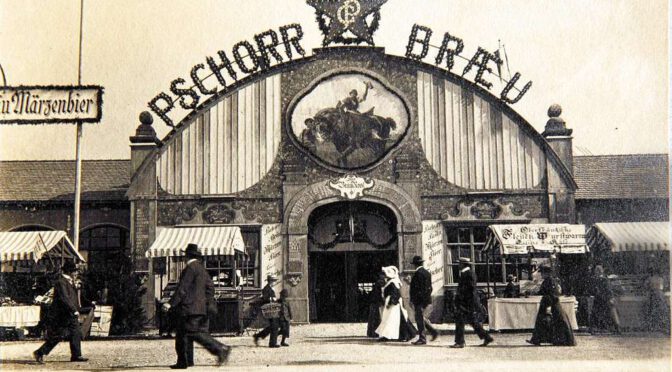
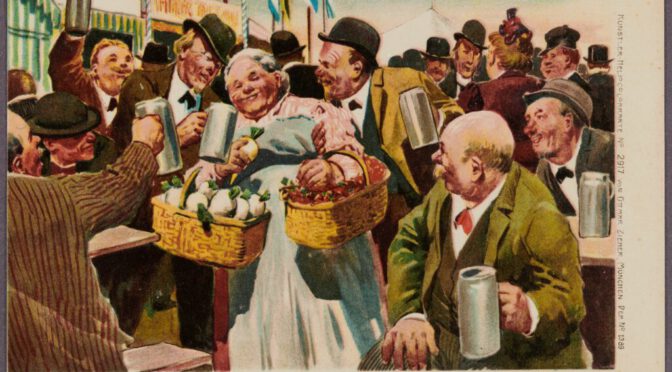
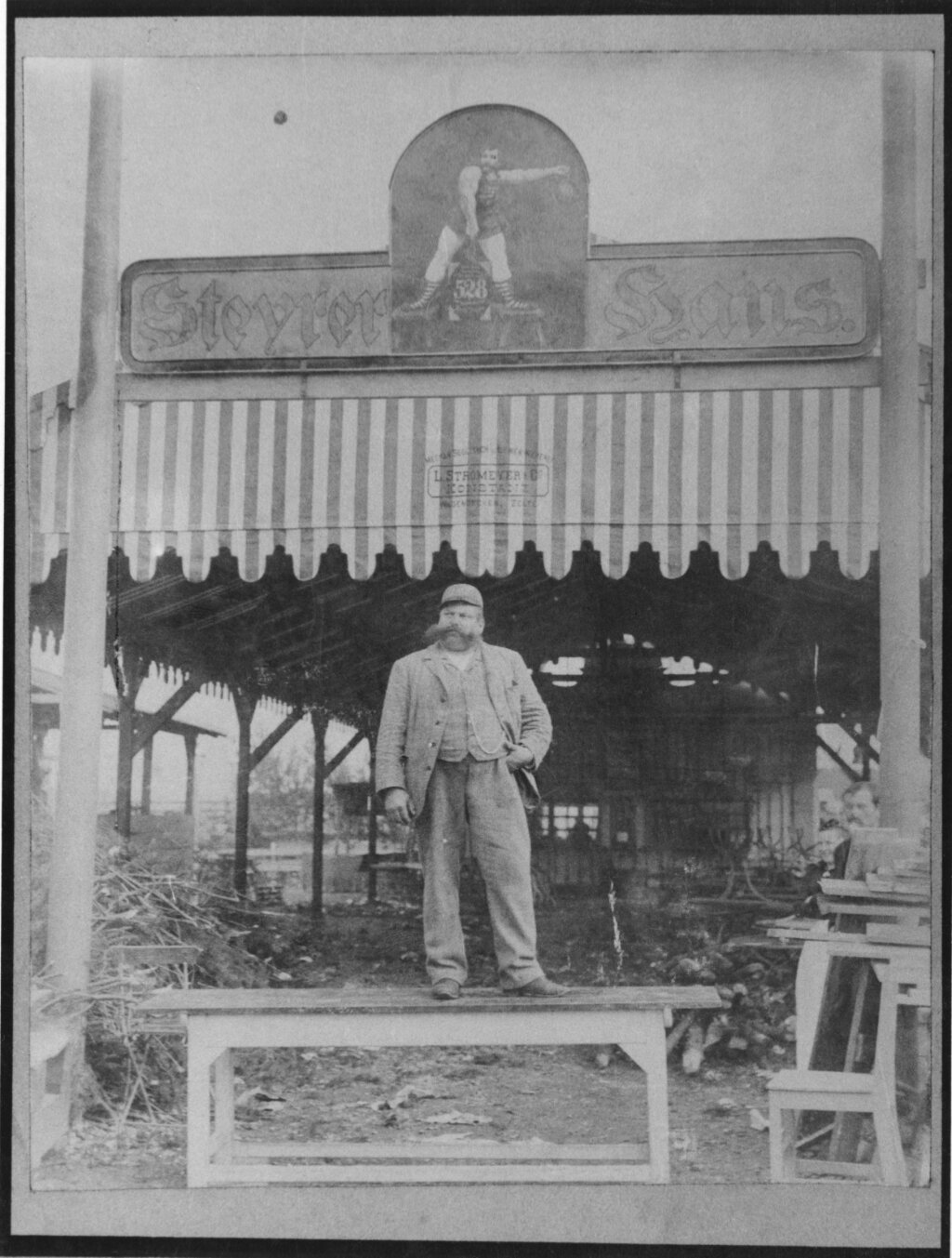
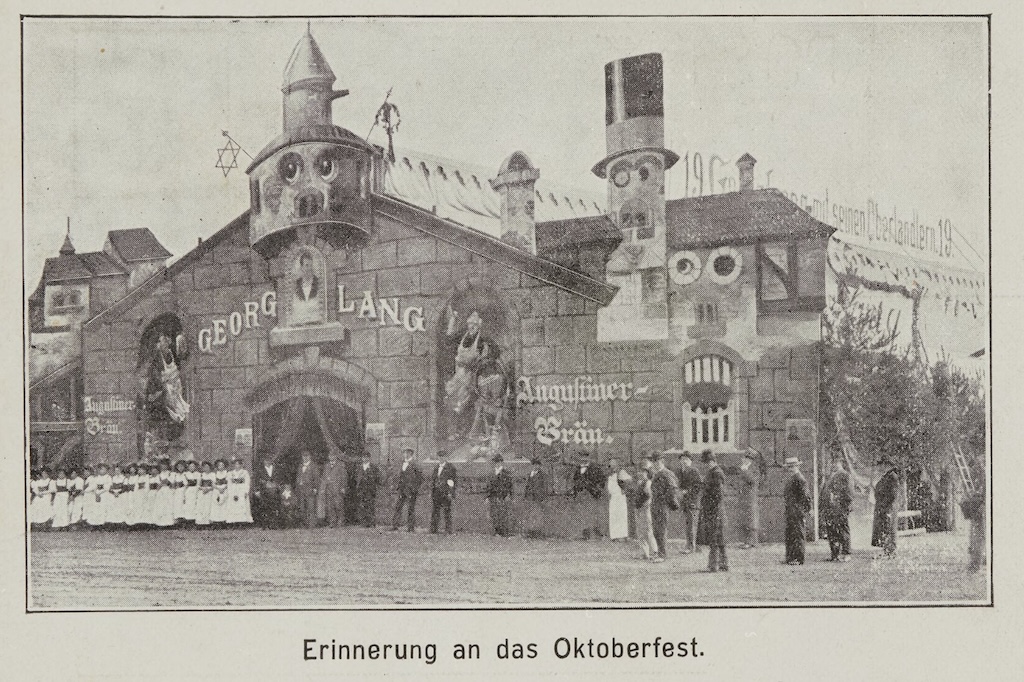
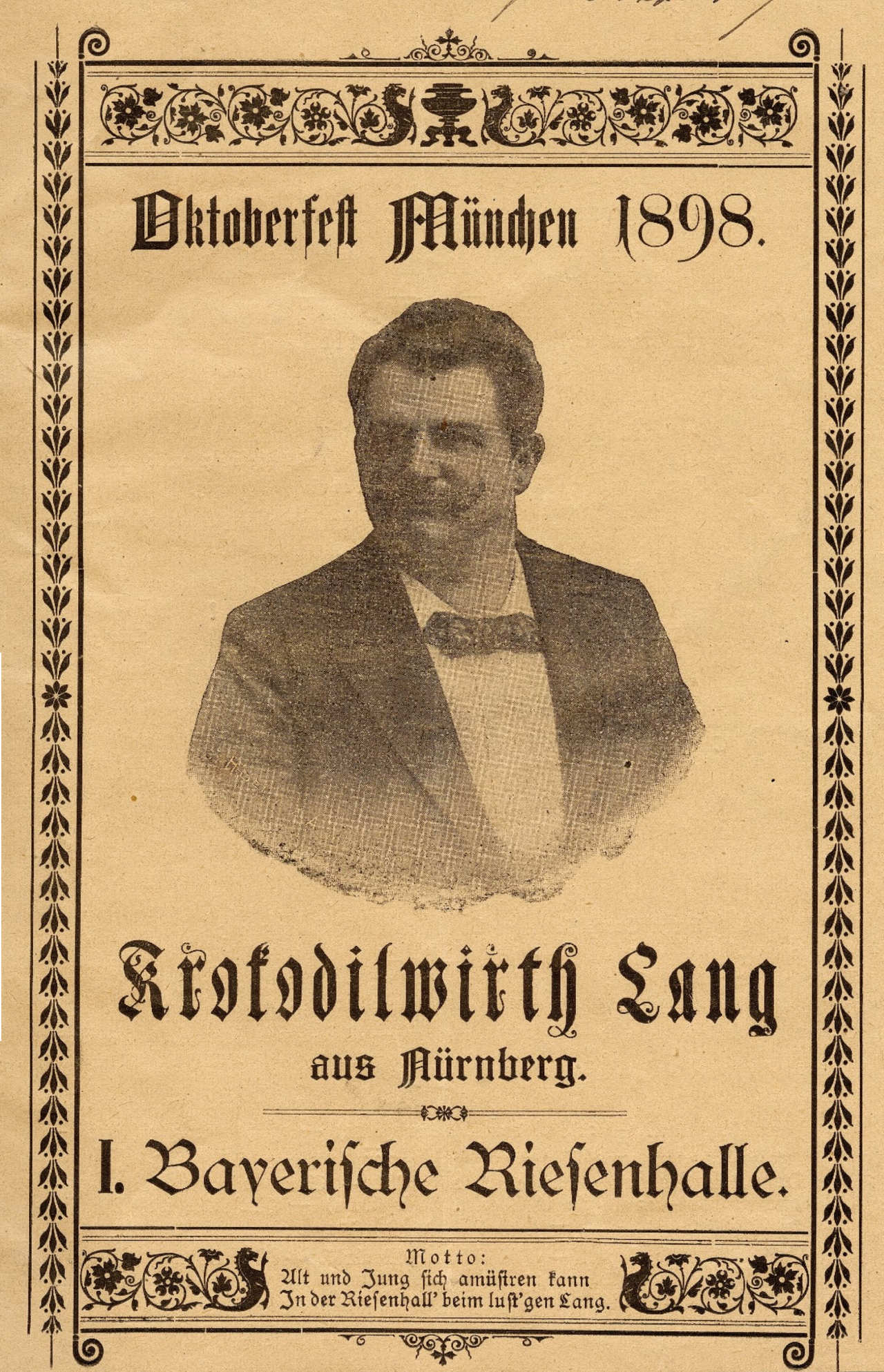
Steyrer Hans, ca. 1895 (source; licensed under CC-BY-ND 4.0) A postcard depicting Georg Lang’s Oktoberfest tent, ca. 1900 (source; licensed under CC0)Cover of the song book handed out for free in his tent in 1898 (source; licensed under CC0)
I’ve previously written about beer at Oktoberfest, like which breweries’ beers were served in 1843, or about various breweries and beers between 1882 and 1936 that we know of from Oktoberfest programmes and newspapers.
The whole question interests me for a particular reason: it shows that the current restrictions on beer at Oktoberfest, namely that it can only be from one of the “traditional” breweries from Munich whose beer conforms to the Oktoberfestbier PGI regulations, which requires them to have a well going several hundred metres deep down, are not rooted in the festival’s own history. It is essentially a form of regulatory capture to make it exclusive to Munich’s big 6 beer brands that has been successfully defended in court before. German online magazine Legal Tribune Online has criticised the restrictions of market access as a “cartel” in the past, and how the city of Munich may possibly be violating antitrust laws with the current practice.
The reality is that beer used to be much more diverse in the 19th and early 20th century than it is nowadays. But if you want to experience a traditional Volksfest with 20+ different beers available, you need to go to e.g. Forchheim for Annafest, because Oktoberfest is not that place anymore.
The two years 1895 and 1896 are in my opinion particularly interesting because there were quite a few really unusual und (at least from our modern perspective) unexpected breweries present in Munich:
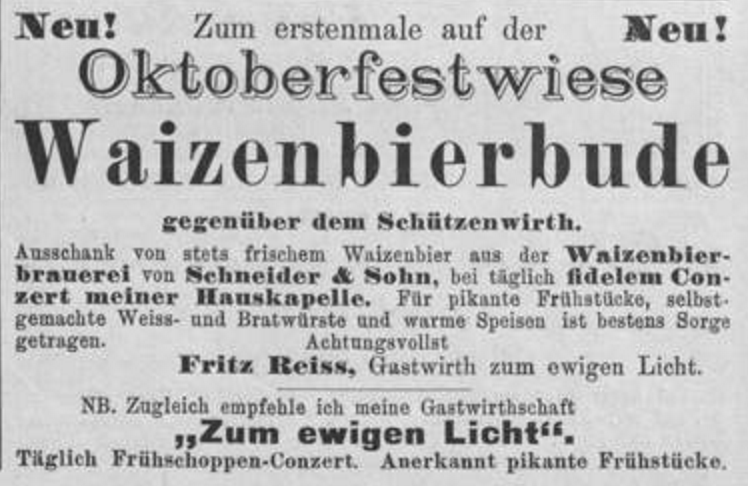
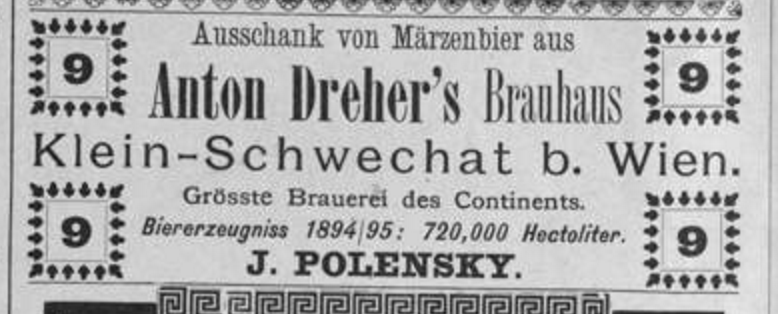
There was of course the Dreher brewery from Kleinschwechat, the original inventors of Vienna Lager, who were first able to serve their beer at the Wiesn’n in 1895. The same year was also the very first time a dedicated Weißbier stall was allowed, the rights for which were won in an auction by restaurateur Fritz Reiss, who then served wheat beer by G. Schneider & Sohn. And then there were specialities like Thomasbräu serving their Pilsner in addition to the regular Märzenbier.
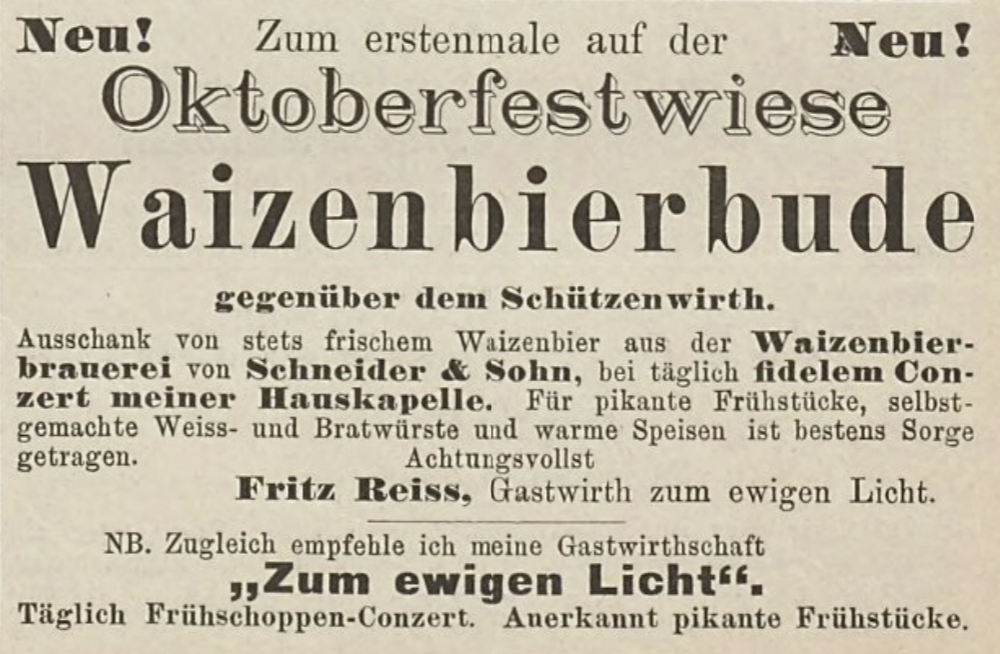
An ad for the “Waizenbierbude” (wheat beer stall) in 1895. (Source)
As I’m still working on my upcoming book, I got a bit sidetracked today while researching a few details to tie up some loose ends, and came across a lot more detailed list about all the beer stalls at the Oktoberfest 1895 and 1896, and it shows how great the variety in beer and breweries was back then. So here’s the list of all breweries that were served at the beer stalls 1 to 26:
Franziskaner Leistbräu
Zacherlbräu
Gambrinusbrauerei
Löwenbräu
Pschorrbräu
Löwenbräu
Münchner Kindl
Spaten
Dreher, Kleinschwechat near Vienna
Bergbräu (Henninger), Munich-Giesing
Münchner Kindl
Salvator-Brauerei
Kochelbräu
Thomasbräu
Hacker
Bürgerbräu
Augustiner
Thomasbräu
Pschorrbräu
Pschorrbräu
Pschorrbräu
Pschorrbräu
Pschorrbräu
Pschorrbräu
Pschorrbräu
Pschorrbräu
In addition to that, there was also the wheat beer stall that was unnumbered and actually a bit away from the other beer stalls, that served G. Schneider & Sohn.
And yes, that’s a lot of Pschorrbräu stalls! The source with all beers as well as a list of all the restaurateurs and how much they paid at the auction can be found in the Bayerische Gastwirths-Zeitung issue dated 25 August 1895. At the time, the beer of some stalls was not known yet (such as stall no. 3 and 9), and for no. 25 the beer changed later. We know this from ads for these particular stalls that were published in the official Oktoberfest programme.
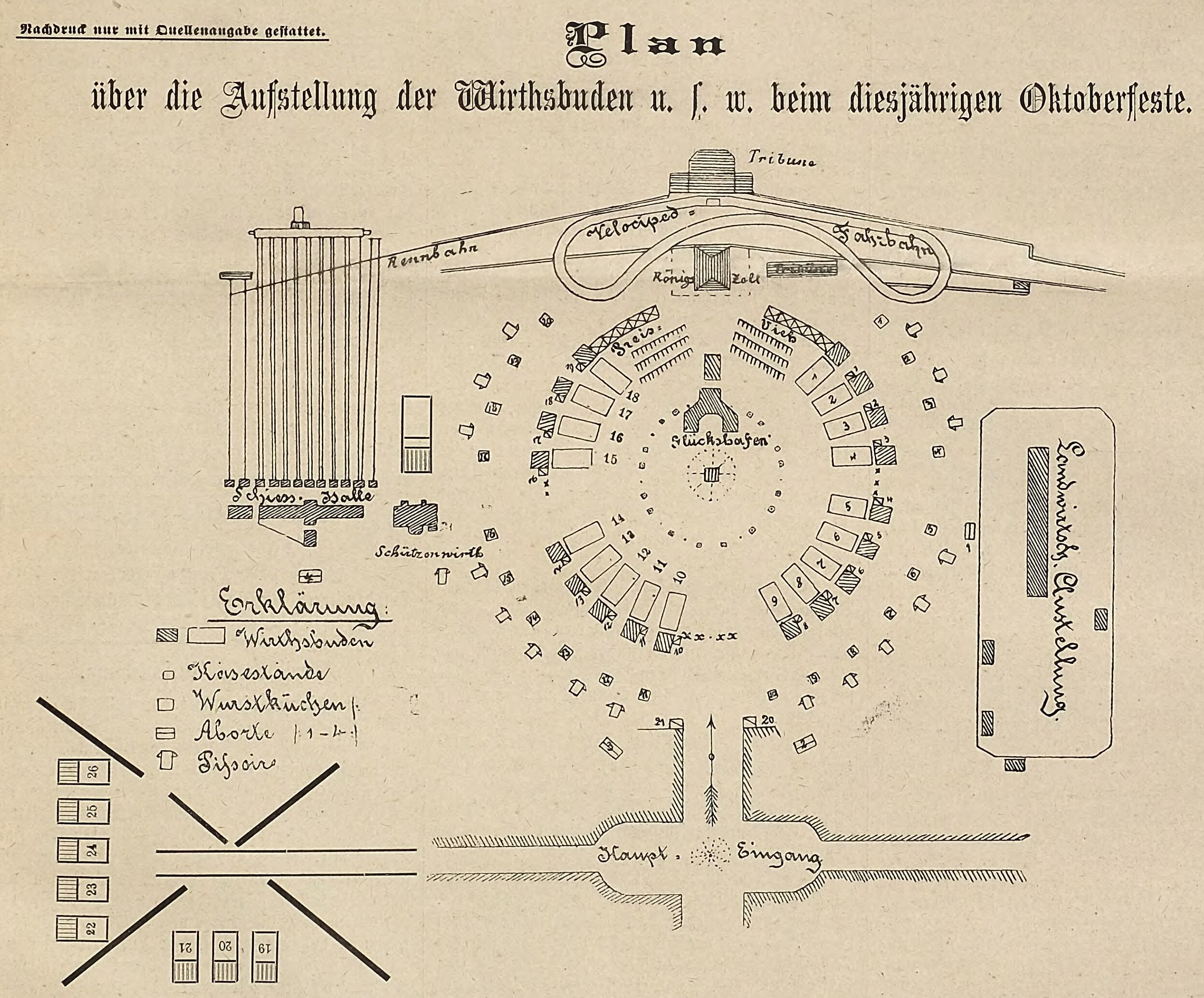
We even have a plan that shows the layout how all the stalls were laid out on Theresienwiese:
Map with the locations of all the stalls at Oktoberfest 1895, including all beer stalls, cheese stands, sausage stands, toilets and urinals. (Source)
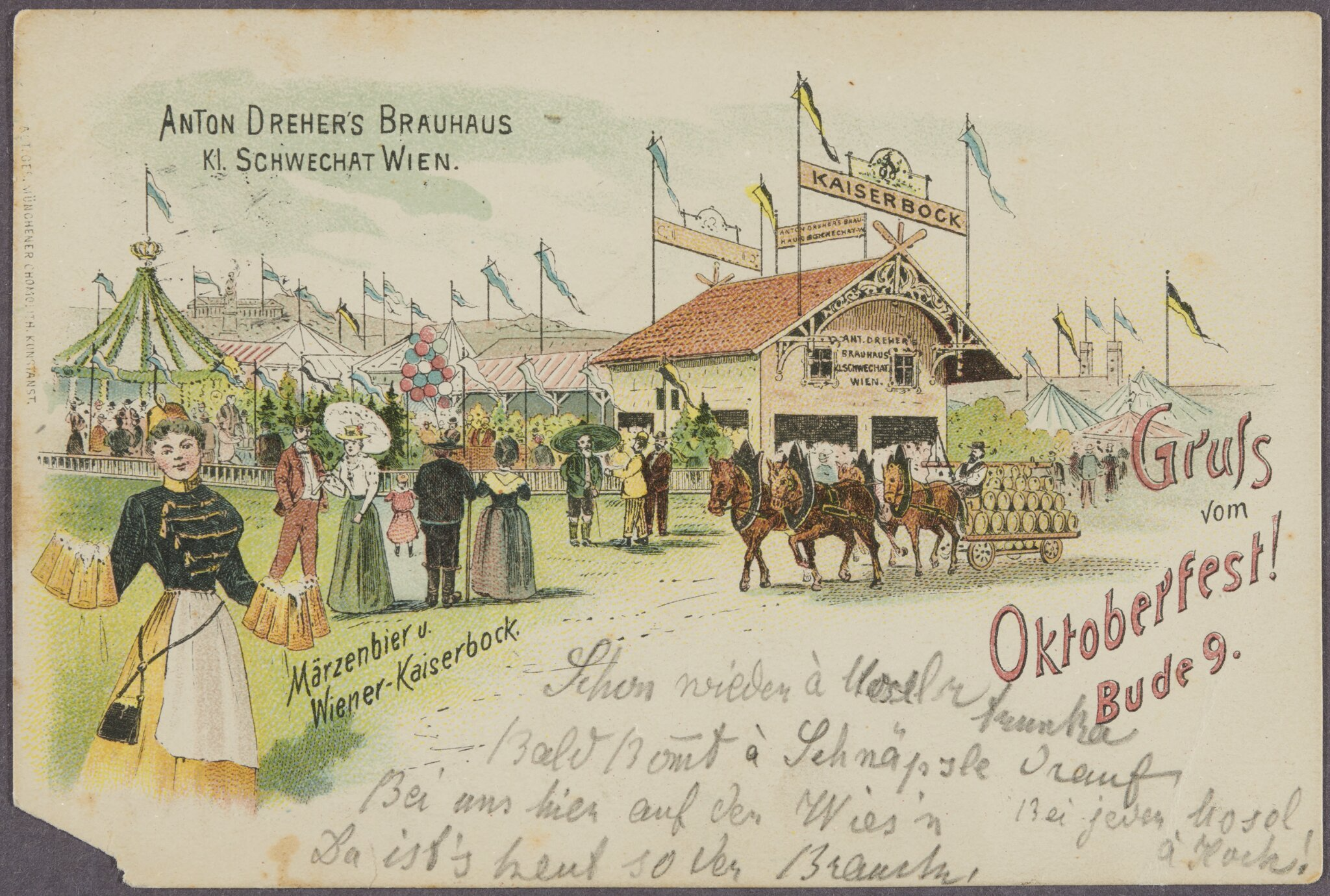
These stalls at the time were nothing like the modern massive beer tents. You can get a good idea what these beer stalls were like from this 1897 postcard of the Dreher beer stall:
1897 postcard showing the Dreher beer stall at Oktoberfest. It shows a waitress in black and yellow uniform carrying beers, a dray with beer casks, the beer stall itself with a beer geraden behind it, Oktoberfest visitors, and other tents in the background. The beers advertised were Märzenbier and Wiener Kaiserbock (Source)
In 1896, the choice in beers slightly changed compared to the previous year:
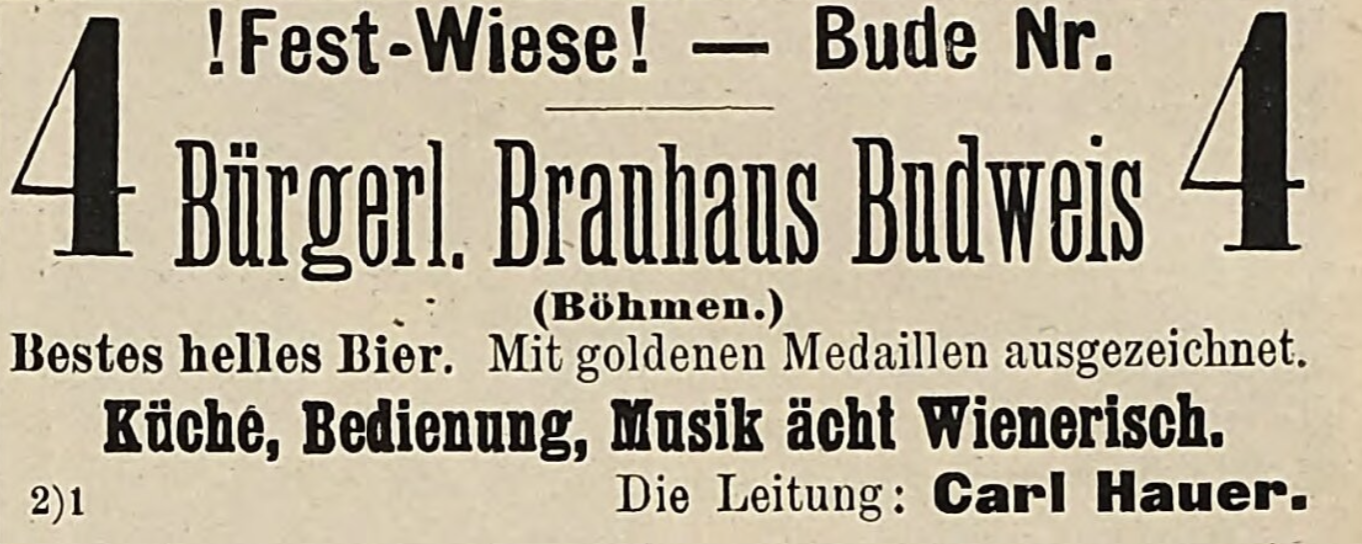
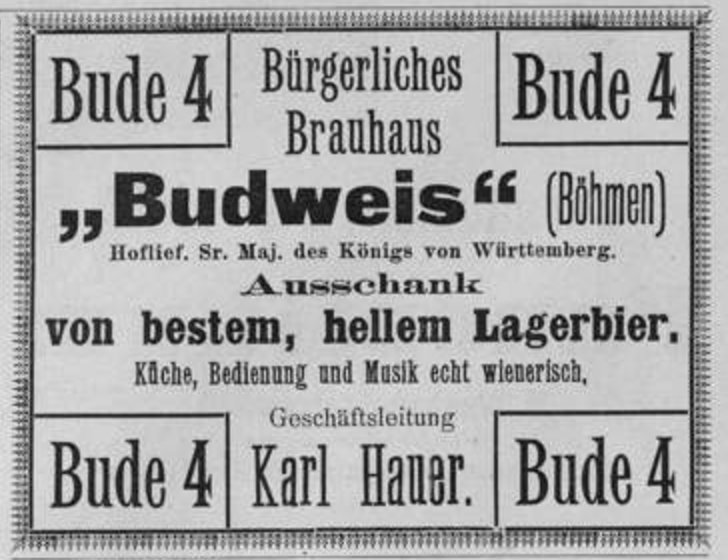
1896 ad for Bürgerliches Brauhaus Budweis at stall no. 4 (Source)
At least in the years 1895 and 1896, it was not unusual to have “foreign” beer from outside Munich served at Oktoberfest, like Vienna Lager/Märzen from Dreher, pale lager beer from Budweis, or Franconian lager from Kulmbacher Export brewery.
Working for a Munich-based startup (though in my case, remotely from Berlin) comes with a few perks. One, travelling to Munich a few times a year for work, two, going to Oktoberfest with my work colleagues because that’s apparently what any respectable Munich company is meant to do.
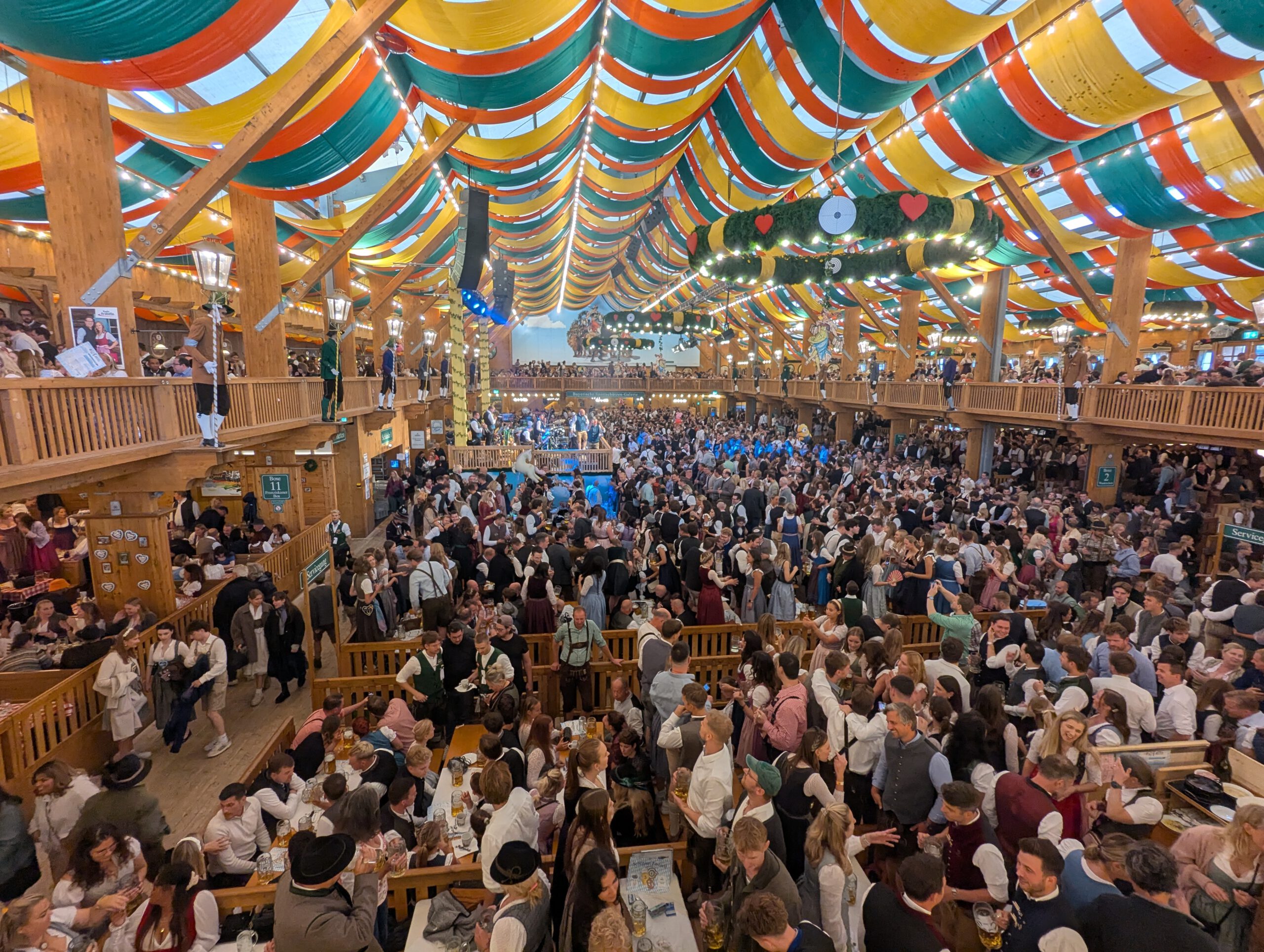
2025 has been my third Oktoberfest in a row now, each year in a different tent serving a different beer brand, in particular Marstall Zelt (Spaten), Augustiner Festhalle (Augustiner) and Schützen-Festzelt (Löwenbräu). While I don’t have a comprehensive overview over all the beer brands, 3 different beers are still half of them.
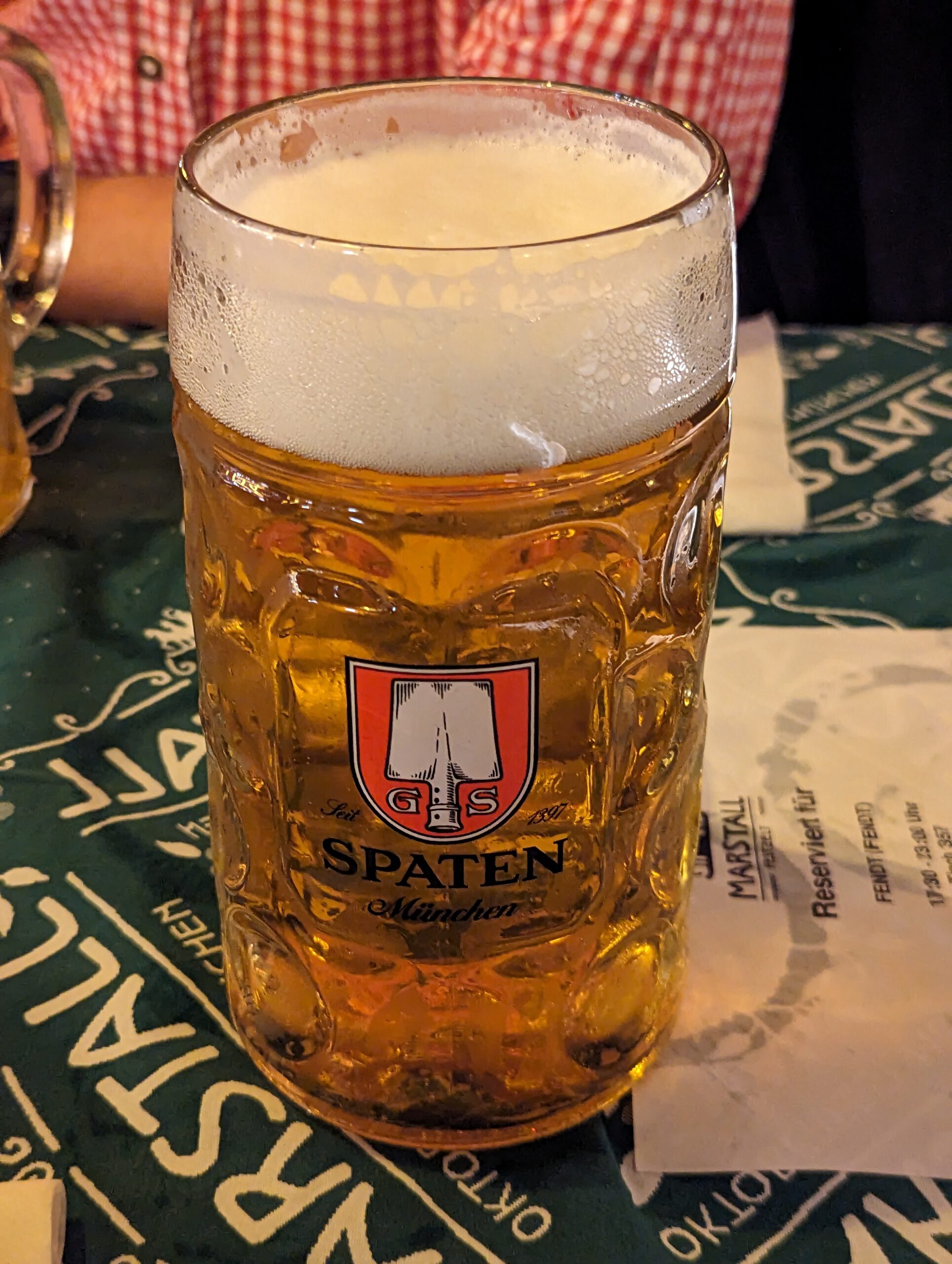
A Maß of Spaten Oktoberfestbier at Marstall Festzelt, 2023
Last year, in the weeks before Oktoberfest, I actually attended a guided Oktoberfest beer tasting, where I was able to try out all six beers (Augustiner, Spaten, Löwenbräu, Paulaner, Hacker-Pschorr, Hofbräuhaus) side by side. In previous years, I did similar taste tests together with my wife Louise and my friend Ben. In these tastings, there were always stark differences, and they weren’t always identical. Two years ago for example, I thought Löwenbräu was fairly good, and ranked it third on my list, while last year, it tasted really bad and I ranked it last. So let’s just say, I have opinions.
Every time I went to Oktoberfest, I had certain expectations about the beer quality, not just connected to my personal prejudice (let’s face it, everyone is somewhat prejudiced about major beer brands) and brand perception, but also informed by previous tastings. But every time, these expectations were shattered.
Spaten at Marstall? Excellent. Cool, fresh, not underpoured, and tasting great.
Augustiner at Augustiner Festhalle? Exactly as I expected and knew it.
Most recently, Löwenbräu at Schützen-Festzelt? Whoa. Fresh, dry, crisp, entirely unlike what I had experienced in previous years.
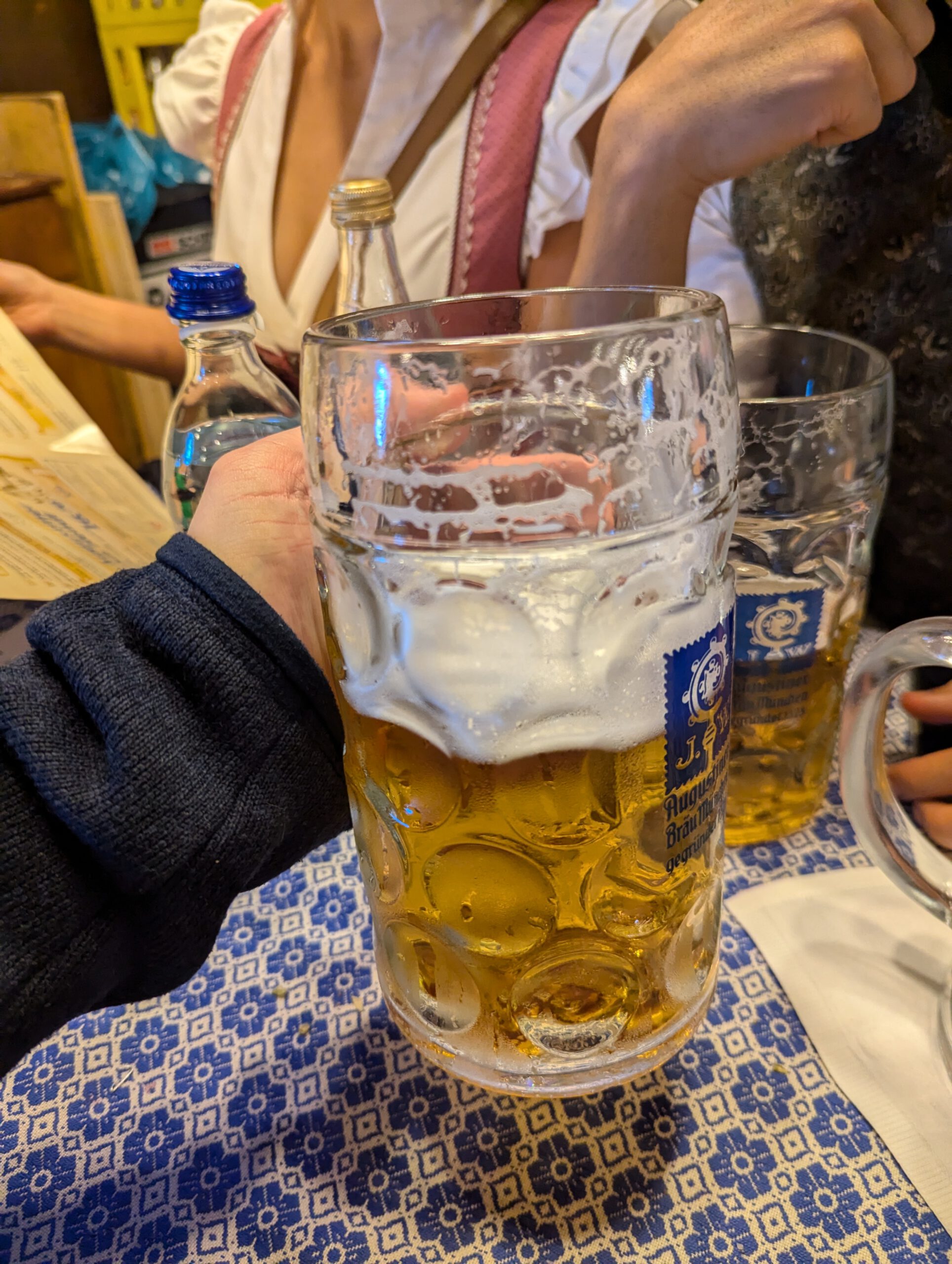
A partially drunk Maß of beer at the Augustiner-Festzelt, 2024
When I came home after Oktoberfest, I actually went back into our beer fridge and tried a can of Löwenbräu Oktoberfestbier. And… it was not the same. It was solid, but nowhere near as good as just a few days before. And it tasted quite different from the Paulaner Oktoberfestbier (also from can) that I had afterwards, and also quite different from the bottled Oktoberfestbier I had had just a few days before.
But thinking back about all the Oktoberfestbier at Oktoberfest over the years, I don’t think I have would been able to distinguish them at all, unlike the ones at the beer tastings. The difference being of course that in all the taste tests, the beers under test were always from bottle or can, while at Oktoberfest, it’s always poured from tap, either as tank beer (for most brands) or from large 200 litre wooden casks (Augustiner only), the taps barely ever close, and the beer is properly cold (which probably doesn’t exactly help with tasting finer details in the beer).
So does the difference in beer at Oktoberfest even matter? To me, it doesn’t seem to, because I honestly don’t think I could taste the difference between Spaten, Löwenbräu and Augustiner. Is the preference of draught Oktoberfest beer at the festival itself just brand loyalty, and has nothing to do with the actual taste? To me, it seems like that at the moment, and it’s not just because people (including me) just get hammered and then nothing else matters. In fact, I never actually got drunk at any of my Oktoberfest visits because I like to pace myself by also drinking Radler and/or alcohol-free beer.
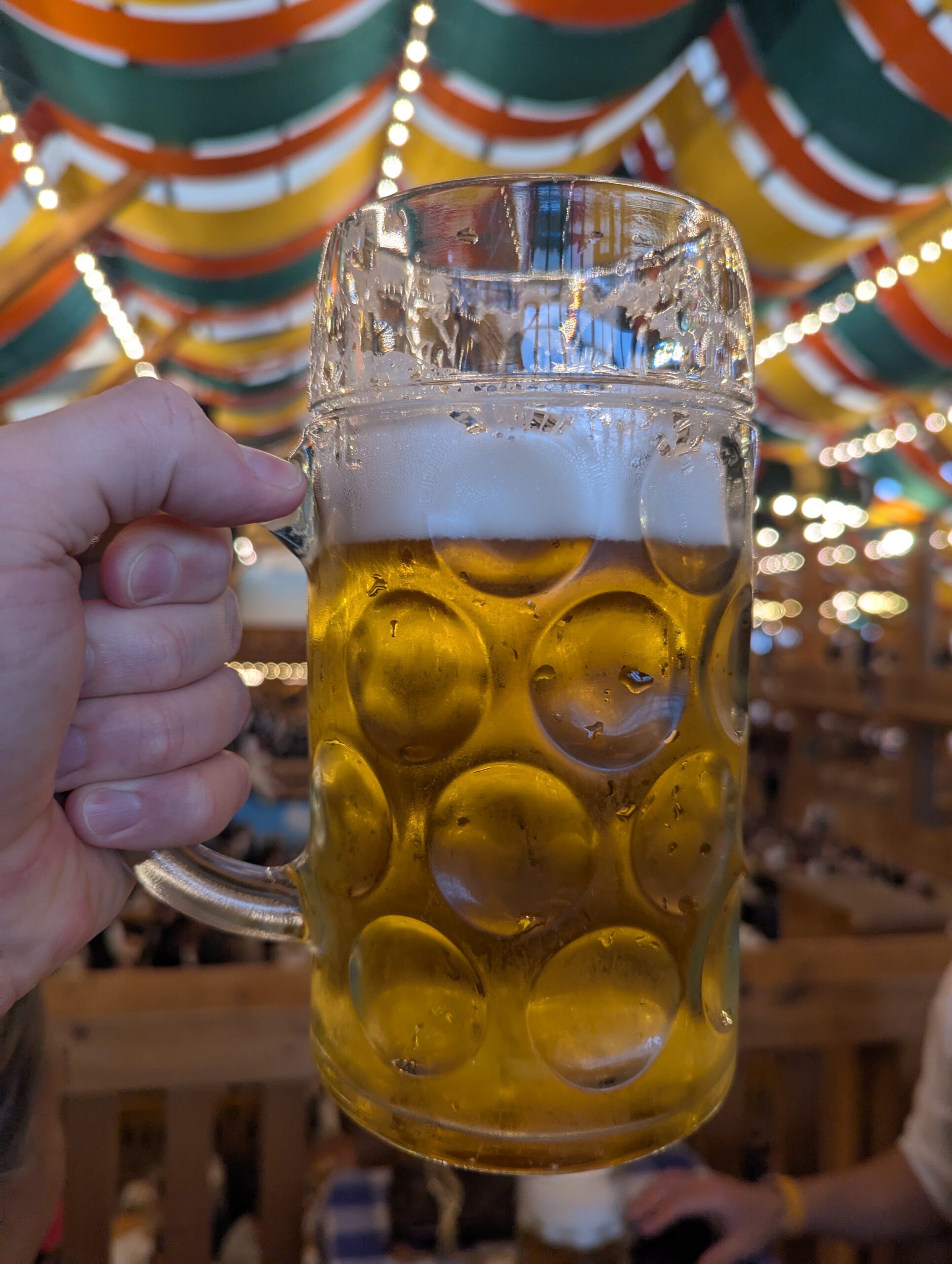
A Maß of Löwenbräu Oktoberfestbier at Schützen-Festzelt, 2025
And the latter is what actually matters in brand differentiation: at Marstall in 2023, they only had Radler as low-alcohol beery option, at Augustiner last year, they had their then new alcohol-free Helles on draught (which is otherwise only available in bottles, even in Augustiner restaurants and beer halls in Munich, so they must have been really sure about shifting a lot without developing microbiological issues in the draught system) which was excellent, and this year, the Schützen-Festzelt only had Löwenbräu’s alcohol-free beer which was a sugary, worty mess that I couldn’t even finish.
So at least for me, while the Oktoberfestbier brand doesn’t seem to matter, it does matter if you want to drink something other than the regular Festbier and explore some of the other options, like the non-alcoholic beers for pacing purposes.
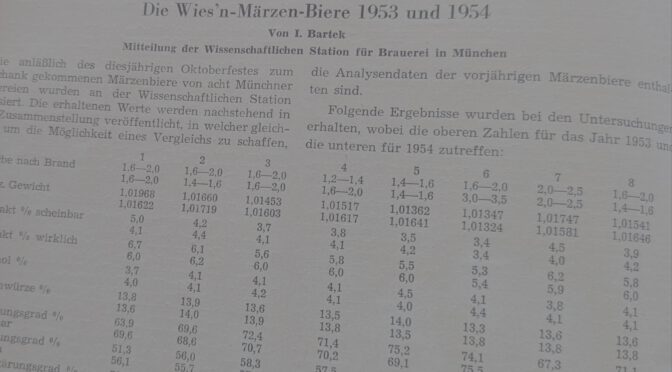
Earlier this week, I did a bit of research in the VLB/GGB library, and by chance came across analyses of Oktoberfest-Märzen in the 1950s, in particular the beers served at Oktoberfest in 1953, 1954 and 1956.
I. Bartek of Wissenschaftliche Station in Munich conducted these analyses and published them in Brauwelt. They analysed 8 different Märzen beers from the Oktoberfest for colour, specific gravity, alcohol content and unfermented sugars, and derived residual extract, attenuation and potential terminal gravity from it. None of the actual breweries are revealed, they are only numbers 1 to 8. When you look at the raw data, the numbers 1-8 of 1953 and 1954 match up (i.e. it’s the same brewery), but it’s not clear whether the same order was kept up for 1956. Interestingly, the 1954 article says that the beers were from 8 Munich breweries. I was wondering which breweries these were, and could only come up with 7 (Augustiner, Paulaner-Thomasbräu, Hacker, Hofbräuhaus, Pschorr, Löwenbräu, Spaten-Franziskaner-Leistbräu). A report about 1954 Oktoberfest only talks about 7 large tents of the big breweries without naming any specific ones. Did one of them serve more than one beers? Augustiner maybe? Their Wiesn-Edelstoff, the archetypal pale Festbier as we know it nowadays, was only released in 1953, but it’s not clear whether Augustiner continued selling the old-school Märzen beside it. I don’t know.
When looking at the data, a few things stand out: in 1953, two of the beers had an OG of only 13.3 resp 13.5%. While technically a Märzen, it would nowadays not be allowed as Oktoberfestbier, as those need to have an OG between 13.6 and 14.0%. The attenuation was lower than what we’re used to, and this also shows in the alcohol content, which is between 4.6% ABV (converted from ABW) and 5.6%.
In particular beer #1 combines a fairly high OG (13.8%) with a relatively poor apparent attenuation of 63.9% and lots of unfermented but fermentable sugars. That beer was probably very sweet.
Similarly, 1954’s beer #5 has an even higher amount of unfermented sugars with an OG of 13.5% and 5% ABV. Probably also rather sweet. There is also another outlier in the same year, beer #6, with over 75% apparent attenuation. With 5.5% ABV, it was probably still quite malty, but otherwise quite highly attenuated and thus not nearly as sweet-tasting as any of the others.
The same beer was also by far the darkest, with a colour (according to the Brand scale) of 3.0 to 3.5. As a very rough approximation, this would be similar to about 50 to 58 EBC, while most other beers are recorded as 1.2-1.4 °Brand (=20-23 EBC), 1.4-1.6 °Brand (23-27 EBC), 1.6-2.0 °Brand (23-33 EBC) or 2.0-2.5 °Brand (33-42 EBC). Compare this with the BJCP guideline for Märzen, which sets the colour at 8-17 SRM (15.8-33.5 EBC), or the Brewers Association’s style guidelines at 8 to 30 EBC.
By 1956, the beers seem to have changed a bit: the OG is now generally at 13.6% or over (all but one are actually in the 13.8-14.0% range), while attenuation is higher: just one beer with 69% apparent attenuation, the rest all 70+%, one even at 78.8%. This also shows in the alcohol content: one beer (the poorly attenuated one) has 5.0% ABV, while the others are all between 5.4 and 5.8% ABV.
For 1956, we also got measurements of pH and carbonation. All but two beers actually had a pH over 4.5, which means microbiologically less stability than the recommended pH of less than 4.5. This is not ideal, but for a beer festival with a large throughput, it was probably not that big of an issue.
The carbonation of the Oktoberfest-Märzen beers is also interesting, between 3.5 g/l and 4 g/l. Compared to modern lager beers, this is pretty low, and closer to the expected carbonation of cask ale or rustic “ungespundet” (unbunged) lager beers in Franconia.
Finally, one observation: as late as 1954, you could drink Oktoberfest-Märzen in Munich which, at least when looking at original gravity and final gravity, and thus alcohol content, was very similar to the Märzen that was served in Vienna in 1876. Only the colour was darker. In that sense, these old-school Oktoberfest beers seem like the remnants of 19th century lager brewing, a proper look into the past. And by 1956, they seem to have been slightly cleaned up to reduce some of the sweetness and further increase the alcohol content.
If you’re interested in all the details, here’s the raw data for 1953 (Brauwelt No. 84, 19 Oct 1954, p.1266):
1
2
3
4
5
6
7
8
Colour (Brand)
1.6-2.0
1.6-2.0
1.6-2.0
1.2-1.4
1.4-1.6
1.6-2.0
2.0-2.5
1.6-2.0
SG
1.01968
1.01660
1.01453
1.01517
1.01362
1.01347
1.01747
1.01541
Apparnet extract [%]
5.0
4.2
3.7
3.8
3.5
3.4
4.5
3.9
Real extract [%]
6.7
6.1
5.6
5.8
5.5
5.3
6.2
5.8
Alcohol by weight [%]
3.7
4.1
4.1
4.1
4.5
4.1
3.8
4.1
OG [%]
13.8
13.9
13.6
13.5
14.0
13.3
13.6
13.6
Apparent attenuation [%]
63.9
69.6
72.4
71.4
75.2
74.1
67.3
71.1
Real attenuation [%]
51.3
56.0
58.3
57.5
60.7
59.6
54.2
57.3
Final apparent attenuation [%]
70.7
73.5
75.0
75.0
82.6
75.9
80.8
74.2
Still fermentable extract [%]
6.8
3.9
2.6
3.6
7.4
1.8
13.5
3.1
Raw data for 1954 (Brauwelt, 19 Oct 1954, p.1266):
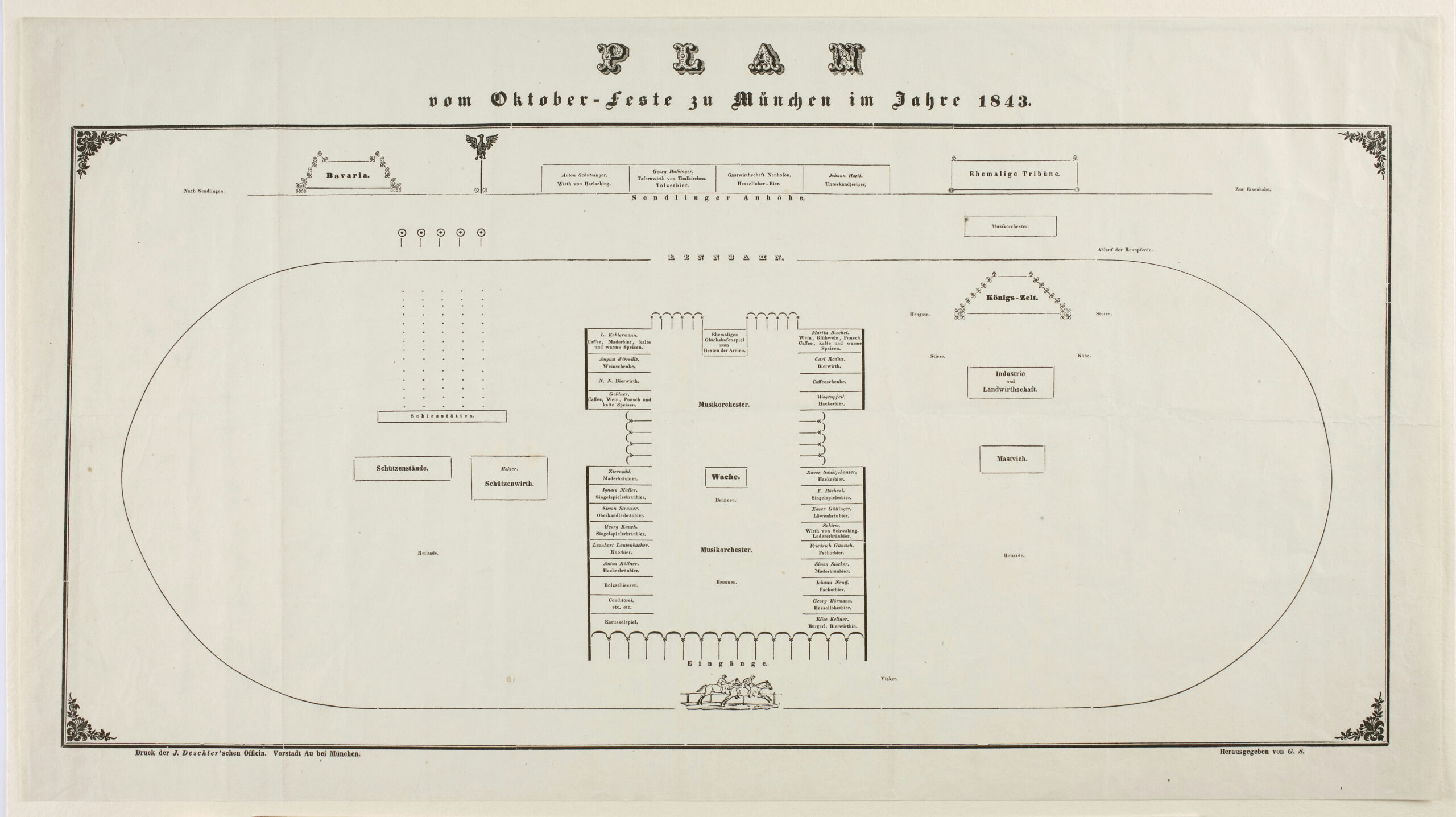
Bavarikon, Bavaria’s internal portal to present treasures, art and other things from its archives, libraries and museums, is an incredibly valuable platform, as you can find all kinds of random bits and pieces related to Bavaria in some shape or some. They of course have lots of digitalized material about Oktoberfest, like this map of Oktoberfest at Theresienwiese from 1843:
A map of Oktoberfest from 1843. Source. Public Domain.
This is great, because not only does it give us insight into the overall setup (basically, the horse racing course was on the outside of the field, while in the middle, most of the stands could be found, with more stands to be found on the hill on the Western side of Theresenwiese, just north of the Bavaria statue.
Of course, the King had his own tent, with the agricultural exhibition placed near it. On the South side, the shooting range was located, while in the center, the most was going on: lots of places serving beer, coffee, wine, punch, cold and hot food, or pastries, but there were also attractions like a carousel and crossbow shooting, and the Glückshafen, a lottery with the purpose that its profit be used to support the city’s poor. That attraction still exists today, and is the oldest operation at the Oktoberfest.
Most importantly though, we also learn which breweries’ beers were served in 1843:
Singelspieler
Mader
Oberkandler
Knor[r]
Hacker
Löwenbräu
Pschor[r]
Unterkandler
Tölzer (from Tölz; nowadays Bad Tölz)
Hesselloher (probably referring to the brewery in Großhesselohe in Pullach, just South of Munich)
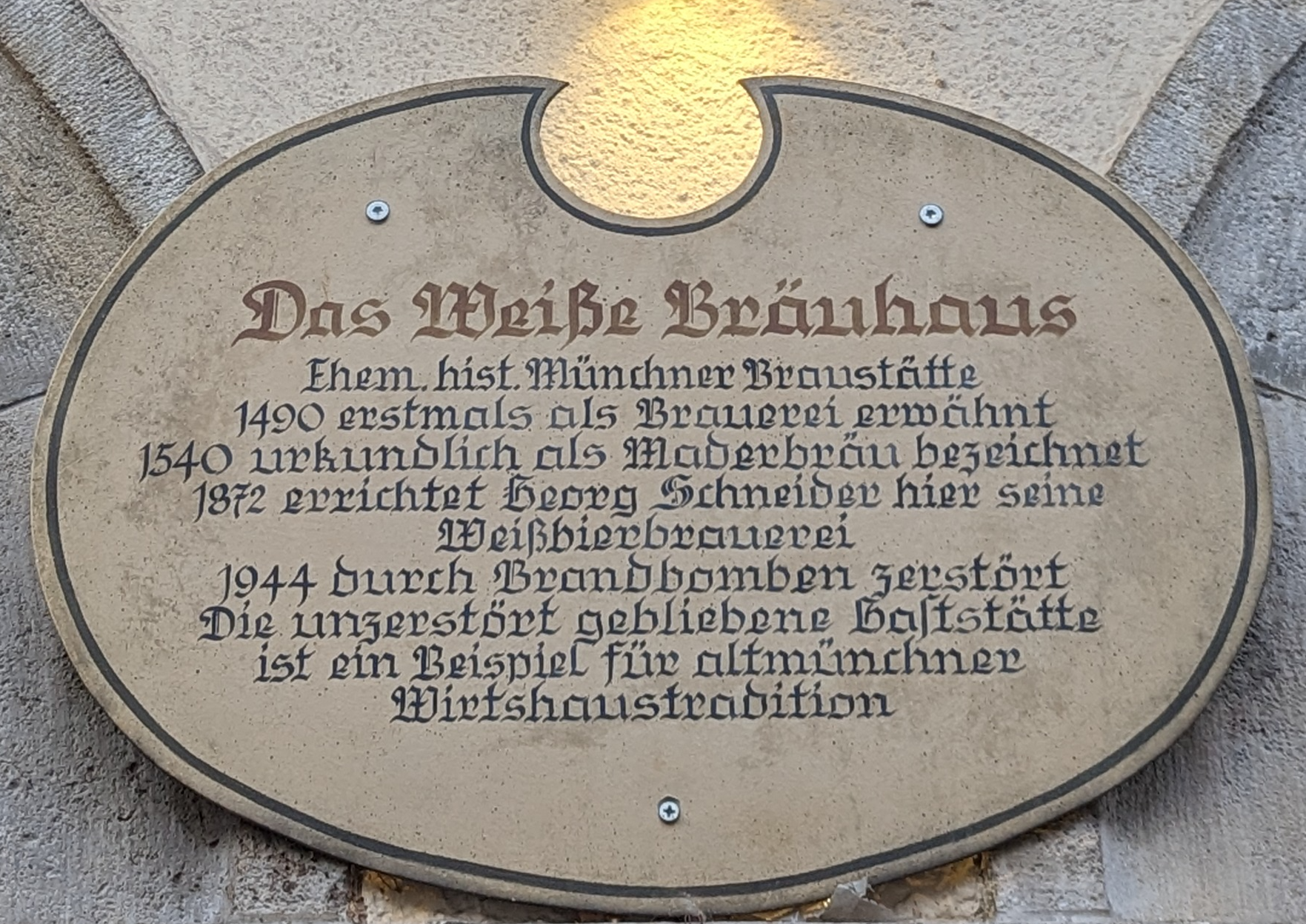
Some of these breweries resp. brands are still around, like Hacker and Pschorr in the Hacker-Pschorr brand, and Löwenbräu, while others are less known: Maderbräu is probably best known these day through Maderbräustraße, the little street next to Weißes Brauhaus in Munich: when Georg Schneider had to move out of the old Weißes Brauhaus (roughly where Hofbräuhaus is located nowadays), he managed to buy the defunct Maderbräu brewery building and relocate his brewery there. Only the street name and a sign on the wall of Weißes Brauhaus are reminders of this old Munich brewery.
Sign on the wall of Weißes Brauhaus, Munich. It says “The White Brewhouse. Former historischer Munich brewery. 1490 first mentioned as brewery. 1540 called Maderbräu in a document. 1872 Georg Schneider built his white beer brewery here. 1944 destroyed by incendiary bombs. The undestroyed restaurant is an example of the old Munich pub tradition.”
The other Munich breweries in this list are attested through an old map from the 1830s of Munich breweries: Knorrbräu on Briennerstraße, Oberkandler and Unterkandler, both on Neuhauser Straße, and Singelspieler on Sendlinger Straße. Even beer from further away was brought to Theresienwiese and served there, such as from Tölz, South of Munich, and Hesselloher Bier, which was likely from the brewery in Großhesselohe in Pullach just outside Munich, but that’s not entirely clear from the source.
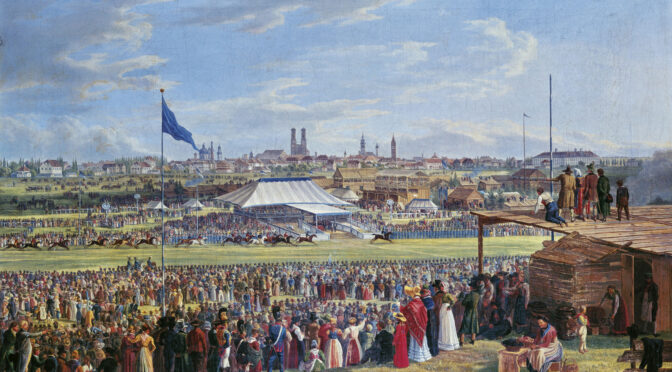
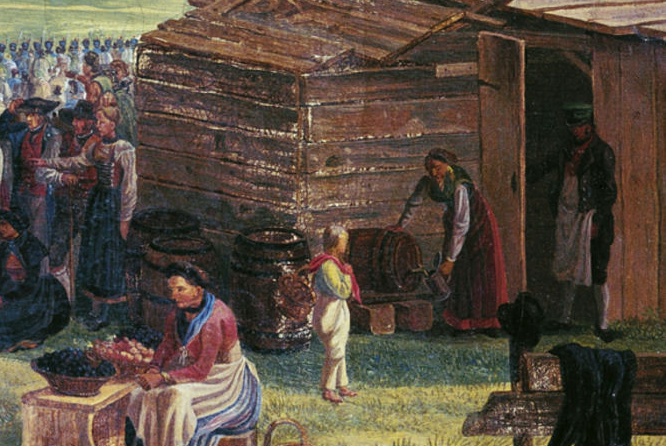
From an 1824 painting by Heinrich Adam, we can also get a rough idea how serving beer used to be organised like, on a much smaller scale than nowadays, from wooden shacks like this one:
Detail from an 1824 painting by Heinrich Adam, depicting beer getting served from a cask at Oktoberfest. License: CC BY-SA 4.0. Source.
(header image by Heinrich Adam, 1824, licensed under CC-BY-SA 4.0. source)
As a followup to my last article on Beer Blogging Friday, “Beer at the Oktoberfest 120 years ago“, I looked more closely into which beers were advertised as being served at the Oktoberfest. This of course is not a comprehensive list of all beers that were served, but merely those that were advertised. Also, the list is not complete, but covers the years 1882, 1893-1900, 1903, 1905, 1910, 1926, 1929, 1932, 1935 and 1936.
Starting in 1882, the beers advertised then were Löwenaktien-Braubier, aka Löwenbräu (without being more specific about the style), a Doppel-Bier from Bürgerliche Brauerei Munich, and the Märzen-Export-Bier from the brewery “zum Franziskaner und Leist”, later better known als Franziskaner-Leist-Bräu, besides Spaten one of the breweries owned by the Sedlmayrs, and allegedly the first brewery to brew a 16°P Vienna-style Märzen especially for Oktoberfest in 1872. The Märzen-Export was also served in a beer tent that is still around nowadays: Schottenhamel.
In the 1890’s, the number of breweries advertising their beer and the tents and stalls at which they’re served increases, and even breweries from outside Munich serve their beer, like Anton Dreher‘s Kleinschwechater Brauerei, or Bürgerliches Bräuhaus Budweis. Most breweries served Märzenbier, like Pschorr, Bergbräu (a relatively short-lived 19th century brewery located in Giesing), Kochelbräu, Thomasbräu, Münchner Kindl, Hacker, Franziskaner-Leistbräu, Bürger-Bräu, Eberlbräu, and Löwenbräu. Some breweries, like Thomasbräu or Bürgerbräu, also served more than one beer, like Thomasbräu-Pilsner and Bürgerbräu Doppel-Bier.
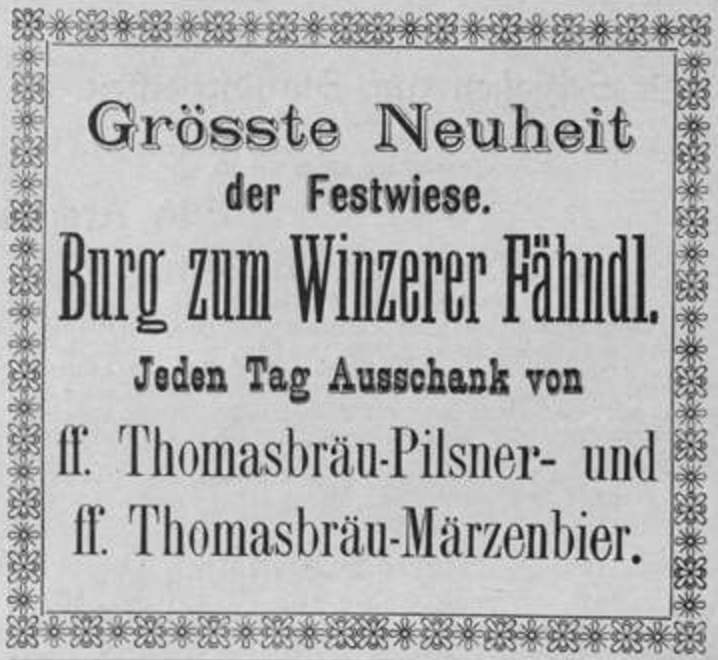
Also, fancier large beer tents were established. Besides the well-known Schottenhamel, others like Wintzerer Fähndl.
In the early 20th century, the breweries advertising their Oktoberfest is consolidating towards Munich breweries. Augustiner for the first time is advertising their Märzenbier in 1903. In 1905, 6 Munich breweries can be found in ads, offering a total of 9 different beers. In 1910, it’s 10 breweries with 13 different beers. Some breweries sold a Märzen and a pale lager (like Thomasbräu), others, like Wagnerbräu, had a Märzen and their Auer-Kirta-Bier, which is mentioned as being a dark lager, and, as the name suggests, was brewed for the Kirta in Au, a south-eastern district of Munich.
In the 1920’s, this diversity seems to have disappeared, as 8 different breweries advertise one beer each in 1926, mostly Märzen, with only two exceptions: Thomasbräu Hell-Urtyp and Schramm’s Fest-Weizenbier. Fischer-Vroni, another well-known beer tent, makes its first appearance in advertising, serving Augustiner Märzen. In 1929, Wagnerbräu is again seen with their Märzen and the Auer-Kirta-Bier, Schneider & Sohn have a Wiesen-Edel-Weiße, and Augustiner for the first time advertises their Edelstoff hell.
In the 1930’s, beer diversity, at least in advertising, seems to go up again: Wagnerbräu offers 4 (!!) different beers in 1932: Oktoberfest-Märzen, Auer-Kirta-Bier, “Weißbier Münchener Weizengold”, and helles Export. In 1935, a large amount of breweries advertise two different beers, and Fischer-Vroni must have switched from Augustiner to Wagnerbräu between 1929 and then.
This is my short and quick contribution to Session 127. After Boak and Bailey asked me about my expectations of Festbier, I thought I should leave a few notes what beer was served at the Oktoberfest in the 19th century.
The Oktoberfest didn’t start out as a beer festival. The first one was a wedding celebration of Bavarian Crown Prince Ludwig I. and Princess Therese in 1810. In the years after that, it became an annual fair where things like horse racing, prize shooting, and an agricultural fair were the main attractions. Eventually, beer was being served, and the whole beer drinking eventually took over. The agricultural fair still exists, but is scheduled to only take place once every four years.
The beer served was, as far as I could find out, regular “Sommerbier” (i.e. lager beer) as it was consumed elsewhere in the city. In 1872, Michael Schottenhamel procured a 16° Vienna-style Märzen brewed at Franziskaner-Leistbräu, which eventually got established as the regular beer at Oktoberfest. But it was not the only beer being served at the Fest, as we know from festival programme advertising of that era.
In 1895, wheat beer from Schneider & Sohn was served, which was a novelty that year, as well as Märzenbier brewed at Klein-Schwechater Brauerei and imported from Vienna. In 1896, beer from Bürgerliches Brauhaus Budweis was served at the Oktoberfest. The brewery was at that time a purveyour to the court of the King of Württemberg.
Some breweries, like Thomasbräu, served both a Pilsner and a Märzenbier.
Most of the other local breweries, like Franziskaner-Leistbräu, Pschorr, Hacker, Spaten, and Löwenbräu, only served a single type of beer, Märzen.
All in all, the variety of beer available at the Oktoberfest back then was not only greater in number, it was also more diverse in available beer styles, and more international. More like what you’d expect from a proper beer festival.