This blog post is my contribution to Session 150 to celebrate Martyn Cornell’s epic work about the complete history of Porter and Stout.
I have been interested in specifically German Porter for quite a while, in particular when I first learned about its existence through the 1947 notes of former Groterjan brewmaster A. Dörfel. I previously wrote about what brewing literature said about the specs of German Porter over the course of the 20th century.
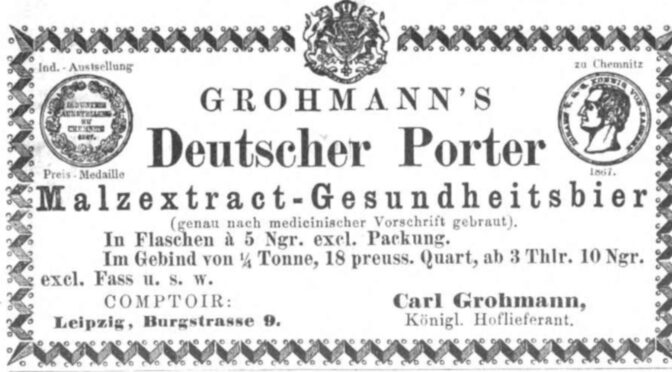
Of course none of that is nearly as comprehensive as what Martyn Cornell wrote about. I have to admit, I’ve only read parts of his book, in particular those about Germany and Austria. What I noticed in there was the early association specifically of German Porter with being a Gesundheitsbier, a health beer, that was often also simply called a Malzextrakt. Remarkably, this was very often used in advertising, in which various producers frequently pointed out how good their beer was for sick people. In fact, when I started looking into it more, I noticed that virtually all mentions of Deutscher Porter from the 1860s to the 1880s that I could find made some health reference.
So how did this German Porter compare to English Porter? One German brewer, Hollack, wanted to show how superior their product. So at the Berlin Exhibition of Hygiene in 1883, they provided specific analyses that they handed out, which we have available:
| Beer | SG | ABW% | Free Acid% |
| English Porter | 1.0258 | 5.35 | 0.275 |
| Malzextract Hoff | 1.0258 | 2.77 | 0.252 |
| Malzextract Werner | 1.0385 | 3.35 | 0.31 |
| Malzextract Grohmann | 1.0535 | 4.46 | 0.315 |
| Malzextract Hollack | 1.0633 | 3.65 | 0.39 |
As you can see, the German Porters had more residual extract and were lower in alcohol. This looks like they were fermented in such a way to be richer in unfermented sugars (with the exception of Hoff’s Porter), while lower in alcohol content.
From a few years later, 1887, we also have a different analysis of Hollack’s Porter:
- SG 1.0564
- 3.43% ABW
- 0.157% lactic acid
- 0.123% phosphoric acid
While the SG and the ABW is slightly lower compared to the 1883 specs, they are still quite high up there.
In 1890, yet another brewer, Th. Krepper, “German Porter and Lager Brewery” in Burg near Magdeburg, advertised their German Porter by posting the analysis results of the Versuchs- und Lehranstalt für Brauerei Berlin (also known as VLB Berlin):
- SG 1.01968 (= 4.9°P)
- 4.56% ABW
- 0.0882% lactic acid
- OG 15.36°P
Compared to the specs of other beers, this beer seems much more attenuated, and also quite a bit lower in acid.
Until then, all ads seem to refer to bottled German Porter only, and quite often in a health context. The first ad of cask German Porter I came across was from 1892, when a breakfast restaurant on Unter den Linden 24 in Berlin advertised cask German Porter 1/4 litre for 20 Pfennig, and cask English Porter 1/4 litre for 30 Pfennig.
And even Köstritzer seemed to have brewed a German Porter during the late 19th century, at least it’s listed as what the brewery exhibited in 1892 at an International Exhibition for the Red Cross in Leipzig.
In 1893, we can find another analysis used in advertising, when Freyberg’s Brauerei near Halle (Saale) put their analysis they got from a Mr. C. Bischoff from Berlin in an ad in a medical newspaper:
- OG 21.27°P (calculated)
- 5.94% ABW (=7.4% ABV)
- FG 7.5°P (apparent extract)
- 0.234% acid
To summarise, even though these German beers were called Porter, they must have been a lot sweeter and richer than their English counterparts, often did not have nearly as much alcohol, and were frequently advertised as a health beer. Some of the description do say that the German Porters are similar to English Porter, and they probably tasted similar, but the numbers suggest quite a large difference.
It would be interesting to work out in greater detail when German brewers moved away from the health claims specifically, and how it turned into the German Porter of later decades that was even codified as part of the East German beer standardisation efforts.
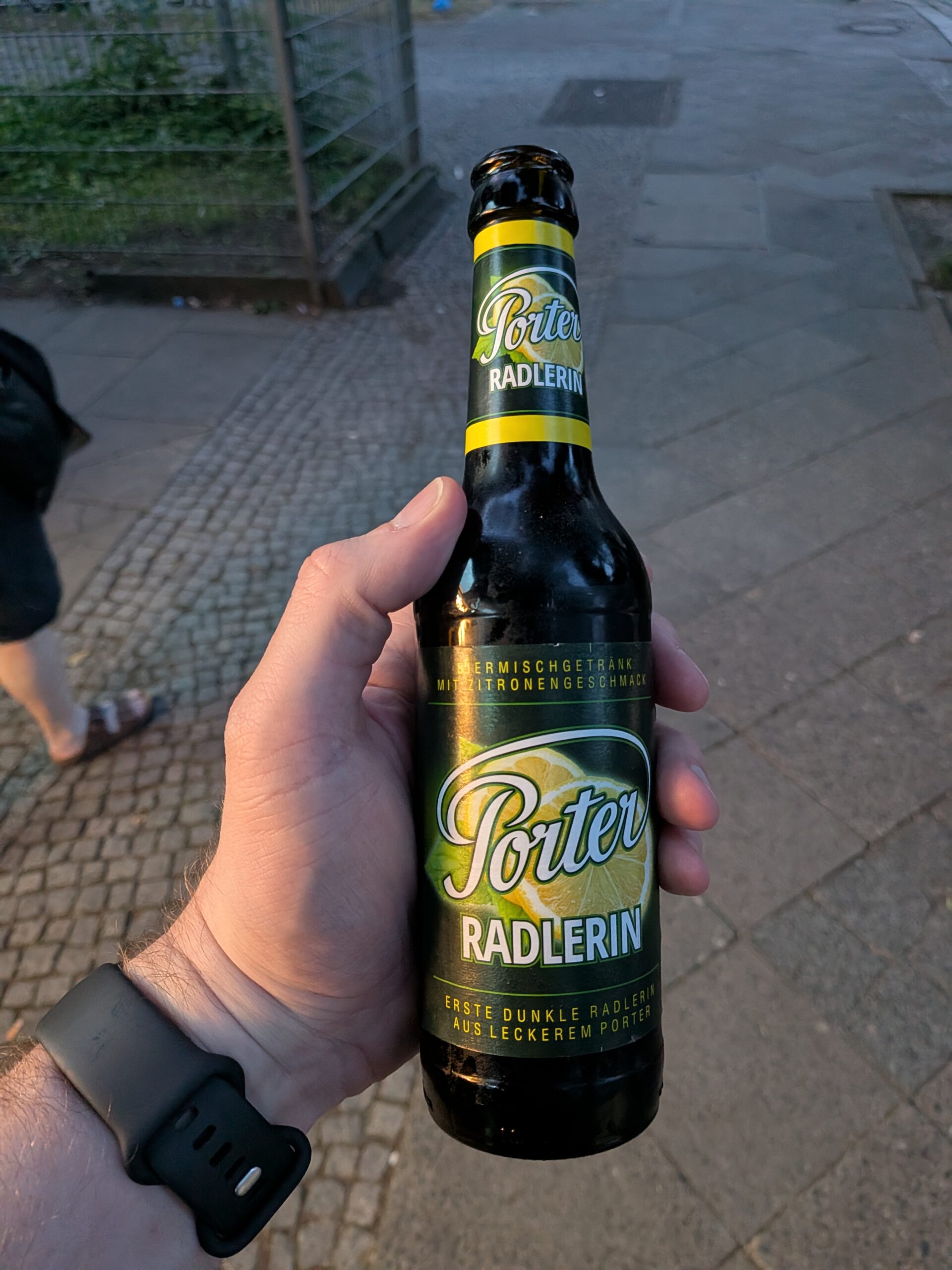
Modern German Porter, apart from the craft beer scene, is just a shadow of its former self. Lausitzer Porter seems to be the only surviving brands, which is a relatively weak beer, with barely any roasted flavours, and also available in fruit-flavoured versions, with cherry or strawberry. And the latest “innovation” that I only came across last week, is “Porter Radlerin”, a dark Radler from Porter and lemonade. Ironically, this is actually something I can get behind, because we could certainly do with more Dunkler Radler.