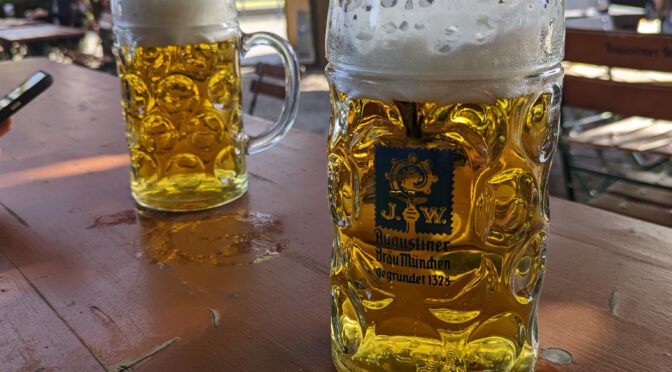
Augustiner brewery of Munich, known to be very conservative, secretive and loaded, recently announced their latest addition to their portfolio, an alcohol-free Helles, aptly named “Augustiner Alkoholfrei Hell”. Augustiner hadn’t released a new beer in 38 years, and in fact was the last of the “big six” Munich brands without an alcohol-free beer.
They first teased the release of a new beer type on Instagram without getting specific, which of course came with lots of outcry, “oh no, not an alcohol-free one! Please anything but an alcohol-free beer!” and such, but my first thought that this could be a game changer. Augustiner obviously cares a lot of about the quality and presentation of their own beers (for example, they still run their own cooperage on the outskirts of Munich to ensure that they can serve all their Oktoberfestbier from massive 200 liter “Hirsch” wooden casks, and will typically serve at least one beer from wooden casks in their prime locations), and a poorly-received alcohol-free beer (or any new beer type, really) could have really tarnished their reputation.
On Monday, 18th March 2024, the rumours of an alcohol-free beer turned out to be true, when Augustiner officially presented their new beer. I was of course very curious, and checked out early reports about it. Süddeutsche Zeitung was probably the first one to report on it (link to a paywall-free archived version of the article), and one thing that caught my eye was how openly Augustiner spoke about their method of production.
Basically, there are two ways of producing an alcohol-free beer: one is to brew a low-gravity wort and ferment either with a poorly attenuating yeast (essentially, one that cannot ferment maltose sugar) or to stop fermentation shortly after it’s started by chilling down the beer very quickly to prevent the yeast from metabolizing any further sugar. This approach is called arrested or restricted fermentation. The other method is to brew a regular beer and then dealcoholize it, i.e. remove the alcohol after fermentation through some method of cold distillation. This is generally called physical dealcoholisation. Both methods have their advantages and disadvantages, leading to either worty-sweet beer with the former method, or very thin, watery and slightly sour with the latter method. And as the Süddeutsche Zeitung says, “Augustiner decided on a mix of both methods.”
Through my very good friend Ben who works as a brewing scientist at VLB, I’ve learned about the paper Effect of Production Technique on Pilsner-Style Non-Alcoholic Beer (NAB) Chemistry and Flavor by Nils Rettberg, Scott Lafontaine, et al., published in early 2022 (Ben himself wrote about his experience with non-alcoholic beers after completing Dry January 2022). One of its conclusions was that blending non-alcoholic beers from restricted fermentation and from vacuum dealcoholisation produced a more harmonious beer that generally fared better in blind tasting than beers solely produced using either method. Another conclusion was that more hop compounds, such as through late kettle-hopping or dry-hopping, can mask the less pleasant flavours of non-alcoholic beers. This a very interesting paper, though of course rather technical, but if you’re interested in all the nitty-gritty details, definitely worth checking out.
While the paper is about Pilsner-type beers, and Helles is certainly not a beer type that has a particularly large amount of hop aroma or flavour, it still shows that for more lightly hopped beers, it still seems to be a practical approach for Augustiner, and they seem to have either drawn the same conclusions as the paper above or got convinced by the methods through it.
The tasting notes from Mareike Hasenbeck describe the beer as having a fresh, spicy and malty aroma with a hint of sulfur, while the flavour is malty-bready with a touch of lemon and sulfur and ample carbon dioxide on the tongue, finishing with a noticeable hop bitterness. Especially that last bit made me wonder whether the hopping rate was slightly increased compared to Augustiner’s regular Helles to create an overall nicer and rounder beer. Even though Augustiner’s approach was not to create a 1:1 copy of their flag-ship Augustiner Lagerbier Hell but rather a really good alcohol-free beer that meets their exacting, Mareike Hasenbeck notes that straight from the fridge, the fact that the beer is alcohol-free could be easily missed by laypeople (i.e. the non-nerdy, less discerning drinkers).
And I think that’s a big deal. If a regular beer drinker can have the non-alcoholic beer served under optimal conditions and not notice that it doesn’t contain alcohol (or at least, less than 0.5% by volume), you’re at a point where it is satisfying enough for consumers. At least for me personally, unless I specifically want to get inebriated, it would then make no difference whether I drink the regular version or the alcohol-free version. In fact, I would sometimes even want to specifically have the alcohol-free version, for example to avoid getting tipsy too quickly.
Previously, only one beer got close enough for me to this ideal, and that’s Guinness with the 0.0 version of their draught stout. When I first had it from nitro can, this was quite the revelation. To this day, I would still call it the most convincing alcohol-free beer, and don’t mind having a can or pint (or two) whenever I have the chance. Unfortunately, Guinness 0.0 has not made it to Germany yet, but I’m still hopeful. The only other beer that got close to it for me was Riedenburger Dolden Null, a German alcohol-free IPA, but their trick is basically to hide the worty flavour under loads of hops.
Everything I’ve read about the Augustiner Alkoholfrei Hell sounds to me as if Augustiner may have pulled off the same as Guinness, to release a convincing alcohol-free Helles that may be pleasing even to consumers and Augustiner fans that otherwise would not choose an alcohol-free beer. That’s a big deal, and could change the landscape and expected quality of alcohol-free beer in Bavaria and the rest of Germany.
As for myself, I have yet to try the new beer, and it doesn’t seem to have arrived in Berlin yet. One drinks wholesaler with a dedicated beer shop in Charlottenburg estimated it 3 to 4 weeks until they get it, while a restaurant/beer garden near the government district that is known for its Augustiner from wooden cask estimated it to take more like 4 to 8 weeks.
Ben on the other hand has already had a chance to try the beer at Augustinerkeller in Munich, and called it “unsurprisingly excellent”. With everything he also told me about it in private conversations, I am very hopeful that Augustiner Alkoholfrei Hell will indeed be a game changer.
Since the release, Tegernseer also started talking about how they’re currently working on their own alcohol-free Helles. The game is definitely on.
P.S.: in case you wondered what the last beer was Augustiner launched 38 years ago: it was their Hefeweizen.