Tag Archives: augustiner

Has Science Gone Too Far? Modern Bavarian Non-Alcoholic Helles

In the last few years, a number of new Bavarian non-alcoholic Helles were launched by reputable breweries such as Augustiner (which really started this new craze), Tegernseer, Bayreuther, Weihenstephaner and Schönramer.

Augustiner’s new non-alcoholic beer was without any doubt Munich’s hype beer of the year 2024, and several other breweries followed suit and launched their own products once they realised that the hype was real.

From what I was told, these new beers are all based on new methods of gentle dealcoholisation using reverse osmosis, to a large extent driven by research at TU Munich at Weihenstephan (one paper about the impact of different production methods on NA beer aroma can be found here).

When Augustiner released that new beer, my prediction was that it would be a big deal, and I firmly stand by that assessment. It’s changed the world of alcohol-free beer for the better, making it actually enjoyable. My first tasting a few weeks later also confirmed it for me. And zebra-striping between Augustiner Oktoberfestbier and Augustiner Alkoholfrei Hell in the Augustiner tent at Oktoberfest on the last day of the festival in 2024 further showed what an incredible beer it is: when served extra cold from keg, it’s virtually indistinguishable in terms of aroma and flavour compared to a regular Augustiner Helles.

When I first tried Tegernseer’s version last year, I actually found it to be even better, at least from the bottle, to the point where it tastes exactly the same except for a slightly noticeable lack of alcoholic mouthfeel.

Last weekend, I finally had the chance to try out the latest contender, Schönramer Alkoholfrei. Schönramer Hell is one of my favourite Helles, it’s incredibly light, fairly dry and just incredibly drinkable. So of course I was looking forward to trying it.

And… it’s good. It’s very good. It seems even more refined than either Tegernseer’s and Augustiner’s version, but it’s the first time where I feel like there’s something lacking in the non-alcoholic Helles (other than the alcohol itself, of course), rather than something still being in there that makes it identifiable as a NA beer. The Schönramer version is so clean, the beeriness almost seems diminished to the point where it reminded me a bit of American light beers.

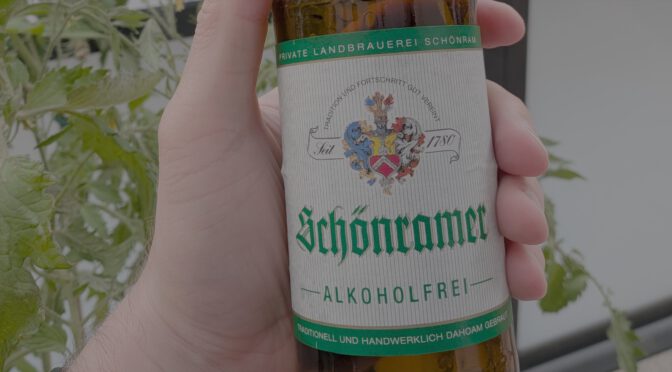
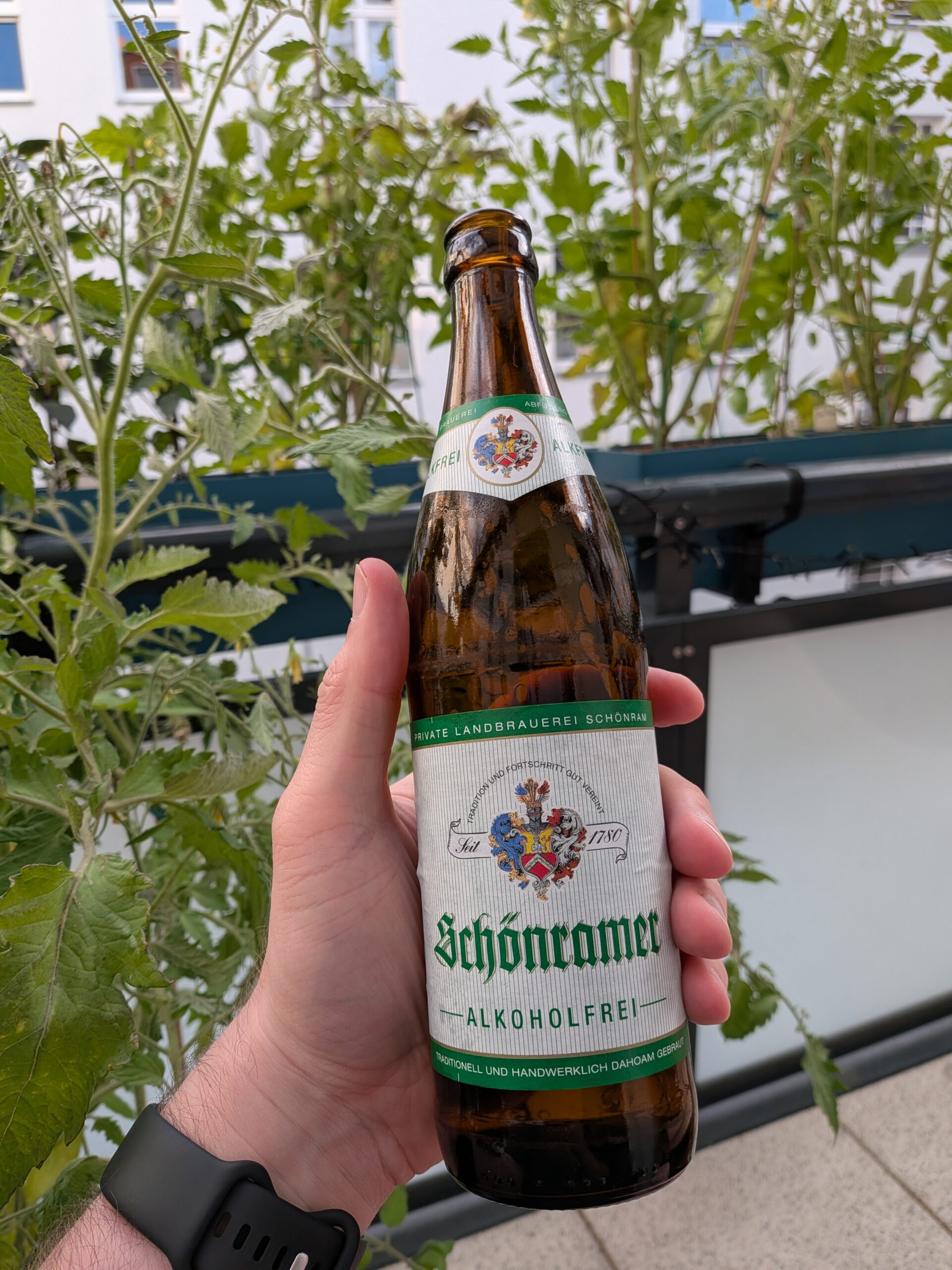
Me holding a bottle of Schönramer Alkoholfrei on my balcony. It's a standard brown German NRW beer bottle. The label says "Private Landbrauerei Schönram", the brewery logo with "seit 1780" referring to the foundation date, and "Schönramer Alkoholfrei" in the center. The label itself is a white with thin vertical green stripes, and green stripes on top and bottom with white text on it. In the background, tomato and chili plants growing on the balcony can be seen.
Me holding a bottle of Schönramer Alkoholfrei on my balcony.

This was the first time when I thought: has science gone too far? Has non-alcoholic Helles been optimised so much in an attempt to make it as clean-tasting as possible, that it has actually lost some of its character as a beer? It still tastes like a beer, don’t get me wrong, but I do wonder whether the non-alcoholic version could just be a bit more characterful. I also wonder whether this is simply down to the base beer, and I don’t know whether this is just a dealcoholised version of their regular Helles, or whether more tweaking was done that caused the beer character to become less and less.

So I had to go back the day after and try the beer again. What I noticed was that from a beer glass (nothing fancy, just a Willibecher), the beer was somewhat more aromatic, without any noticeably increased non-alcoholic character, and closer to the regular Schönramer Helles.

Anyway, in a few week’s time, I’ll be drinking Schönramer straight from the source, and we also have a tour booked, so I hope I’ll be able to ask a few more questions about the specific way Schönramer produce their non-alcoholic Helles and report back on my blog.

My Year in Beer, 2024 Edition

2024 was an exciting year. For the first time, I was invited to speak at a conference about one of my favourite topics, Vienna Lager, and not just at one conference, but actually two. First at Heimbrau Convention (HBCon) in Romrod back in March, and most recently, at Sympozjum Piwowarów in Kraków, Poland.

Beyond just talking about Vienna Lager, both events were great: at HBCon, I learned everything there is to learn about brewing beer like Mönchsambacher Weihnachts-Bock which I then used later on in a home-brewed Franconian-style Kellerbier, drank lots of excellent home-brewed beers, and met up with lots of other homebrewers, while in Kraków, I got to meet people from the Polish craft beer scene as well as see a few super interesting talks about the history of Porter, the latest brewing trends in the US, and a rather enlightening introduction to the human sense of smell and taste.

I also managed to go to Bamberg 3 times. First, as a farewell to a good friend and beer aficionado who moved from Berlin to Bishkek earlier this year but had never been to Franconia before; then to celebrate my good friend Ben‘s 30th birthday by doing a crazy day trip where we took the first train in the morning from Berlin to Bamberg, went all over Bamberg, and then went home on the last train; and finally, as a place to stay and visit BrauBeviale, the annual brewing and beverage industry fair in Nuremberg. For a slight change, we ventured a bit further out and did a day trip to visit the breweries Hummel and Wagner in Merkendorf and Höhn in Memmelsdorf, followed by a leisurely Frühschoppen trip to Zur Sonne in Bischberg the next day, all breweries we had not been to before that were easy enough to reach by public transport (if you pre-plan your trip a bit).

For my 40th birthday, my wife got me a two week trip to the US, which we of course used as a beery holiday and as an opportunity to meet people we had previously only known or talked to online or heard of their beers. Our main stops were Chicago, Austin, and Boston, with visits to Dovetail, Goldfinger, Live Oak, Notch and a few more. It’s safe to say that the American craft lager scene is very strong and is brewing tasty, diverse beer at a high technical level, combined with an incredible enthusiasm for the products they create.

And at the beginning of October, I even managed to visit Oktoberfest and the Augustiner tent on the festival’s very last day.

On the beer writing side, I did not manage to get any new big projects started, but I was nevertheless productive: in 2024, I wrote and published 31 blog posts (including this one), adding up to more than 31,000 words. In terms of page views, these are the top 5 most often read articles of 2024 that I wrote in the same year:

  1. Why Augustiner’s new alcohol-free Helles is a big deal
  2. How To Brew Mönchsambacher Weihnachts-Bock, according to the brewmaster
  3. My Summer Beers for 2024
  4. Alcohol-Free Augustiner: The Tasting
  5. Liquid yeast: why do I even bother?

I was a bit surprised to see just how popular my blog posts about Augustiner’s new beer, an alcohol-free Helles, had gotten, but then, non-alcoholic beers with ≤ 0.5% ABV have been the big new trend in 2023 and 2024, with overall quality of beers massively improving compared to 5, 10, 20 years ago. At Oktoberfest, I then experienced the new Augustiner beer in its absolutely best state: properly cold and served fresh on draught by the liter, it is a delight that is virtually indistinguishable from the regular strength beer. I didn’t miss the alcohol in the beer, because it didn’t feel like it was actually missing, and there were none of the off-flavours typical for alcohol-free beer that would have reminded me of the fact what I was drinking.

But the actual number one most often read blog post this year was not even written in 2024, but rather A Very Biased Guide To Berlin Beer and Pubs, October 2023 Edition, which is now responsible for more than 30% of all the page views on my blog.

Cheers to that! And while I don’t have any other big beer history project lined up, I still have a few more interesting topics that I want to further research and discuss in this blog. Watch this space.

Why Augustiner’s new alcohol-free Helles is a big deal

Augustiner brewery of Munich, known to be very conservative, secretive and loaded, recently announced their latest addition to their portfolio, an alcohol-free Helles, aptly named “Augustiner Alkoholfrei Hell”. Augustiner hadn’t released a new beer in 38 years, and in fact was the last of the “big six” Munich brands without an alcohol-free beer.

They first teased the release of a new beer type on Instagram without getting specific, which of course came with lots of outcry, “oh no, not an alcohol-free one! Please anything but an alcohol-free beer!” and such, but my first thought that this could be a game changer. Augustiner obviously cares a lot of about the quality and presentation of their own beers (for example, they still run their own cooperage on the outskirts of Munich to ensure that they can serve all their Oktoberfestbier from massive 200 liter “Hirsch” wooden casks, and will typically serve at least one beer from wooden casks in their prime locations), and a poorly-received alcohol-free beer (or any new beer type, really) could have really tarnished their reputation.

On Monday, 18th March 2024, the rumours of an alcohol-free beer turned out to be true, when Augustiner officially presented their new beer. I was of course very curious, and checked out early reports about it. Süddeutsche Zeitung was probably the first one to report on it (link to a paywall-free archived version of the article), and one thing that caught my eye was how openly Augustiner spoke about their method of production.

Basically, there are two ways of producing an alcohol-free beer: one is to brew a low-gravity wort and ferment either with a poorly attenuating yeast (essentially, one that cannot ferment maltose sugar) or to stop fermentation shortly after it’s started by chilling down the beer very quickly to prevent the yeast from metabolizing any further sugar. This approach is called arrested or restricted fermentation. The other method is to brew a regular beer and then dealcoholize it, i.e. remove the alcohol after fermentation through some method of cold distillation. This is generally called physical dealcoholisation. Both methods have their advantages and disadvantages, leading to either worty-sweet beer with the former method, or very thin, watery and slightly sour with the latter method. And as the Süddeutsche Zeitung says, “Augustiner decided on a mix of both methods.”

Through my very good friend Ben who works as a brewing scientist at VLB, I’ve learned about the paper Effect of Production Technique on Pilsner-Style Non-Alcoholic Beer (NAB) Chemistry and Flavor by Nils Rettberg, Scott Lafontaine, et al., published in early 2022 (Ben himself wrote about his experience with non-alcoholic beers after completing Dry January 2022). One of its conclusions was that blending non-alcoholic beers from restricted fermentation and from vacuum dealcoholisation produced a more harmonious beer that generally fared better in blind tasting than beers solely produced using either method. Another conclusion was that more hop compounds, such as through late kettle-hopping or dry-hopping, can mask the less pleasant flavours of non-alcoholic beers. This a very interesting paper, though of course rather technical, but if you’re interested in all the nitty-gritty details, definitely worth checking out.

While the paper is about Pilsner-type beers, and Helles is certainly not a beer type that has a particularly large amount of hop aroma or flavour, it still shows that for more lightly hopped beers, it still seems to be a practical approach for Augustiner, and they seem to have either drawn the same conclusions as the paper above or got convinced by the methods through it.

The tasting notes from Mareike Hasenbeck describe the beer as having a fresh, spicy and malty aroma with a hint of sulfur, while the flavour is malty-bready with a touch of lemon and sulfur and ample carbon dioxide on the tongue, finishing with a noticeable hop bitterness. Especially that last bit made me wonder whether the hopping rate was slightly increased compared to Augustiner’s regular Helles to create an overall nicer and rounder beer. Even though Augustiner’s approach was not to create a 1:1 copy of their flag-ship Augustiner Lagerbier Hell but rather a really good alcohol-free beer that meets their exacting, Mareike Hasenbeck notes that straight from the fridge, the fact that the beer is alcohol-free could be easily missed by laypeople (i.e. the non-nerdy, less discerning drinkers).

And I think that’s a big deal. If a regular beer drinker can have the non-alcoholic beer served under optimal conditions and not notice that it doesn’t contain alcohol (or at least, less than 0.5% by volume), you’re at a point where it is satisfying enough for consumers. At least for me personally, unless I specifically want to get inebriated, it would then make no difference whether I drink the regular version or the alcohol-free version. In fact, I would sometimes even want to specifically have the alcohol-free version, for example to avoid getting tipsy too quickly.

Previously, only one beer got close enough for me to this ideal, and that’s Guinness with the 0.0 version of their draught stout. When I first had it from nitro can, this was quite the revelation. To this day, I would still call it the most convincing alcohol-free beer, and don’t mind having a can or pint (or two) whenever I have the chance. Unfortunately, Guinness 0.0 has not made it to Germany yet, but I’m still hopeful. The only other beer that got close to it for me was Riedenburger Dolden Null, a German alcohol-free IPA, but their trick is basically to hide the worty flavour under loads of hops.

Everything I’ve read about the Augustiner Alkoholfrei Hell sounds to me as if Augustiner may have pulled off the same as Guinness, to release a convincing alcohol-free Helles that may be pleasing even to consumers and Augustiner fans that otherwise would not choose an alcohol-free beer. That’s a big deal, and could change the landscape and expected quality of alcohol-free beer in Bavaria and the rest of Germany.

As for myself, I have yet to try the new beer, and it doesn’t seem to have arrived in Berlin yet. One drinks wholesaler with a dedicated beer shop in Charlottenburg estimated it 3 to 4 weeks until they get it, while a restaurant/beer garden near the government district that is known for its Augustiner from wooden cask estimated it to take more like 4 to 8 weeks.

Ben on the other hand has already had a chance to try the beer at Augustinerkeller in Munich, and called it “unsurprisingly excellent”. With everything he also told me about it in private conversations, I am very hopeful that Augustiner Alkoholfrei Hell will indeed be a game changer.

Since the release, Tegernseer also started talking about how they’re currently working on their own alcohol-free Helles. The game is definitely on.

P.S.: in case you wondered what the last beer was Augustiner launched 38 years ago: it was their Hefeweizen.