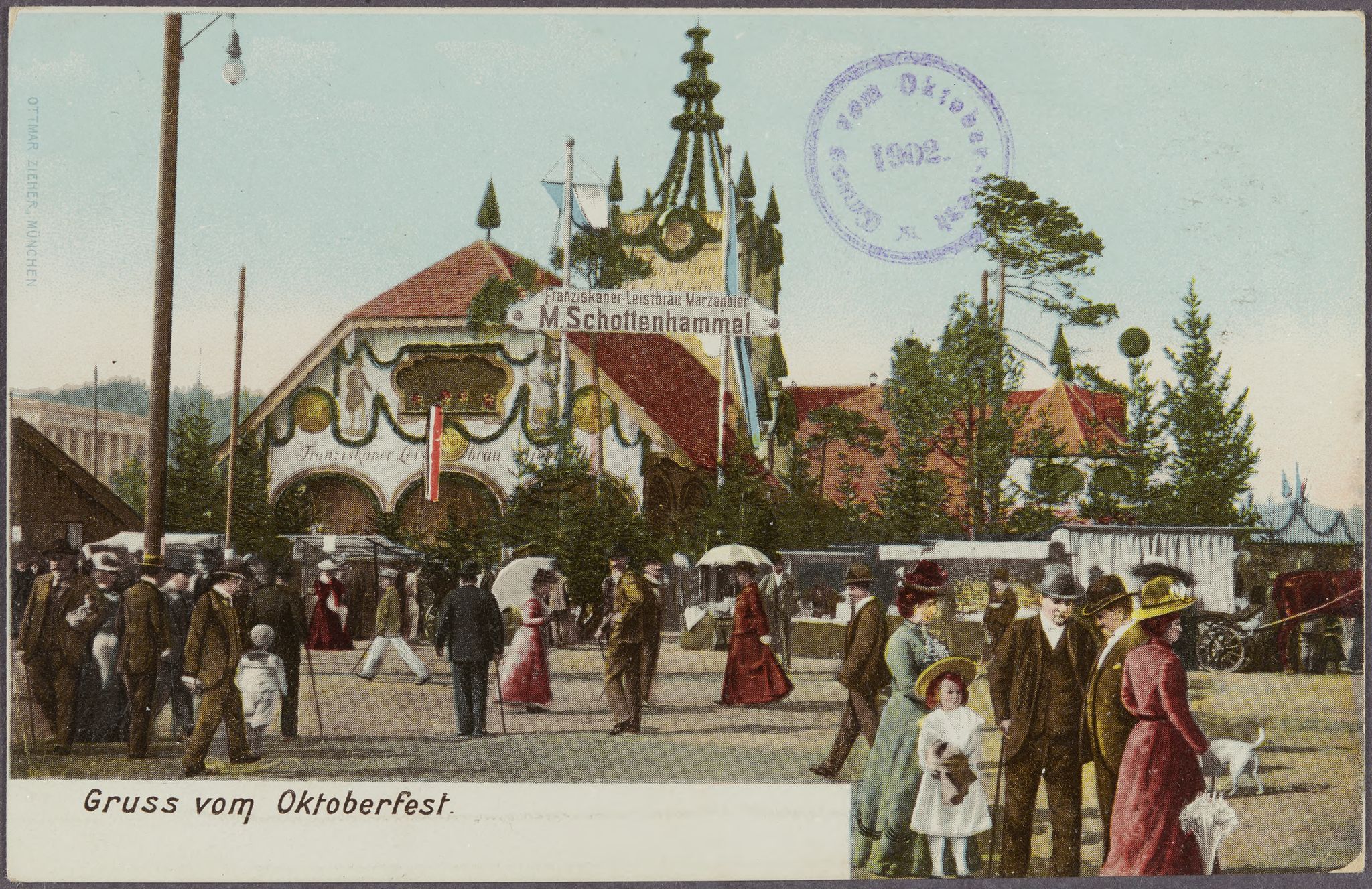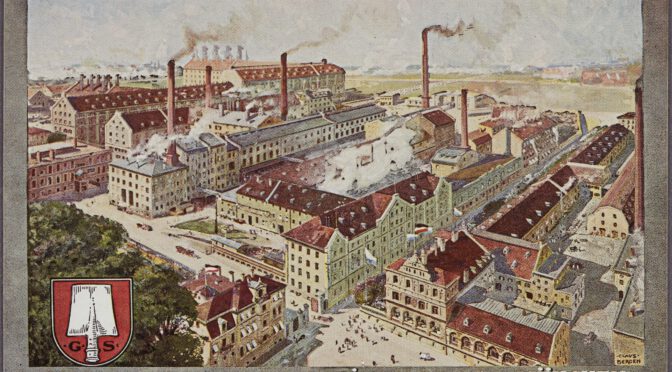
This is not the story of the earliest Munich Helles, an apparent hype of pale lager beer from the 1820s until the early 1840s, during which most of the Munich breweries brewed a relatively pale lager, though it is not clear how pale, before they reverted back to brewing dark lager.
Instead, this is the story about modern Munich Helles, the stuff that’s popular these days and has become the standard beer of Munich and really, much of Bavaria. This beer style can be traced back to a very specific brewery and a very specific date: it was Spaten Helles Lagerbier, first released in Munich on 20 June 1895.
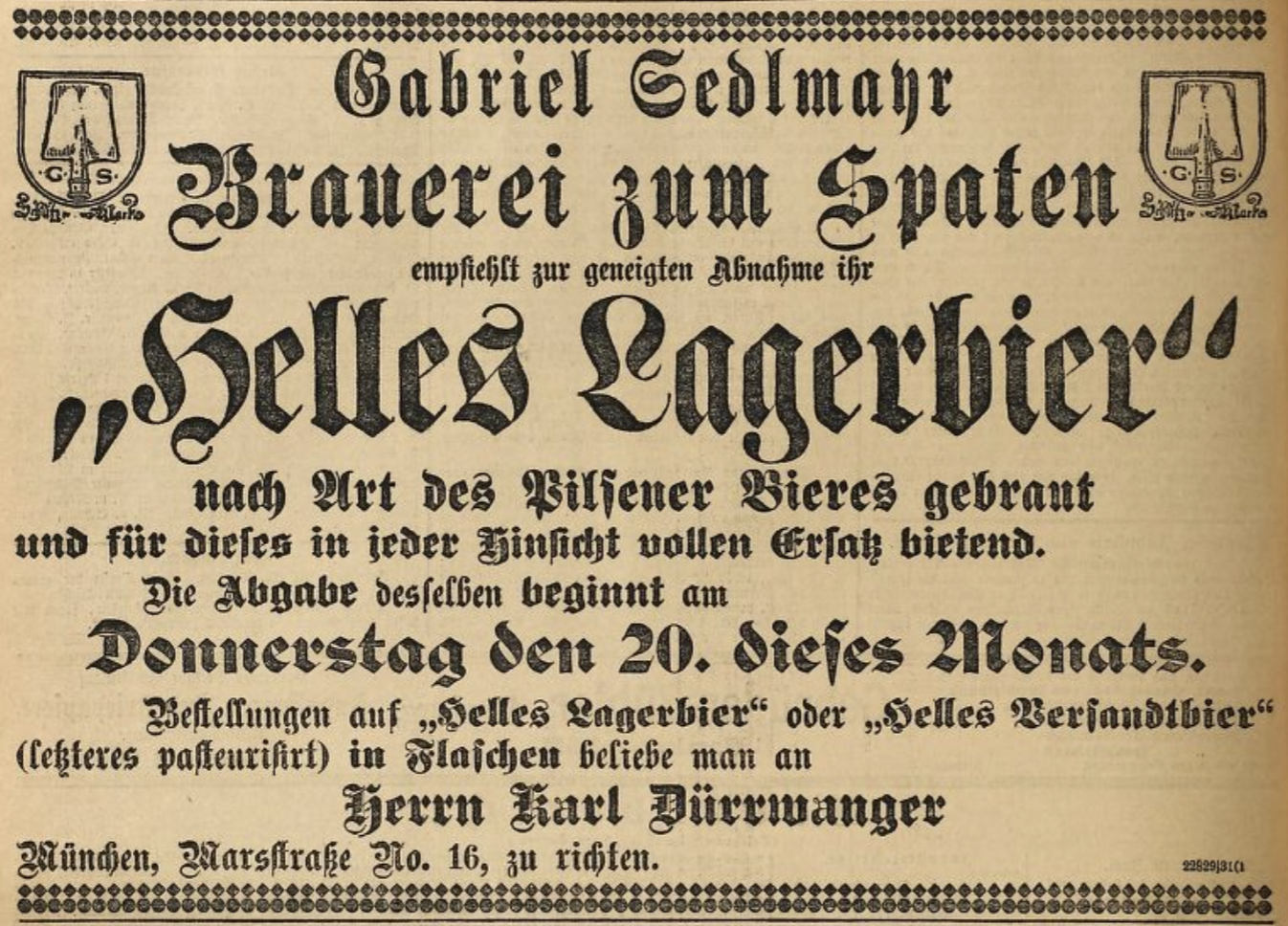
Spaten didn’t just release this beer, but instead were testing it in other markets. In particular, they served it at “Ronacher’s Bierausschank” in Hamburg as early as 1894, which probably was Restaurant Spatenbräu on Hermannstraße 26, run by Jakob Ronacher.
The first commentary in an industry publication that I was able to find was an article in Wochenschrift für Brauerei, published by VLB, dated 19 July 1895, which directly compared it to both Pilsner and Dortmunder, and noted that while Bavarian industry publications have not published anything about it yet, Munich newspapers called it a “natural progression” of Munich beer, while the VLB publication called it a “beer-political event of the first order”, whatever that meant exactly.
The 1898 edition of Brockhaus Encyclopedia contains some analytical data, and if we believe it, this Helles was a quite odd: with an OG of 11.7°P (1.047), it only had 2.69% ABW (3.36% ABV) and a meagre 45.7% real attenuation. Compared to Munich Helles nowadays, it must have been very sweet.
But the Wochenschrift für Brauerei on 20 December 1895 contained analytical data of two brands of Helles (anonymised as “pale Bavarian beer” no. 1 and no. 2), with an OG of 12.37°P and an ABW of 3.45% (4.31% ABV) for the first beer and an OG of 13.2°P and an ABW of 3.8% (4.75% ABV), which paints a slightly different picture. Even though it was still not as highly attenuated as modern beers, with 53.5% and 55.3% real attenuation, it’s closer to a regular dark lager in Munich at the time in terms of OG and attenuation.
By 1902, the beer style seems to have developed a clearer profile, at least that’s what the analytical data in Bayerisches Brauer-Journal suggests: by that time, 15 different Helles were brewed in Munich. Compared to the Dunkel beer brands at the time, the Helles was on average brewed 1°P weaker (average 13.52°P for Dunkel, 12.35°P for Helles) and was slightly more attenuated (51.79% for Dunkel, 57.32% for Helles). The authors of Bayerisches Brauer-Journal also emphasised that the data shows that the Munich Helles isn’t just an imitation of other, foreign pale lagers, or a “characterless beer like it’s brewed oftentimes in other places”, but rather its very own distinct beer type.
And while this beer type was established by the early 20th century, it didn’t mean that it was the most popular. Between the beer’s launch in 1895 and the beginning of World War 1, Spaten’s beer production was never more than about 10% (Christian Schäder, Münchner Brauindustrie 1871-1945, p.92). This was virtually the same for other Munich breweries. Only Thomasbräu was different, as their Helles allowed them to increase annual output from 75,000 hl in 1895/1896 to nearly 200,000 hl in 1913/1914.
Interestingly, Spaten and Sedlmayr did not consider themselves innovators: in 1907, Carl Sedlmayr freely admitted that Munich breweries had already brewed pale lager beer from the 1820s until the 1840s, and that after that, Spaten brewed a pale Vienna-style lager (at least paler than Munich Dunkel) for the French market in the 1860s. Sedlmayr even specifically rejected a proposal to sue Thomasbräu for registering the trademark “Urtyp” (“original type”) because he did not think of Spaten as the inventors of pale lager beer in Munich, and instead credited Franziskaner-Leistbräu and their pale Märzen that they introduced in 1871 as an earlier pale lager from Munich. Carl Sedlmayr himself thought that only Franziskaner-Leistbräu or Hackerbräu (which had introduced a pale “Hacker-Gold” in 1893 that was likely a Vienna-style lager) would have a chance to challenge Thomasbräu’s “Urtyp” trademark (Schräder, pp.97-99).