
Tag Archives: bohemia

Bohemian White Beer: What I Didn’t Put in My Latest Book

If you’ve already read my latest book Bavarian White Beer, you will come across the section about how Bavarian white beer originally made it into Upper Palatinate and Lower Bavaria from Bohemia where white beer had already been popular before.

One of the most interesting sources about early Bohemian white beer is Tadeáš Hájek’s (Thaddaeus Hagecius in Latin) book De cervisia eiusque conficiendi ratione, natura, viribus, & facultatibus, opusculum, which translates to “About beer and its preparation methods, nature, powers and capabilities, a small work”. It was first published in 1585 and describes beer brewing with a focus on white beer production (even involving wheat). You can find an English translation of this book here.

Hájek’s description is interesting because he puts white beer (brewed with wheat) as consumed in Bohemia (and his description really seems to be based on Prague, as that’s where he was based, and his mother was married twice to Prague brewers) into a broader context. In particular, he mentions that this beer type was not only consumed in Bohemia, but also in Poland and certain cities in Germany. While this is interesting by itself because it recognises the similarities of various local white beer types or even a certain wider spread of one beer type, it gets even more interesting when it comes to the ingredients.

Hájek describes the malt not as purely air-dried, but rather as very lightly kilned over a low fire from beechwood and/or oak, which left behind a “somewhat spicy or smoky” taste, but also removed unpleasant smells from the steeping process.

In 19th century Bavarian brewing literature, air-dried malt was considered to be ideal, but for practical purposes, Bavarian white beer brewers had to kiln some of the white malt, and often using smoke kilns (smoke-free kilns only gained widespread adoption in Bavaria in the first half of the 19th century). We know this because some of the earliest white beer had kilns. So at least some of the white beer in Bavaria was slightly smoky, even if the air-drying step beforehand would have minimised the smoke flavour.

What piqued my interest though is the combination of these two facts: a slightly smoky wheat malt, used in a beer spread across Bavaria, Bohemia and Poland. Does that ring a bell?

It is of course pure speculation, but could there be a relationship between Bavarian white beer and Grodziskie, a Polish smoky wheat beer style?

What both beers have in common is the use of wheat: some historic sources suggest that Bavarian white beer brewers tended to use 100% wheat malt grists and were even legally obliged to do so in some instances, while Grodziskie is also typically brewed from 100% oak-smoked wheat malt.

Where both beers differ is the yeast, and also the hopping: for Bavarian white beer, the yeast character of banana esters and clove-like phenolic notes is an important part of the style itself, while the yeast character of Piwo Grodziskie is much cleaner and non-phenolic, and also significantly more bitter than its Bavarian counterpart.

By the early 17th century, there was an active guild of maltsters (which also admitted brewers) in Grodzisk, so brewers must have been active there for even longer than that before they even formed a guild. Around that time, two beer types were brewed in the city, a strong dark beer named “Kuc” as well as a weaker pale beer, both from wheat malt only (source). So a white beer similar to modern Piwo Grodziskie was most likely already brewed back then.

So are they both related? We don’t know, but Hájek making the connection between three local white beers is certainly interesting. It may simply be an expression of a local beer fashion at the time, spanning from Lower Bavaria and Bohemia all the way to Poland, similar to how sour white beers like Broyhan, Gose and Berliner Weisse could be found all over Northern Germany from the 16th to the 19th century.

If you want to learn more about Bavarian white beer like Hefeweizen, including its general history and old malting and brewing techniques, you can read more about it in my new book Bavarian White Beer.
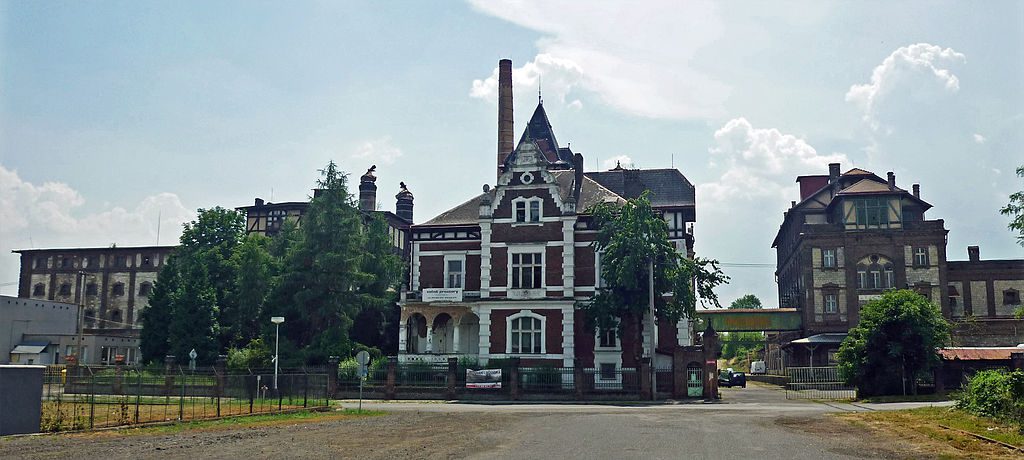
About Saazer Genossenschaftsbrauerei

As some of you may have noticed on my Twitter account, I am currently researching for a book about historic and contemporary Vienna Lager. As with my previous book, I want to lay out the history of the style as detailed as possible, and accompany it with historic recipes and authentic brewing instructions. On top of that, I want to describe how “modern” Vienna lager came to be as part of the craft beer revolution, and what the current state of the beer style is.

Why am I doing this? Because I think that, compared to the popularity of the style, very little is known is about the beer’s history, and in addition, a lot of misinformation and myths have been spread which I try to clear up and reset the narrative.

As part of my historic research, I stumbled upon several references of “Anton Dreher’s Export-Brauerei” in Saaz/Žatec, a city best known for the local hop variety grown in and around it. I found this strange, because historic sources talk about only four brewery locations that were bought and run by Anton Dreher father and son: the main brewery in Klein-Schwechat just outside of Vienna, a brewery in Steinbruch/Kőbánya near Pest (nowadays Budapest), a brewery and hop garden in Michelob/Měcholupy just outside Saaz/Žatec, and a brewery in Trieste, but none of them mention a fifth brewry directly in Saaz. So of course I had to find out more about this brewery.

The first traces of the brewery can be found in newspaper articles mentioning its foundation on either 23 or 25 May, 1898, under the name “Saazer Genossenschaftsbrauerei”, literally “Saaz cooperative brewery”, allegedly by a syndicate that had managed to raise 3 million Crowns, the equivalent of over 42 million Euros nowadays.

The building works took several years, and only in January 1902 the brewery was able to announce that they would start operations in spring of the same year. Already later that year, ads can be found of their beer named “Urstoff” (lit. “original stuff”).

The other brewery from Saaz/Žatec, Bürgerliches Brauhaus (burgher brewhouse) Saaz, was not happy about it, went to court, and obtained judgement prohibiting Genossenschaftsbrauerei from using the name “Urstoff” altogether, and instead earning the right to the “Saazer Urstoff” brand exclusively for Bürgerliches Brauhaus. The court decided that the name “Urstoff” was consumer deception, probably because it insinuated that it was the “original” beer from Saaz, especially since Bürgerliches Brauhaus had been around since 1801, while Genossenschaftsbrauerei had been founded very recently at that time.

In 1903, Genossenschaftsbrauerei went one step further and made the “Urstoff” part of the company name: “Saazer Genossenschaftsbrauerei” was renamed to “Urstoff-Genossenschaftsbrauerei in Saaz”. Bürgerliches Brauhaus complained about this as well, and saw this as an attempt to circumvent the court’s verdict, which was again confirmed by court.

When looking not at trademark court cases but at beer production volume, Genossenschaftsbrauerei was doing quite well for such a young brewery: in 1903/1904, the brewery produced 85000 hectolitres. This was relatively miniscule compared to the amounts other Austrian breweries around that time period were brewing (Klein-Schwechat 1896/97: 770536 hl, Bürgerliches Brauhaus Pilsen 1904: 808000 hl).

In 1905, the legal troubles came to an end, when it was finally decided by the Austrian trade ministry that the “Urstoff” brand registered by Genossenschaftsbrauerei had to be deleted.

In 1914 then, the brewery was converted from a cooperative to a limited liability company (GmbH) named “Exportbrauerei GmbH in Saaz”, with a nominal capital of 1,029,000 Crown, about 5.7 million Euros in today’s money.

During World War I, the Austrian government apparently regulated beer exports, and Exportbrauerei was a complainant about this: the regulation apparently based on OG of the beers, and assumed an average of 11% which – according to Exportbrauerei – severely disadvantaged breweries only brewing 12% beers but no 10% beers, and suggested to instead determine an actual average OG per brewery. It is not known what came of this, but it does tell us one thing about the food economy in Austria-Hungary during the World War: at least in 1916, enough grains must have still been available to brew full-strength beers.

After the breakup of the Austrian-Hungarian Empire, Exportbrauerei was located in newly founded Czechoslovakia, and of course operated like before. It was not exactly a big player in the export business, though: Bürgerliches Brauhaus Pilsen, by then also known as “Pilsner Urquell”, was responsible for 209000 hl beer export in 1929. The total beer exports of all of Czechoslavakia in the same year were 271000 hl, but Exportbrauerei Saaz was responsible for only 5000 hl of those.

One blog claims that Exportbrauerei was renamed to “Anton Dreher’s Exportbrauerei” in 1926, but interestingly, I haven’t really been able to find any other sources about it. In any case this is an interesting year, because at that time, the Dreher family was not really involved with the Austrian brewing business anymore: Anton Dreher Jr. had died in 1921, his son Anton Eugen Dreher died at the age of 54 in 1925, his son Theodor had died in 1914 in a car accident, and his son Eugen had moved to Budapest and sold off his stocks. The inheritance went to Anton Eugen’s daughter Katharina “Kitty” Wünschek-Dreher.

Exportbrauerei Saaz nowadays (photo by SchiDD, licensed under CC BY-SA 4.0)

I have not been able to find out who had the idea to give Exportbrauerei Anton Dreher’s name, and more importantly, why, as there is no discernible direct connection between Anton Dreher, who made Klein-Schwechater brewery big and pale lager beer famous around the world, and this medium-sized Bohemian brewery. This is also the reason why I decided to tell the story of “Anton Dreher’s Exportbrauerei” in my blog instead of my upcoming book, as it does not touch the history of Vienna Lager itself.