Tag Archives: wheat beer

Bavarian White Beer, My New Book

Today I can proudly announce that I just published my new book, Bavarian White Beer. Very much in the spirit of my previous book about Vienna Lager, my intention was to find out as much as possible about Bavarian White Beer, the beers people more commonly know as Bavarian Weissbier, Weizenbier or Hefeweizen, first from a historic perspective: how did the beer style get popular? How did it develop over time? What were the important locations and historic events during all of that? How did it survive to this day?

I then looked into the historic brewing literature to see what we can learn about the style there. This is also where the title for the book came from: I very quickly realised that even though the style’s history is also closely connected to the use of wheat malt in brewing, using wheat was far from obligatory, and plenty of examples of white beer using just barley malt were also brewed. This is why I don’t like using names involving only wheat when talking about the breadth of historic beers in that tradition.

And since my focus of previous books of mine has also been on brewing in general, I also took a look at the latest science and state-of-the-art technology and processes that are used to brew great Bavarian(-style) white beer in all its forms. This is of course complemented by a collection of homebrew recipes that cover the variety of historic and modern styles and variations: classic banana-forward Hefeweizen, oak-smoked wheat beer (a Bavarian-style wheat beer loosely inspired by early historic descriptions), historic Kelheim wheat beer from 100% wheat malt, Hefeweizen brewed on a Burton Union set (and what the Burton Union has to do with brewing wheat beer), modern hoppy wheat beer, and three homebrew versions of commercial beers: Skeleton Key & Goldfinger’s Bavarian Breeze, a beer that I was able to try at Goldfinger’s taproom in 2024, then the award-winning Live Oak Primus Weizenbock, and finally Sapwood Cellar’s Exaggerated Truth, a hazy IPA recipe that demonstrates how Bavarian wheat beer yeast can be used to add more complex fruity flavours to hoppy beers. Homebrewers can even learn how to malt their own wheat and make historically accurate air-dried wheat malt at home.

In terms of what’s covered, this is the most detailed brewing and history book solely dedicated to Bavarian white beer. You can buy it on Amazon as paperback or e-book. Visit waizenbier.de for more information. It has all the links to all the Amazon stores, and you can get an overview what to expect through the book’s table of contents.

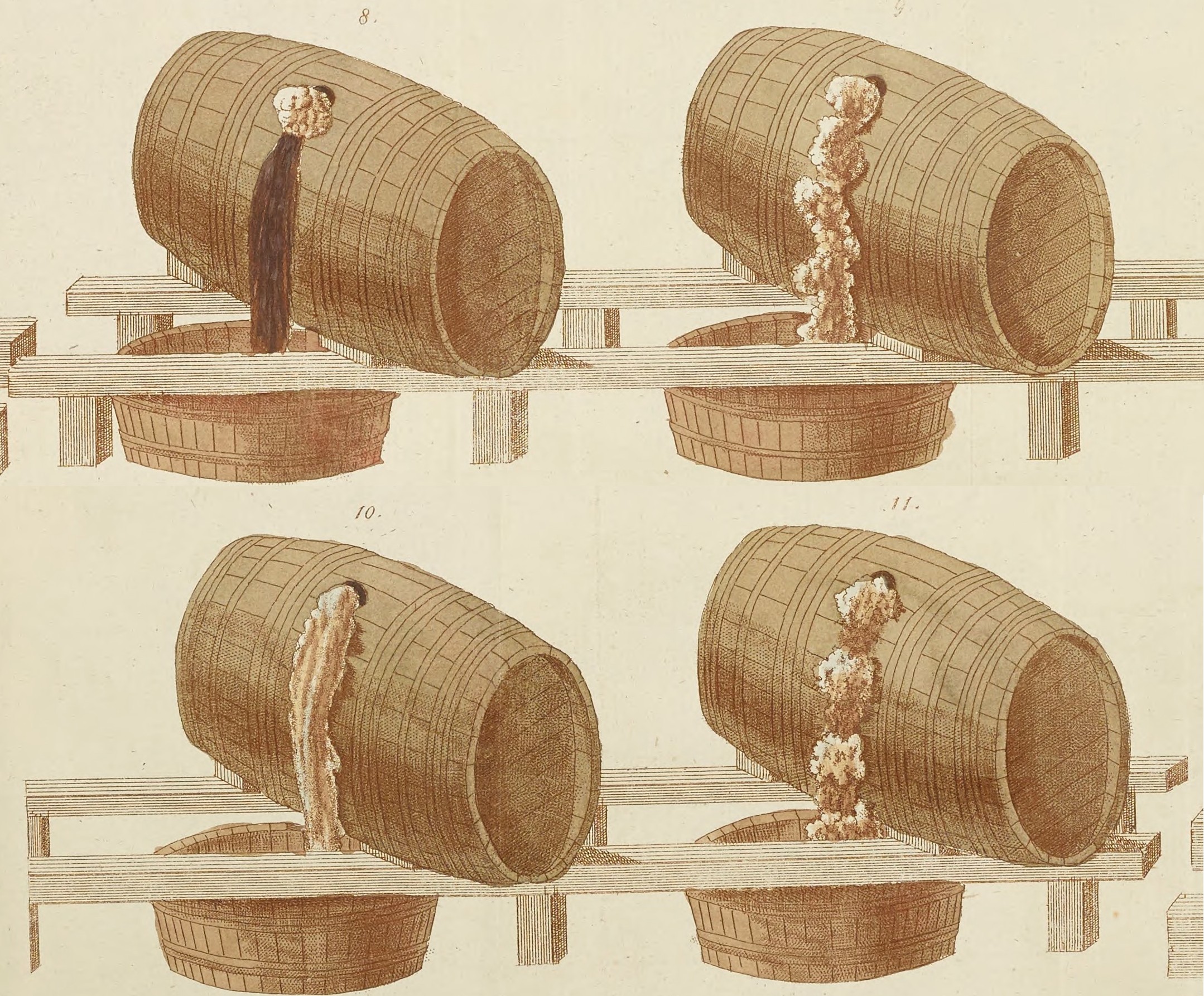
An 1827 illustration showing wooden casks expelling foam during fermentation, so-called Spundgärung, which was common for top-fermented beers at the time.

What inspired me to look into this whole topic was actually another beer writer getting in touch with me. In early 2023, Jonny Garrett approached me with very specific history questions about the Degenberger family for a book he was working on then, The Meaning of Beer. The Degenbergers were a noble family from Bavaria who were very closely involved in the early development of white beer, in particular in Lower Bavaria. I couldn’t answer some of the questions, so I had to visit a specialised library to see what existing literature there was about the Degenbergers and the beginning of the Bavarian white beer monopoly. And just that got me down a rabbit hole about a nowadays very popular beer style that had already been popular in Bavaria from the 16th to the late 18th century.

And while some literature about it was around, it was either about super specific aspects of this whole history or just more general brewing literature. I realised that no book just focusing on this style existed that explained both history and brewing science to the level of detail that I would have liked to have. So I sat down and wrote that book myself.

While the idea had been in my head since 2023, it took me until June 2025 to actually start the work on it, and in the roughly 12 months since then, I managed to write a book pretty much how I wanted it to be. I have not been able to answer every single question about the style that there is, but I was able to dispel quite a few myths and unearth surprising historic details along the way, and overall, it covers all its important history, from its early establishment as a beer style in the 15th and 16th century all the way to the 21st century.

While writing the book, I noticed an interesting 80:20 effect, or at least something like it: in the first 2.5 months of working on the book, I wrote roughly 60% of the final text, while for the remaining 40%, it took me another 8 months, most of which was researching a lot of tiny details and very particular aspects of the history and brewing science of Bavarian white beer. The remaining time was proof-reading, incorporating corrections from reviewers, and technical things like fixing the layout, finding and adding images, and just sorting out all the tiny details to get everything ready for self-publishing both as a printed paperback book and as an e-book.

At this point, I also have to say many thanks to the people who were willing to review my manuscript and give me valuable feedback on it: Brian Alberts, Dave Carpenter and Ben Palmer. Their feedback greatly helped me improve the bits and pieces that just weren’t quite there yet.

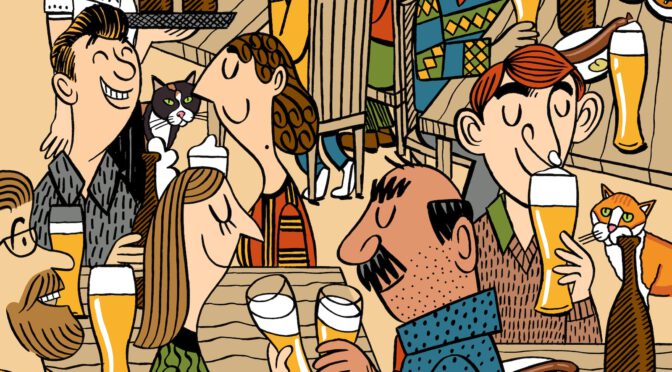
I’m also saying thanks to David Bailey, who created the colourful, happy-looking cover image of a beer hall full of people enjoying Bavarian wheat beer, snacks, and each other’s company. I’ve known David’s work mainly through Pellicle Magazine, and always loved his style, so I was very happy when he agreed to draw the book cover.

One thing that I rediscovered while writing this book was how much I actually liked Hefeweizen. The beer style as such was quite formative for me because it was the only truly different beer on offer back when I was 17, 18 years old, compared to all the Austrian Märzen (which is really just a slightly more bitter Helles). As part of my work on the book, I also reacquainted myself with the style, and drank all the ones I could find, no matter whether on draught or from bottles. I realised how good the beer style actually is, and how much complexity there can be to it, and it somewhat made me understand why the beer must have been popular when the alternative would have been darker, slightly smokey lager beers.

As part of sampling all this Bavarian wheat beer, I also ventured into territories I hadn’t explored much before, and also realised that Kristallweizen (basically a clear, filtrated version with slightly more bitterness) can be excellent, even when it’s probably one of the least fashionable beer styles around right now.

So yeah, I hope the book can also increase the interest in this quite unique beer style, get more people to homebrew Bavarian white beer, and learn something about the beer’s history along the way! So please buy my book (all the information is on waizenbier.de), and don’t hesitate to get in touch if you have any further questions about the topic.

“Why waizenbier.de?”, you may wonder. Well, the story behind that is that I like vanity domains to promote books. What would be spelled “Weizenbier” in modern German actually wasn’t standardised until the German Orthographic Conference of 1901, and in particular the spelling “Waizenbier” was nearly as common between the 1760s and the late 19th century. The very first time G. Schneider & Sohn served their beer at Oktoberfest in 1895, they advertised their stall (it was likely more like a wooden hut) as “Waizenbierbude”, and that was very much my inspiration.

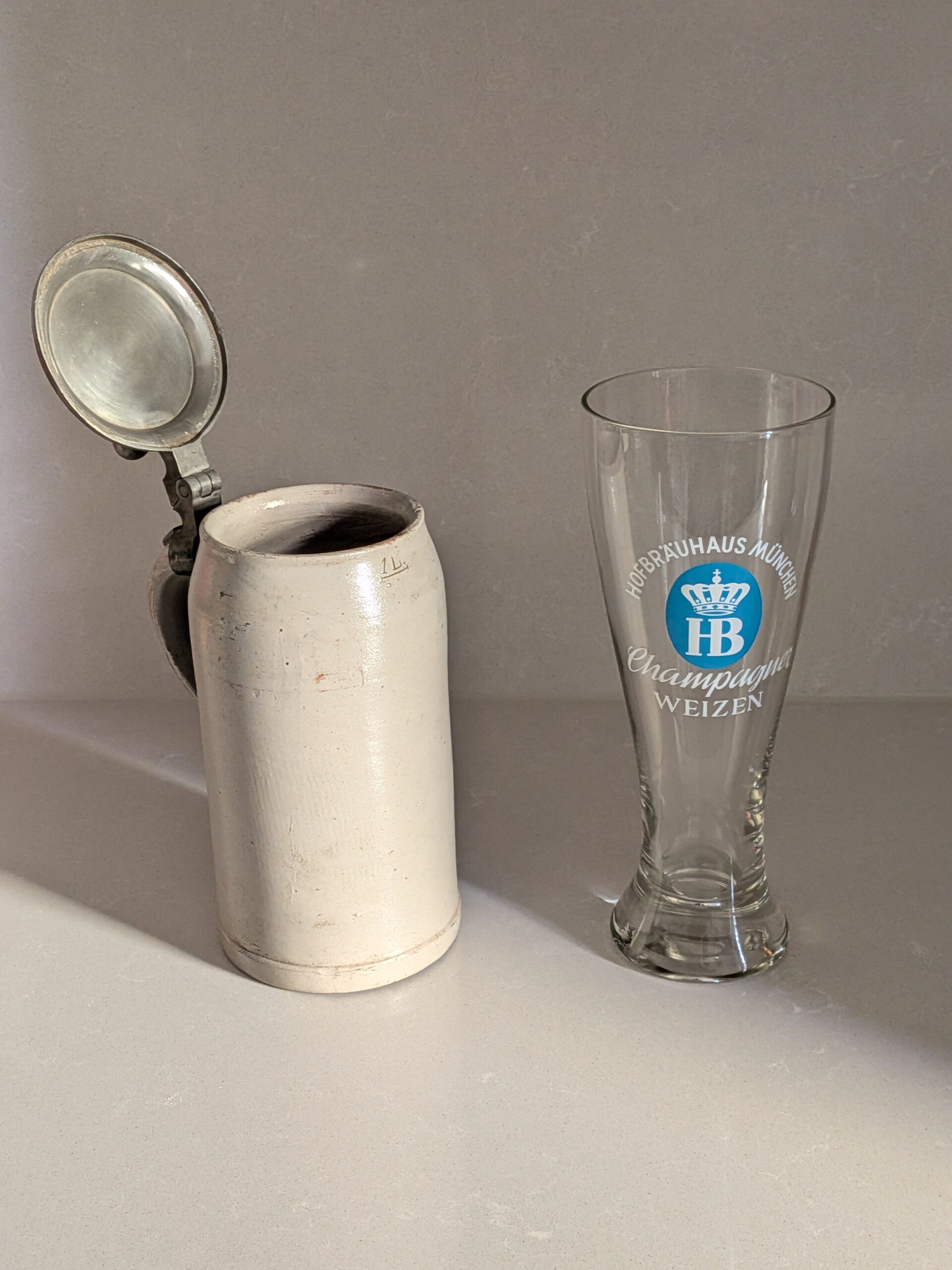
A historic stoneware mug with a tin lid (ca. 1900)  and a wheat beer glass (ca. 1960) with Hofbräuhaus München Champagner Weizen branding.
A historic stoneware mug with a tin lid (ca. 1900) from which white beer would have been drunk out of, and a wheat beer glass (ca. 1960) with Hofbräuhaus München Champagner Weizen branding.

How the Hofbräuhäuser of Bavaria were established

Even if you’ve only ever dabbled a little bit in Bavarian beer, you will have stumbled upon the Hofbräuhaus in Munich, owned by the State of Bavaria, and with a beer hall in the heart of the city. But then you look further, and realise that there’s also a Hofbräuhaus Traunstein 75 minutes outside of Munich, and then there’s of course Weißes Bräuhaus. But how were these “court brew houses” established?

It all actually started with a bit of a brewing crisis. Starting from 3 September 1571, brewing in Munich was totally banned. That year’s rye harvest was rather poor, and barley was needed as a substitute to feed the population. Brewing white or brown beer was seen as a waste, and thus completely stopped through a Ducal order.

This brewing ban remained in place until 1580 when it was partially lifted. Of course, the Duke and his court still needed beer. So for the Duke, beer from Zschopau in Saxony was ordered, and the Nuremberg-based trading house Unterholzer facilitated the delivery of Ainpöckischpier from Einbeck from 1573 until 1589.

The court servants though got different beer: grain from the Duke’s storehouse was given to breweries, in particular the religious orders of the Franciscans and the Augustinians, and the brewer Georg Mänhart who held the title of “court brewer”. With that grain, these breweries were ordered to brew beer of the best quality to be delivered to the court.

Soon after Duke Wilhelm V. took office in 1579, he inquired about which breweries in the Bavarian Forest were brewing “white Bohemian beer” and where they got their brewing ingredients from. A commission of 4 people produced a report in 1581 that listed all the white beer breweries in the designated area as well as those that belonged to the Prince-Bishopric of Passau. In 1586, the Duke gave a brewing privilege to the Schwarzenberg family and their male descendants that allowed them to brew white wheat beer, a privilege that otherwise only the Degenberg family held. At the same time, he also inquired about the general profitability of white beer. An earlier report handed to him noted that brewing white beer was considered to be a waste, but could be turned into a profitable business.

In the end, Duke Wilhelm V. remained cautious and only founded one brewery in 1589, the Hofbräuhaus in Munich for brewing brown beer, but building works for it only started in 1591. When the new brew house started operating, the previous court brewer Mänhart lost much of his business and fell into poverty, but was compensated for it with an annual payment of 100 florin a year.

When the Degenberg family went extinct in 1602 through the death of Hans VIII. Sigmund of Degenberg, Duke Maximilian I. set a plan in motion to gain control over white beer brewing in Bavaria. He was much more ambitious and had already looked into white beer brewing before taking office in 1597, as Bavaria was close to bankruptcy and he saw white beer as a profitable way of making the Bavarian Duchy rich again.

Before even the Degenberg inheritance was settled, he immediately continued paying the brewers at the Degenberg brew houses to keep up brewing operation, even though he legally did not own them. Only in 1607, he came to an agreement with the heirs of the Degenberg family, in which he was allowed to purchase the Degenberg breweries for 82,000 florin while cancelling a debt of 20,000 florin of the heirs. Maximilian I. now owned 3 white brew houses, in Zwiesel, Schwarzach and Linden.

Already in 1602, brewers from the Schwarzach brewery were ordered to Munich to teach the Hofbräuhaus staff how to brew white beer and to brew the first batches. The first court-brewed white beer was then sold in Munich on 16 October 1602, directly from the Ducal cellar. A separate white brew house was finally built in 1607 and a dedicated brewmaster for white beer was hired.

A newly built brew house in Gossersdorf that opened in 1600 and interestingly had not been banned by the court (they only banned the brewer from using domestically grown wheat) was sold to Maximilian I. in 1602.

At that time, the court in Munich had already forgotten about the Schwarzenberg brewing privileges granted in 1586, but when their family was able to provide them with original documents, Maximilian I. offered to buy their brew house in Winzer which was finalized on 29 April 1603.

Now owning all the white brew houses of the Degenberg and the Schwarzenberg families, he was the exclusive brewer of white beer in Bavaria. Well, almost, because there were nine communal brew houses in Lower Bavaria (the remnants of the communal brew house system in parts of Bavaria are nowadays better known as Zoigl) that historically also had a customary right to brewing white beer. The Duke also managed to subjugate them and forced them to share their revenue through a duty they had to pay. These nine brew houses were located in Viechtach, Regen, Kötzting, Furth im Wald, Neukirchen bei Hl. Blut, Eschlkam, Schönberg, Grafenau and Hals.

On top of that, more white beer breweries were established: in Mattighofen, the brown brew house was converted to producing white beer in 1607. In the summer of the same year, building works started in Kelheim for a new brewery which started brewing white beer in April 1608, while in Traunstein, an existing building was bought and turned into a brewery in 1611.

By 1612, Duke Maximilian had established a formidable network of state-owned breweries: not only was there the Hofbräuhaus in Munich that produced brown beer, but he also directly owned nine white brew houses and received a passive income from nine more communal white brew houses. Technically speaking, these were all court brew houses, and a dense network of them stretched over Old Bavaria that only got extended with more breweries over the years.

Some of them are still around: the white beer brewery in Traunstein was destroyed in 1704, rebuilt and eventually sold in 1820. Since 1896, it has been owned by the Sailer family and run as Hofbräuhaus Traunstein.

The “white brew house” in Munich kept operating next to the Hofbräuhaus and was leased to brewers. The last one was Georg Schneider. When the buildings of the white brew house were to be repurposed in the 1870s, he simply bought the rights for it from the court and moved to another building, the former Maderbräu building on Im Tal, just a few hundred metres away from the old brewery, which made it easy for his existing customers to visit the new place. The old Maderbräu building was renamed Weißes Bräuhaus (white brew house) and became the headquarters for the Schneider family brewer. In 1928, the Schneider family bought the white brewhouse in Kelheim, another formerly state-owned brewhouse which became their main brewery after World War II, and which they now claim to be the oldest white brew house in Bavaria.

What remains though is that the Hofbräuhaus is still around, even though ownership has changed, as the Bavarian King transferred it to the Bavarian State in 1852. The white beer privilege has long been broken, but even of these formerly privileged white brew houses, some are still in operation, the one in Kelheim even still dedicated to the production of white wheat beer.