
This whole Vienna Lager topic still somehow has me captivated, even 11 years after I first looked into the historic beer style, and almost 6 years after I released my book about the (mostly) complete history of Vienna Lager.
As some of you probably already know, the Oktoberfest Märzen style started out as a strong “pale Viennese” style lager beer brewed by Josef Sedlmayr’s son Gabriel at Franziskaner-Leistbräu in 1871, after he had returned from vocational training at the Dreher brewery in Kleinschwechat. Because of a beer shortage in Munich due to the hot weather, Michael Schottenhamel, who operated a beer stall at Oktoberfest, approached Josef Sedlmayr, who could promptly offer him this Vienna-style lager. It required a permit to sell this stronger-than-normal beer, but once that went through, it was branded as “Märzenbier”, reviving an old term that had been applied to any lager or “summer” beer in Munich until 1799. The rest is history.
Prior to that, Vienna Lager had already been fairly popular in Southern Germany. In my 2020 book, the examples I mentioned were Vienna Lagers by Munich breweries Hackerbräu and Löwenbräu, as well as one from Würzburger Hofbräuhaus and another one from Mainzer Aktien-Bierbrauerei.
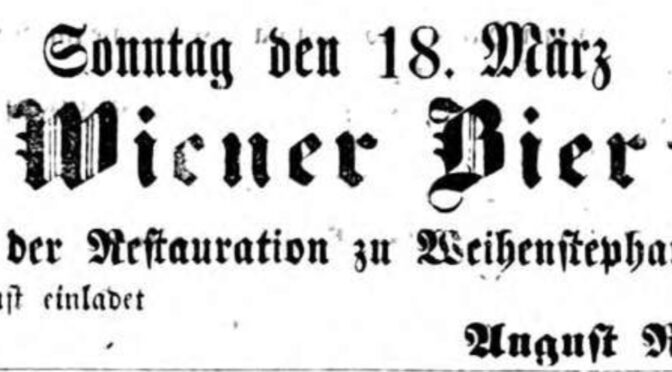
What I hadn’t looked into in detail at the time was which one was the first “Vienna Lager” brewed outside of Austria. At least the German-speaking sources that I’ve been able to consult point towards two breweries that successfully brewed the style quite early on. One was brewed at Weihenstephaner brewery in Freising, during the 1865/1866 brewing season. A first report about that was published on 25 March 1866, mentioning that the brewery had also brewed beer according to the “Viennese method”, and that experts who had recently tried the beer could confirm that it was equal to Vienna Lager in terms of purity, taste and colour.
Very similar news were reported on 6 April the same year about the brewery of Mr. Müller in Drachselsried in the Bavarian Forest, who had also used the Viennese method and also produced a beer equal to the original. And Kemptner Zeitung on 4 April 1866 noted that Viennese beer is slowly gaining acceptance in Bavaria, mentioning Weihenstephaner brewing both Bavarian and Viennese-style beer for this first time.
On 15 December 1867, an ad for Vienna Lager at Hackerbräu was published in a Munich newspaper. In the 1867/1868 brewing season, Vienna Lager really seemed to have taken off in Munich. The Münchner Anzeiger newspaper on 1 January 1868 contained a page half of which were just ads for Vienna Lager. The beers mentioned on the page were Spatenbräu Bock (2 ads, 1/3 of the page) and Löwenbräu “Vienna Beer”, “Vienna Lager” or “Vienna Export Beer” (4 ads, 2/3 of the page).
In 1870, Vienna Lager was also served (and presumably brewed) at the Jagenlauf brewery in Stadtamhof, nowadays a district of Regensburg. And by 1872, a “Mainzer Wiener-Lagerbier” (that’s one way of fitting two place names into a name) was sold in Mainz.
So was Weihenstephan-brewed “Viennese-style lager” the first Bavarian-brewed Vienna Lager, probably even in all of Germany? We can’t know for sure, but it’s at least it’s the first one for which I’ve been able to find hard evidence. The style itself definitely caught on when at least two Munich-based breweries started brewing the style, and by the 1870s, it had spread to other parts of Bavaria and Southern Germany, when a strong version of Vienna Lager became the template for Oktoberfest-Märzenbier that is nowadays internationally mainly known as “Märzen” and was served at Oktoberfest until the 1980s when the paler Festbier took over in popularity.