
I’ve previously written about beer at Oktoberfest, like which breweries’ beers were served in 1843, or about various breweries and beers between 1882 and 1936 that we know of from Oktoberfest programmes and newspapers.
The whole question interests me for a particular reason: it shows that the current restrictions on beer at Oktoberfest, namely that it can only be from one of the “traditional” breweries from Munich whose beer conforms to the Oktoberfestbier PGI regulations, which requires them to have a well going several hundred metres deep down, are not rooted in the festival’s own history. It is essentially a form of regulatory capture to make it exclusive to Munich’s big 6 beer brands that has been successfully defended in court before. German online magazine Legal Tribune Online has criticised the restrictions of market access as a “cartel” in the past, and how the city of Munich may possibly be violating antitrust laws with the current practice.
The reality is that beer used to be much more diverse in the 19th and early 20th century than it is nowadays. But if you want to experience a traditional Volksfest with 20+ different beers available, you need to go to e.g. Forchheim for Annafest, because Oktoberfest is not that place anymore.
The two years 1895 and 1896 are in my opinion particularly interesting because there were quite a few really unusual und (at least from our modern perspective) unexpected breweries present in Munich:
There was of course the Dreher brewery from Kleinschwechat, the original inventors of Vienna Lager, who were first able to serve their beer at the Wiesn’n in 1895. The same year was also the very first time a dedicated Weißbier stall was allowed, the rights for which were won in an auction by restaurateur Fritz Reiss, who then served wheat beer by G. Schneider & Sohn. And then there were specialities like Thomasbräu serving their Pilsner in addition to the regular Märzenbier.
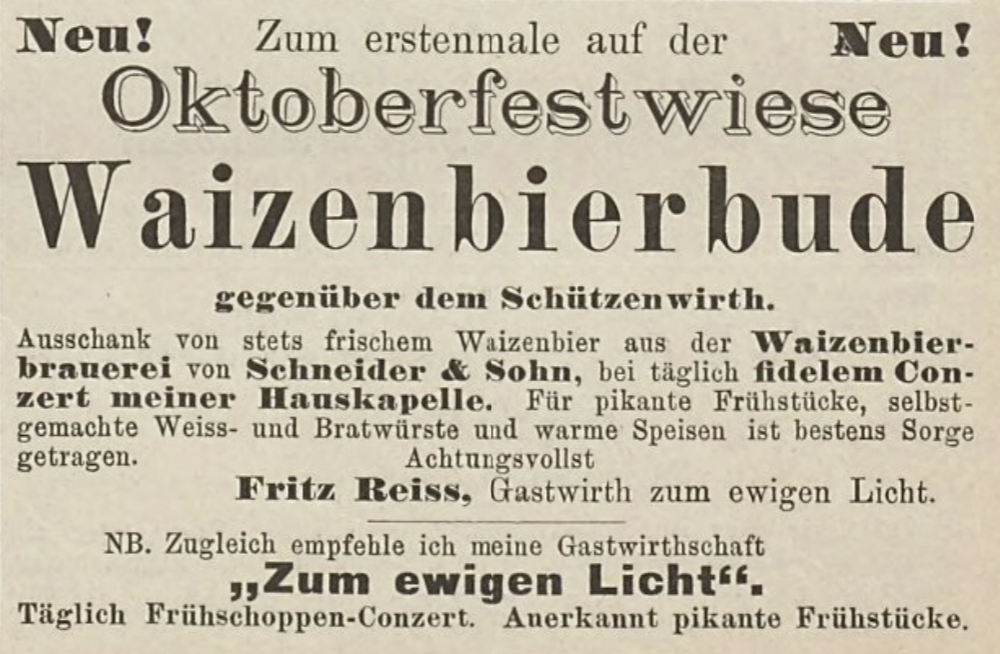
As I’m still working on my upcoming book, I got a bit sidetracked today while researching a few details to tie up some loose ends, and came across a lot more detailed list about all the beer stalls at the Oktoberfest 1895 and 1896, and it shows how great the variety in beer and breweries was back then. So here’s the list of all breweries that were served at the beer stalls 1 to 26:
- Franziskaner Leistbräu
- Zacherlbräu
- Gambrinusbrauerei
- Löwenbräu
- Pschorrbräu
- Löwenbräu
- Münchner Kindl
- Spaten
- Dreher, Kleinschwechat near Vienna
- Bergbräu (Henninger), Munich-Giesing
- Münchner Kindl
- Salvator-Brauerei
- Kochelbräu
- Thomasbräu
- Hacker
- Bürgerbräu
- Augustiner
- Thomasbräu
- Pschorrbräu
- Pschorrbräu
- Pschorrbräu
- Pschorrbräu
- Pschorrbräu
- Pschorrbräu
- Pschorrbräu
- Pschorrbräu
In addition to that, there was also the wheat beer stall that was unnumbered and actually a bit away from the other beer stalls, that served G. Schneider & Sohn.
And yes, that’s a lot of Pschorrbräu stalls! The source with all beers as well as a list of all the restaurateurs and how much they paid at the auction can be found in the Bayerische Gastwirths-Zeitung issue dated 25 August 1895. At the time, the beer of some stalls was not known yet (such as stall no. 3 and 9), and for no. 25 the beer changed later. We know this from ads for these particular stalls that were published in the official Oktoberfest programme.
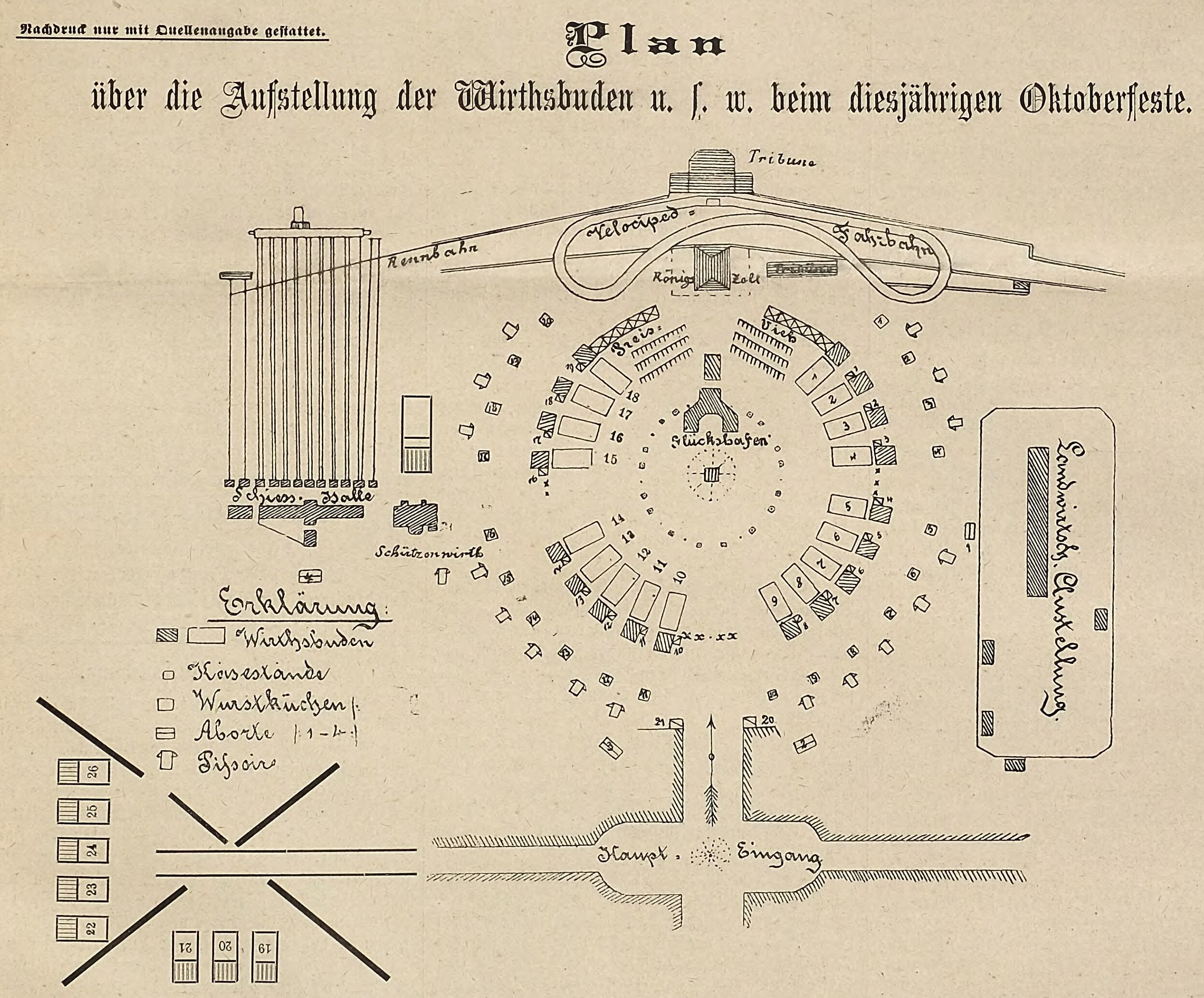
We even have a plan that shows the layout how all the stalls were laid out on Theresienwiese:
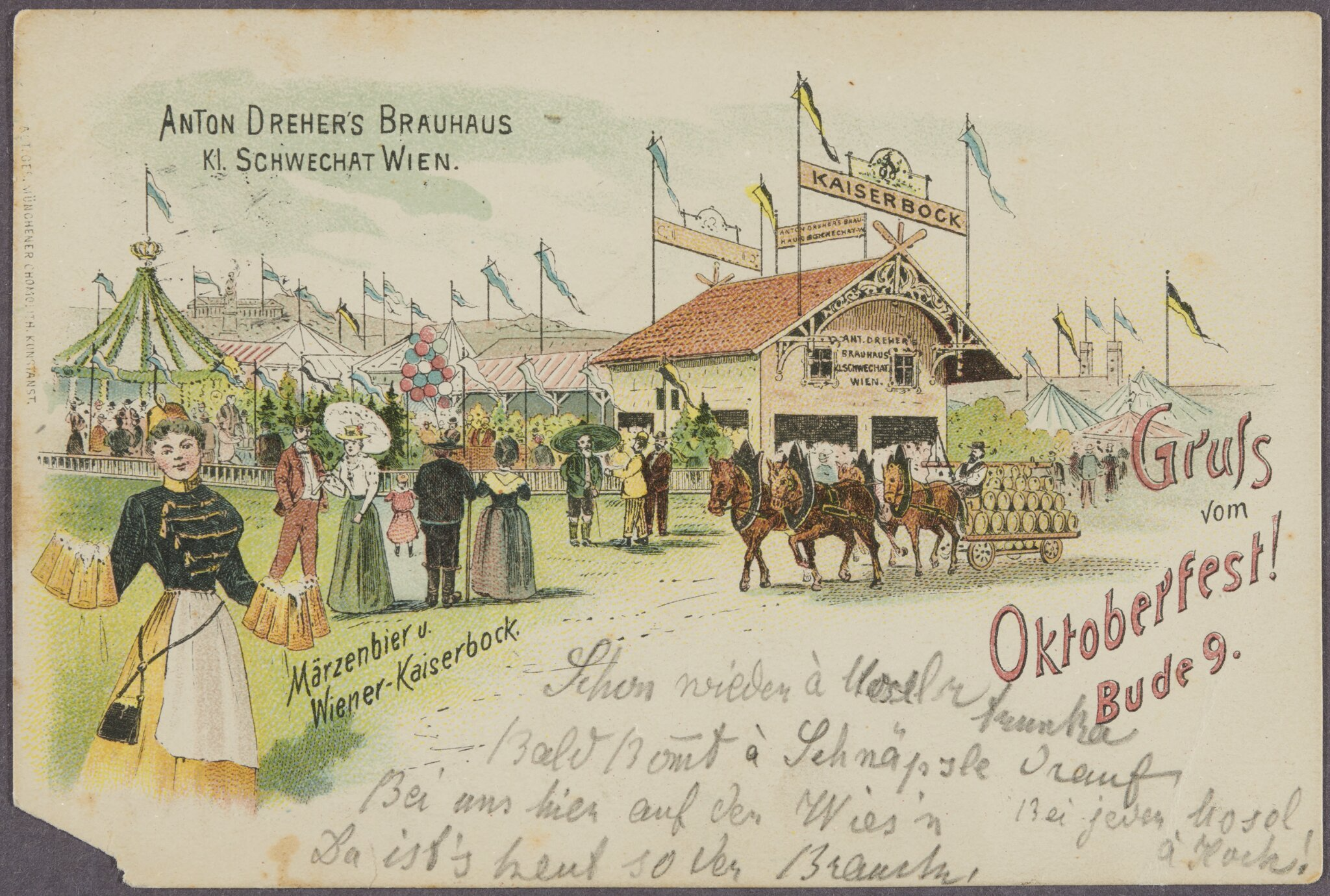
These stalls at the time were nothing like the modern massive beer tents. You can get a good idea what these beer stalls were like from this 1897 postcard of the Dreher beer stall:
In 1896, the choice in beers slightly changed compared to the previous year:
3. Kochelbräu
4. Bürgerliches Bräuhaus Budweis (yes, Bohemian beer at Oktoberfest!)
10. Augustiner
11. Hackerbräu
16. Pschorrbräu
17. Spatenbräu
19. Kulmbacher Export
20. Augustiner
21. Hackerbräu
22. Unionsbräu
24. Klosterbräu
25. Hackerbräu
26. Bürgerbräu
27. Pschorrbräu
(Source)
Interestingly, the wheat beer stall is not listed or mentioned anywhere, but still appears on the map of stalls in 1896 opposite the Schützenwirth, next to the shooting range.
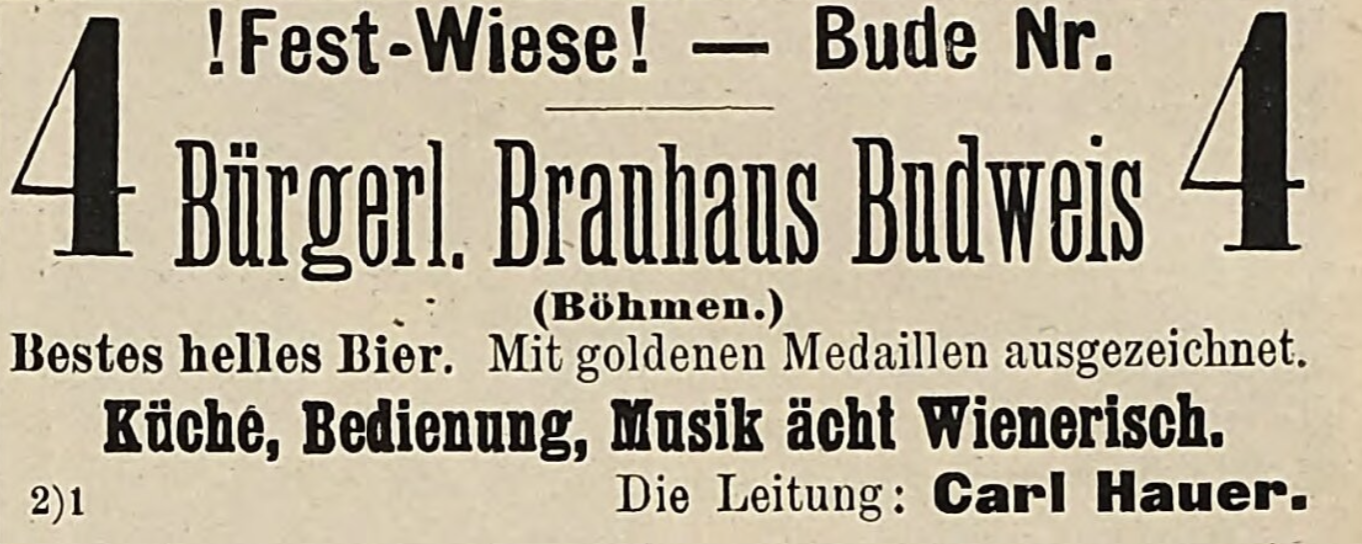
At least in the years 1895 and 1896, it was not unusual to have “foreign” beer from outside Munich served at Oktoberfest, like Vienna Lager/Märzen from Dreher, pale lager beer from Budweis, or Franconian lager from Kulmbacher Export brewery.
One thought on “Beers at Oktoberfest 1895 and 1896”