That title says it all, but let me briefly explain. Just a few weeks ago I asked whether science has gone too far with the development of alcohol-free Bavarian Helles.
A few days ago, I came back from our summer holiday. One big part of it was visiting Waging am See which is roughly half-way between Traunstein and Petting-Schönram. The former is the home of three breweries, including Hofbräuhaus Traunstein, while the latter is the home of Private Landbrauerei Schönram, a regional brewery firmly embedded in the Rupertiwinkel region of Bavaria.
Of course, the locally dominant beers there are Hofbräu Traunstein Helles and Schönramer Hell, with Schloßbrauerei Stein also having some presence. Naturally, we drank plenty of Traunsteiner and Schönramer, and of Schönramer’s beers, I enjoyed having their Alkoholfrei readily available and pre-chilled in the local supermarkets.
I now very much believe that this is the perfect alcohol-free beer. When it’s properly chilled, and poured into a glass, it’s absolutely beautiful, and is virtually indistinguishable from a regular Helles. Only in the nose, there’s a tiny trace of an aroma that is a bit off, and while tasting the beer, the body is almost right. Literally the only thing that’s missing is that tiny bit of alcohol that is noticeable. Other than that, no flaws.
As we were in the area, we also did a tour of the brewery, which is an experience in itself. Probably the best brewery tour ever, other than maybe the handful of times where I was given private tours by brewers. Everyone was very open about the brewing practices and processes, and all my questions were answered. The only thing they said they wouldn’t hand out is brewing recipes, but if you wanted to brew Schönramer beers, you can get a good idea about their approach through articles like this one and home-brew recipes like this one.
As for the alcohol-free beer itself, that’s what I’ve been able to find out: Schönramer currently contracts out the dealcoholisation process, which is done at Brauerei Hutthurm near Passau. Hutthurm dealcoholises via reverse osmosis membrane filtration, exactly the modern method I mentioned the other week. The resulting beer is then returned by tanker to Schönram, where it is then blended with Schönramer’s Surtaler beer (which in itself has 3.5% ABV) to get just below 0.5%.
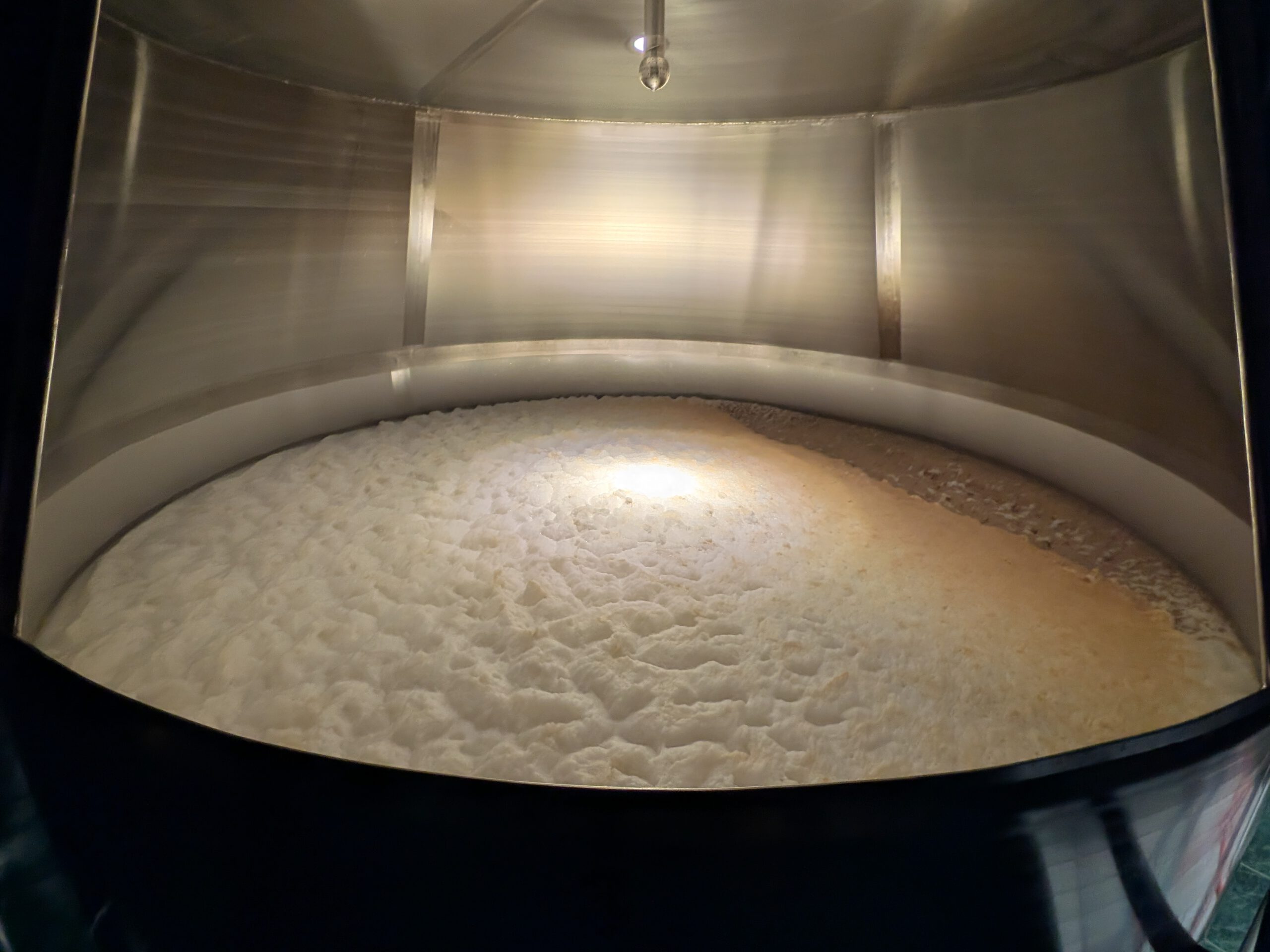
An open fermenter at Schönramer brewery with fermenting beer in it, with kräusen (white-ish foam) on top.
Schönramer is apparently working on moving dealcoholisation in-house, but this is still in the planning phase. When I briefly spoke to senior brewmaster Eric Toft (I had a bit of a fanboy moment), he actually voiced his preference for the Surtaler Schankbier, and to me it sounded like he wasn’t 100% happy with moving towards a beer style that is much more resource-intensive in production compared to their other beers (even just the dealcoholisation itself, never mind sending it around with tankers), especially after all the effort Schönramer put it to make the whole brewing process as energy-efficient as possible, including energy recovery at various stages of the process.
I still think Schönramer Alkoholfrei is an excellent beer, and knowing all the details that go into making the Schönramer beers as good as they are, it is not an accident, but rather shows the technical excellence of the brewmasters and the staff at that regional Bavarian brewery.
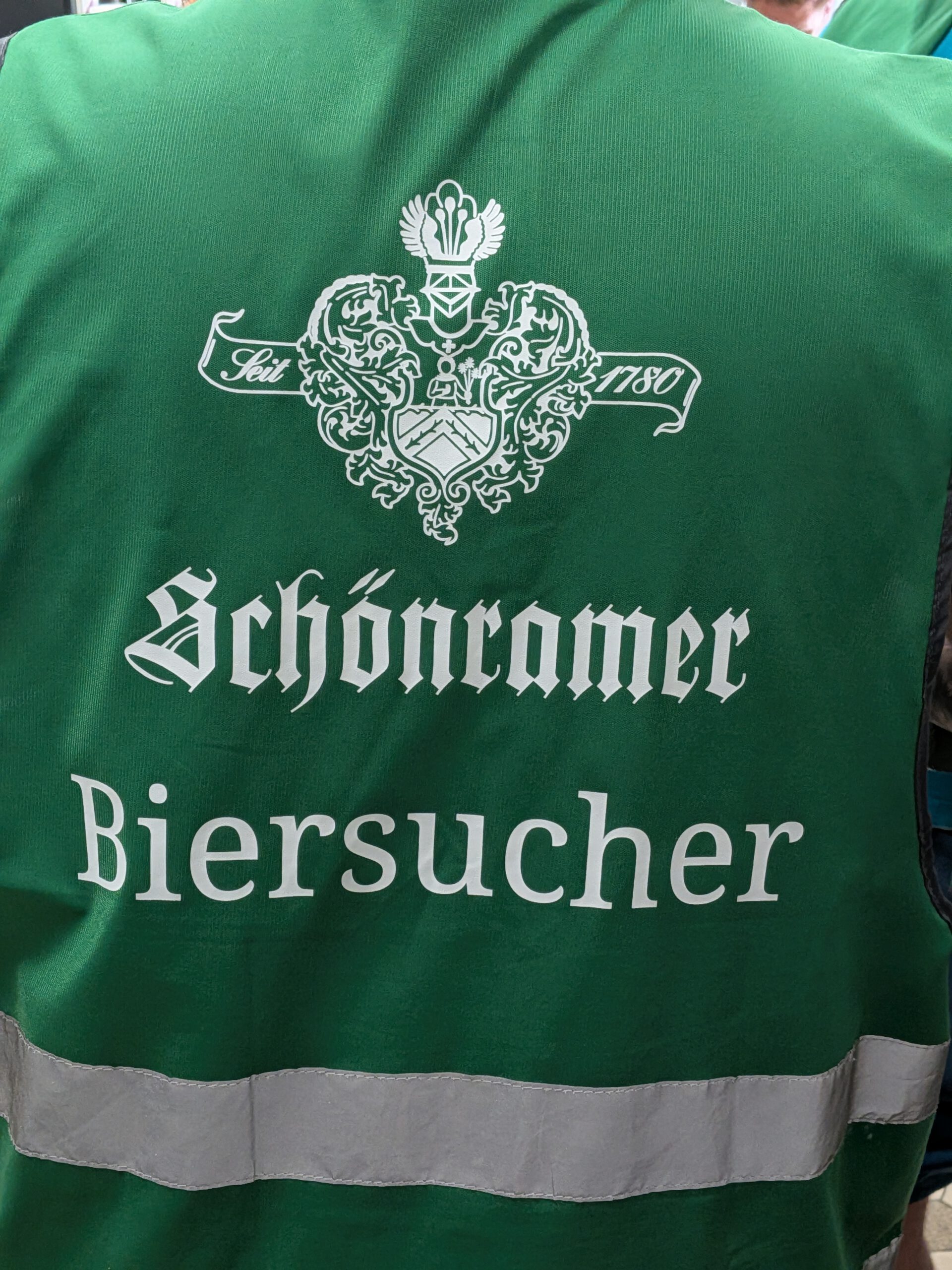
The back of a Schönramer-branded high-vis vest worn by a brewery tour participant. It says “Biersucher” on the back, a portmanteau of “Bier” and “Besucher” (visitor).
In the last few years, a number of new Bavarian non-alcoholic Helles were launched by reputable breweries such as Augustiner (which really started this new craze), Tegernseer, Bayreuther, Weihenstephaner and Schönramer.
Augustiner’s new non-alcoholic beer was without any doubt Munich’s hype beer of the year 2024, and several other breweries followed suit and launched their own products once they realised that the hype was real.
From what I was told, these new beers are all based on new methods of gentle dealcoholisation using reverse osmosis, to a large extent driven by research at TU Munich at Weihenstephan (one paper about the impact of different production methods on NA beer aroma can be found here).
When Augustiner released that new beer, my prediction was that it would be a big deal, and I firmly stand by that assessment. It’s changed the world of alcohol-free beer for the better, making it actually enjoyable. My first tasting a few weeks later also confirmed it for me. And zebra-striping between Augustiner Oktoberfestbier and Augustiner Alkoholfrei Hell in the Augustiner tent at Oktoberfest on the last day of the festival in 2024 further showed what an incredible beer it is: when served extra cold from keg, it’s virtually indistinguishable in terms of aroma and flavour compared to a regular Augustiner Helles.
When I first tried Tegernseer’s version last year, I actually found it to be even better, at least from the bottle, to the point where it tastes exactly the same except for a slightly noticeable lack of alcoholic mouthfeel.
Last weekend, I finally had the chance to try out the latest contender, Schönramer Alkoholfrei. Schönramer Hell is one of my favourite Helles, it’s incredibly light, fairly dry and just incredibly drinkable. So of course I was looking forward to trying it.
And… it’s good. It’s very good. It seems even more refined than either Tegernseer’s and Augustiner’s version, but it’s the first time where I feel like there’s something lacking in the non-alcoholic Helles (other than the alcohol itself, of course), rather than something still being in there that makes it identifiable as a NA beer. The Schönramer version is so clean, the beeriness almost seems diminished to the point where it reminded me a bit of American light beers.
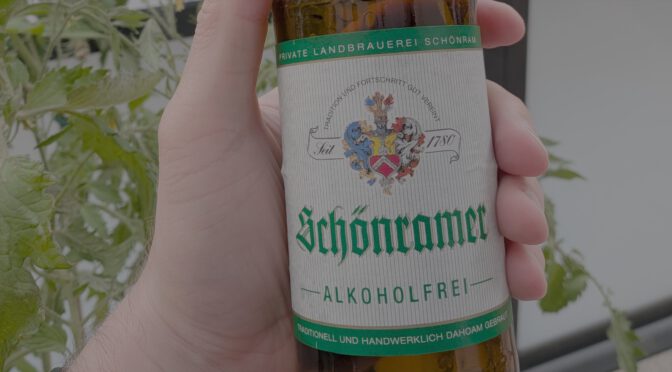
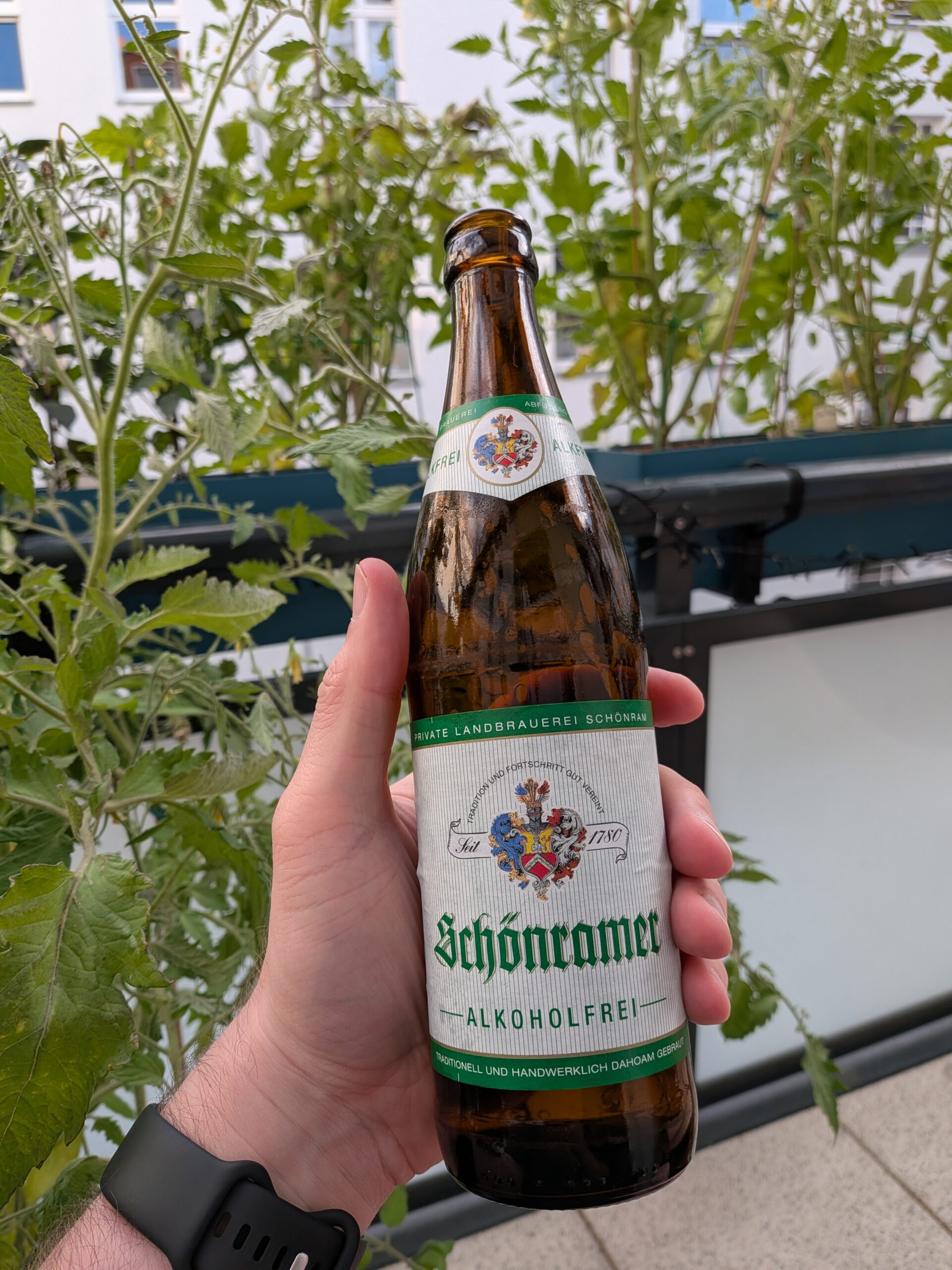
Me holding a bottle of Schönramer Alkoholfrei on my balcony.
This was the first time when I thought: has science gone too far? Has non-alcoholic Helles been optimised so much in an attempt to make it as clean-tasting as possible, that it has actually lost some of its character as a beer? It still tastes like a beer, don’t get me wrong, but I do wonder whether the non-alcoholic version could just be a bit more characterful. I also wonder whether this is simply down to the base beer, and I don’t know whether this is just a dealcoholised version of their regular Helles, or whether more tweaking was done that caused the beer character to become less and less.
So I had to go back the day after and try the beer again. What I noticed was that from a beer glass (nothing fancy, just a Willibecher), the beer was somewhat more aromatic, without any noticeably increased non-alcoholic character, and closer to the regular Schönramer Helles.
Anyway, in a few week’s time, I’ll be drinking Schönramer straight from the source, and we also have a tour booked, so I hope I’ll be able to ask a few more questions about the specific way Schönramer produce their non-alcoholic Helles and report back on my blog.
Some time ago, my wife and I started collecting Steinkrüge, German-style stoneware mugs for beer drinking. I don’t know what exactly started our interest, but what played into it was a historic Steinkrug of Franziskaner-Leistbräu that I got to photograph for my most recent book about Vienna Lager.
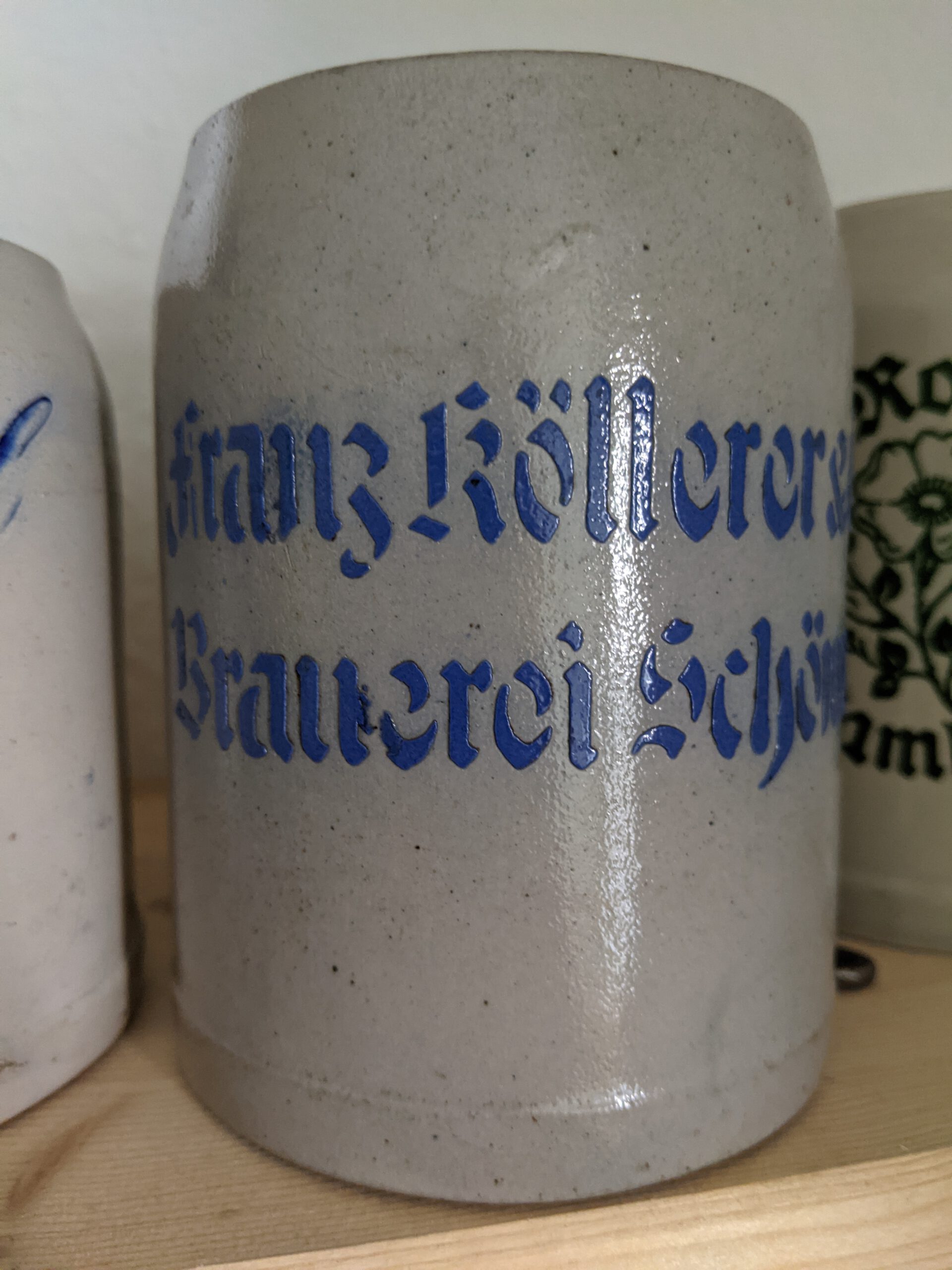
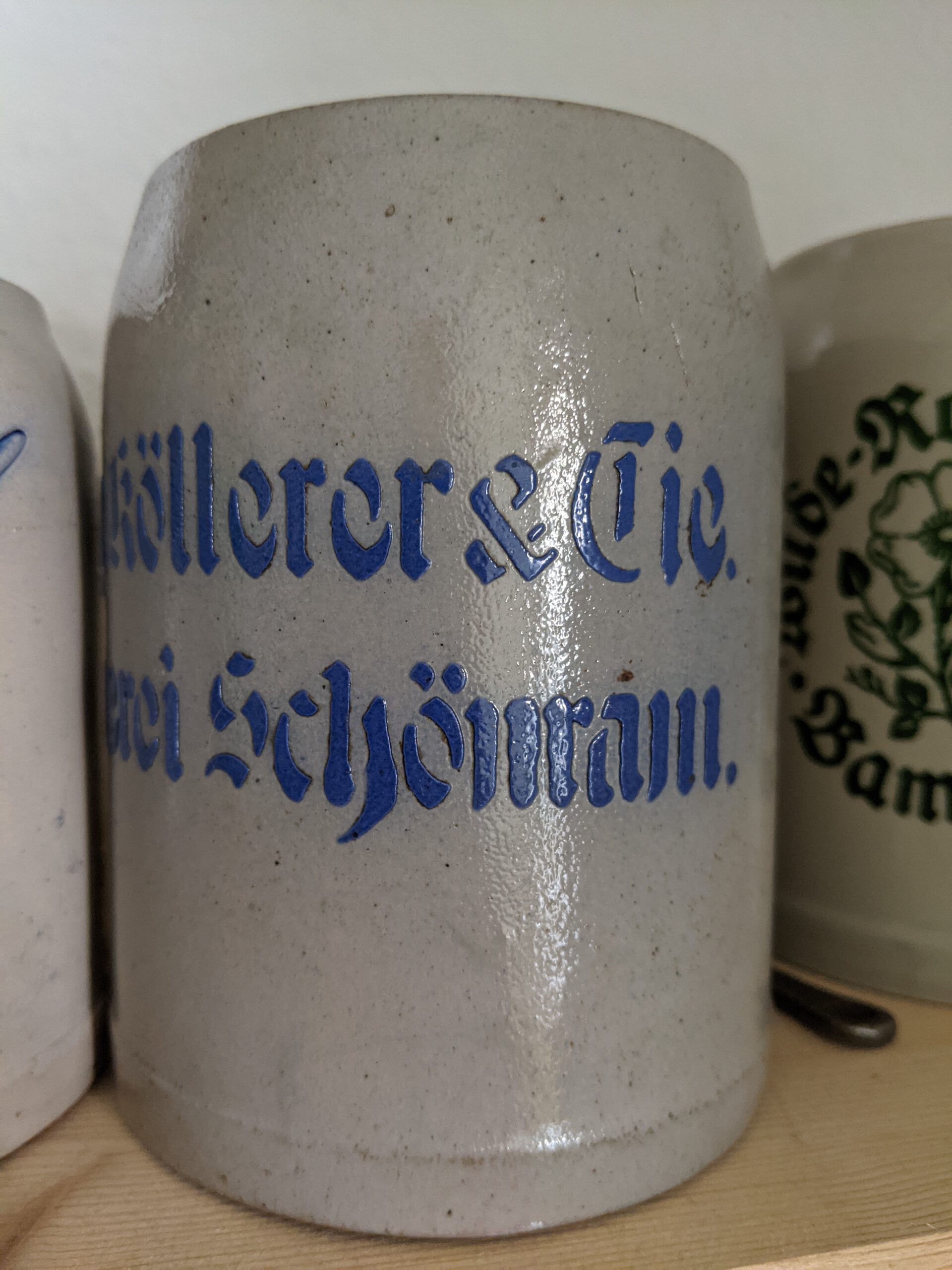
Most recently, we managed to win an online auction for a historic Steinkrug of one of our favourite breweries, Brauerei Schönram located in the Bavarian municipality of Petting, in particular a small settlement of it called Schönram. The Steinkrug that we got said “Franz Köllerer & Cie Brauerei Schönram” on it. From Schönramer’s own history on their website, I knew that the Köllerer surname has been connected with the brewery since 1780, the brewery’s official year of foundation when Jakob Köllerer bought the place, and only changed shortly before World War 2 when a daughter from the Köllerer family, Lisa, got married to Alfred Oberlindober.
So who was Franz Köllerer, and what does “Franz Köllerer & Cie” mean anyway? That whole thing got me down a bit of a rabbithole when I checked all my usual sources to see what I was able to find.
The earliest person named Franz Köllerer that I was able to identify was Franz Seraphim Köllerer, born on Sept 14, 1839 in Schönram. The Köllerer family must have been reasonably wealthy, as Franz was able to attend grammar school in nearby Salzburg. Schönram and Salzburg had been well-connected for quite some time, as Schönram was located on postal routes between Salzburg and Munich as well as Salzburg and Regensburg. According to a 1815 post manual for the kingdom of Bavaria, the local postman in Schönram was a certain Anton Köllerer.
Another sign of Franz Köllerer’s wealth is how well-travelled he was. Not only can his name be found in public records that he stayed in Salzburg, Linz and Graz several times during the 1860s and 1870s, a book titled “Deutscher Parlaments-Almanach” (German Parliament Almanac) credited him with having travelled abroad to Hungary, the principalities along the river Danube, Turkey, Asia Minor, Syria, Egypt, Greece and Italy.
“Why would he be mentioned in such a book?”, you wonder. Very simple: because he got elected as Member of Parliament to the German Reichstag in Berlin in 1874, for the district of Rosenheim, a role in which he served until he stepped down in 1877. According to Salzburger Chronik in 1874, he was “not a studied man” but a well-known man with a “healthy heart and mind from the midst of the German people”.
During his time as brewery owner, Brauerei Schönram must have been at a reasonable level of modernization. In 1870, it is cited as only one of two breweries in the region to have any sort of automation going on. In particular, the brewery had a steam engine, which not only was used for the brew kit, but also for crushing the malt. The brewery used an annual amount of about 2000 Scheffel of barley. The amount of beer that could be brewed from a certain quantity of barley was strictly regulated in Bavaria at the time, so we can roughly estimate how much beer was brewed annually, and it must have been roughly 7000 to 8000 hl. This is remarkably consistent with Schönramer’s “official” history on their website, which states that between 1900 and the 1960s, the brewery steadily produced about 7000 hl of beer every year.
Half of the barley that the brewery used was from the area, the other half was imported from Innviertel (Upper Austria), Moravia and Hungary. The hops that were bought were from the Bavarian hop regions as well as Bohemia, and more than 50 Zentner (2500 kg) were used every year. From that we can also derive the rough hopping rate of the typical beer brewed at Schönram, at 3 to 3.5 g/l.
Franz Köllerer died on January 26, 1879, in Schönram.
I was also able to find out about another Franz Köllerer. Unlike the previous one, he was indeed a studied man, an alumnus of Weihenstephan brewing school in 1894/1895. When he joined the alumni club of “Weihenstephaner” in 1903, he was credited as brewery owner in Schönram. He died from a stroke in 1915, aged only 41, which would make his year of birth 1874 or 1875. I haven’t been able to find out about how he was related to Franz Seraphim Köllerer, but it wouldn’t be unlikely if he was his son.
Franz Köllerer wasn’t the only brewery owner at the time, though. We know this because on August 1, 1900, the firm “Franz Köllerer & Cie Brauerei Schönram” was registered as a partnership, with a total of five business partners: Franz Köllerer, Anton Riedler, his wife Maria Riedler, and Wilhelmine and Seraphine Köllerer, the latter two described as adult brewery owner daughters. Judging from Franz Köllerer’s age, Wilhelmine and Seraphine were likely Franz Seraphim’s daughters.
And this is where we have the exact company name that is also on our Steinkrug. This at the very least helps us date it to the year 1900 or later.
After a bit of searching, I finally also understood was the “& Cie” stood for, it was short for “Compagnie”, and was used as a suffix for a particular type of company that was comprised of more than two business partners (five in Brauerei Schönram’s case). Nowadays, the suffix “& Co” would be more common in Germany.
Another partner, Anton Riedler, died in 1923, but only a few years later, in 1926, a new business partner makes his appearance in historic sources. Rudolf Nebinger, an Austrian retired cavalry officer of the Landwehrulanenregiment 4 stationed in Olomouc and veteran of World War I at Austria-Hungary’s Eastern front, who got engaged to Elsa Köllerer in 1917. His armed forces service is better documented than his work as brewery owner: in a registry book of regimental officers in 1911, he appears as First Lieutenant, when he got engaged in 1917, he had been promoted to Rittmeister (the cavalry’s equivalent to Captain), and he retired at some point, presumably at the end of World War I, as Lieutenant Colonel.
Another location they owned, Hotel Krone in Freilassing, also fell victim to fire: in the night of March 25-26, 1922, a defective oven caused the building to catch fire. Even the fire brigade from nearby Salzburg had to come and help extinguish.
Hotel Bavaria in Bad Reichenhall was also owned by the brewery and opened in 1890. They also owned two local train station restaurants, one in Piding (sold in 1926 to business man Matthias Schöndorfer), the other one in Hammerau.
And that was all I was able to find out in a few days research. While not representing a complete history of Schönramer brewery, I was still able to highlight a few more details about the owners over time, and in particular, was able to shed some light on the particular text on our Steinkrug.