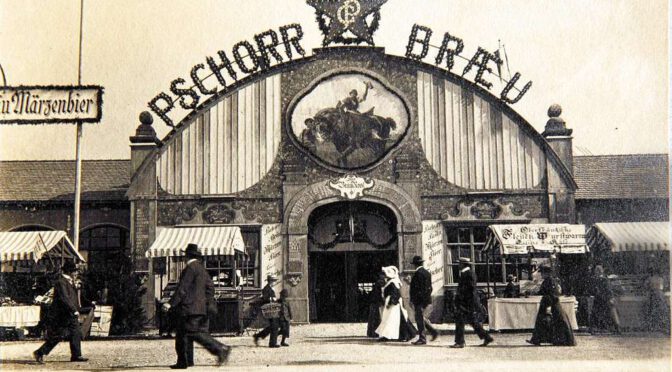
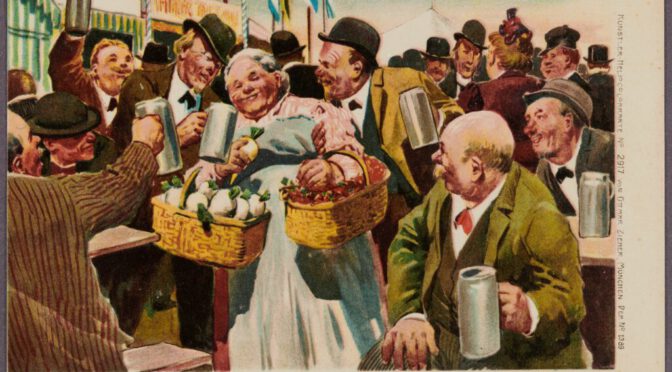
Tag Archives: munich

What is Märzen? A 1950 Court Case in Munich

In December 1949, the city administration of Munich filed criminal charges against the second brewmaster of Hofbräuhaus, Heribert Kraus. The alleged crime? Hofbräuhaus sold Märzen during Oktoberfest with less than the minimum 13°P original gravity, which according to the city administration violated food law.

During the investigation, it was found out that Hofbräuhaus had produced its Märzen not by brewing dedicated batches, but rather by blending 12°P beer with 16°P and 18°P export beers. Due to the error margins in that process, some of the beer had a calculated OG of slightly less than 13°P.

In February 1950, Heribert Kraus was put on leave due to the open investigation after he had requested so, the Bavarian finance ministry announced. What added to the political sensitivity was that Heribert Kraus was the son of Bavarian finance minister Dr. Hans Kraus, who at the time had announced that he would step down, but was still officially in charge. Minister Kraus officially stepped down due to health reasons, but was also indirectly involved in the “Blum affair”, in which he was accused of favouritism in making his son brewmaster of the state-owned Hofbräuhaus. Ironically, son Heribert uncovered this affair in which 790,000 DM and building material were provided by Hofbräuhaus for the reconstruction of the “Royal” hotel in Stuttgart, which had been the main destination for Hofbräuhaus in South West Germany prior to World War 2.

When the case about the adulterated beer went to trial, it was not only Heribert Kraus who was accused, but also Hofbräuhaus deputy technical director August Ott. In total, they were alleged to have served 5,876 hectolitres of Märzenbier below the typical OG range of 13-14°P. The prosecutors claimed that this was in violation of food law and a deception of consumers, while the defendants said that it was common to call blended beers below the minimum OG “Märzenbier” as long as they had a “Viennese colour”, and that an error margin of about ±0.5°P was unavoidable.

In June 1950, both Heribert Kraus and August Ott were found guilty of selling adulterated beer below the minimum OG, thus deceiving consumers, and were fined to pay DM 800 and DM 200 each. Their defence, though unsuccessful, was that Märzen was defined by its alcohol content, colour and wholesomeness, while prosecutors pointed out that consumers didn’t want to be served blended beer, no matter how good it tasted.

Effectively, the court in this verdict clarified that Märzen, at least in Bavaria, was defined by its original gravity between 13 and 14°P, not by its colour or alcohol content.

Early Munich Helles

This is not the story of the earliest Munich Helles, an apparent hype of pale lager beer from the 1820s until the early 1840s, during which most of the Munich breweries brewed a relatively pale lager, though it is not clear how pale, before they reverted back to brewing dark lager.

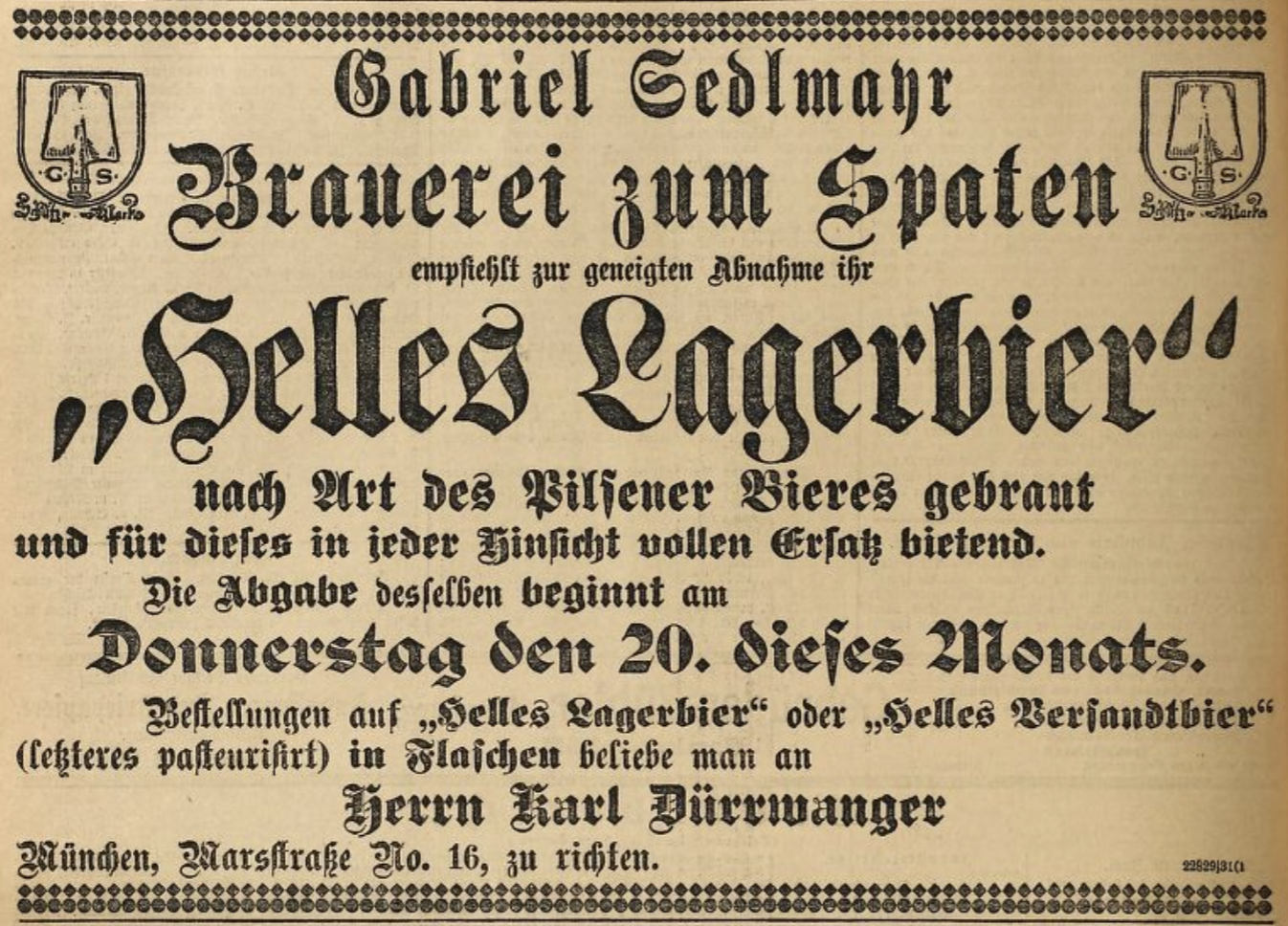
Instead, this is the story about modern Munich Helles, the stuff that’s popular these days and has become the standard beer of Munich and really, much of Bavaria. This beer style can be traced back to a very specific brewery and a very specific date: it was Spaten Helles Lagerbier, first released in Munich on 20 June 1895.

An ad for Spaten Helles Lagerbier that appeared on 20 June, 1895 in Augsburger Postzeitung
An ad for Spaten Helles Lagerbier that appeared on 20 June, 1895 in Augsburger Postzeitung (source)

Spaten didn’t just release this beer, but instead were testing it in other markets. In particular, they served it at “Ronacher’s Bierausschank” in Hamburg as early as 1894, which probably was Restaurant Spatenbräu on Hermannstraße 26, run by Jakob Ronacher.

The first commentary in an industry publication that I was able to find was an article in Wochenschrift für Brauerei, published by VLB, dated 19 July 1895, which directly compared it to both Pilsner and Dortmunder, and noted that while Bavarian industry publications have not published anything about it yet, Munich newspapers called it a “natural progression” of Munich beer, while the VLB publication called it a “beer-political event of the first order”, whatever that meant exactly.

The 1898 edition of Brockhaus Encyclopedia contains some analytical data, and if we believe it, this Helles was a quite odd: with an OG of 11.7°P (1.047), it only had 2.69% ABW (3.36% ABV) and a meagre 45.7% real attenuation. Compared to Munich Helles nowadays, it must have been very sweet.

But the Wochenschrift für Brauerei on 20 December 1895 contained analytical data of two brands of Helles (anonymised as “pale Bavarian beer” no. 1 and no. 2), with an OG of 12.37°P and an ABW of 3.45% (4.31% ABV) for the first beer and an OG of 13.2°P and an ABW of 3.8% (4.75% ABV), which paints a slightly different picture. Even though it was still not as highly attenuated as modern beers, with 53.5% and 55.3% real attenuation, it’s closer to a regular dark lager in Munich at the time in terms of OG and attenuation.

By 1902, the beer style seems to have developed a clearer profile, at least that’s what the analytical data in Bayerisches Brauer-Journal suggests: by that time, 15 different Helles were brewed in Munich. Compared to the Dunkel beer brands at the time, the Helles was on average brewed 1°P weaker (average 13.52°P for Dunkel, 12.35°P for Helles) and was slightly more attenuated (51.79% for Dunkel, 57.32% for Helles). The authors of Bayerisches Brauer-Journal also emphasised that the data shows that the Munich Helles isn’t just an imitation of other, foreign pale lagers, or a “characterless beer like it’s brewed oftentimes in other places”, but rather its very own distinct beer type.

And while this beer type was established by the early 20th century, it didn’t mean that it was the most popular. Between the beer’s launch in 1895 and the beginning of World War 1, Spaten’s beer production was never more than about 10% (Christian Schäder, Münchner Brauindustrie 1871-1945, p.92). This was virtually the same for other Munich breweries. Only Thomasbräu was different, as their Helles allowed them to increase annual output from 75,000 hl in 1895/1896 to nearly 200,000 hl in 1913/1914.

Interestingly, Spaten and Sedlmayr did not consider themselves innovators: in 1907, Carl Sedlmayr freely admitted that Munich breweries had already brewed pale lager beer from the 1820s until the 1840s, and that after that, Spaten brewed a pale Vienna-style lager (at least paler than Munich Dunkel) for the French market in the 1860s. Sedlmayr even specifically rejected a proposal to sue Thomasbräu for registering the trademark “Urtyp” (“original type”) because he did not think of Spaten as the inventors of pale lager beer in Munich, and instead credited Franziskaner-Leistbräu and their pale Märzen that they introduced in 1871 as an earlier pale lager from Munich. Carl Sedlmayr himself thought that only Franziskaner-Leistbräu or Hackerbräu (which had introduced a pale “Hacker-Gold” in 1893 that was likely a Vienna-style lager) would have a chance to challenge Thomasbräu’s “Urtyp” trademark (Schräder, pp.97-99).

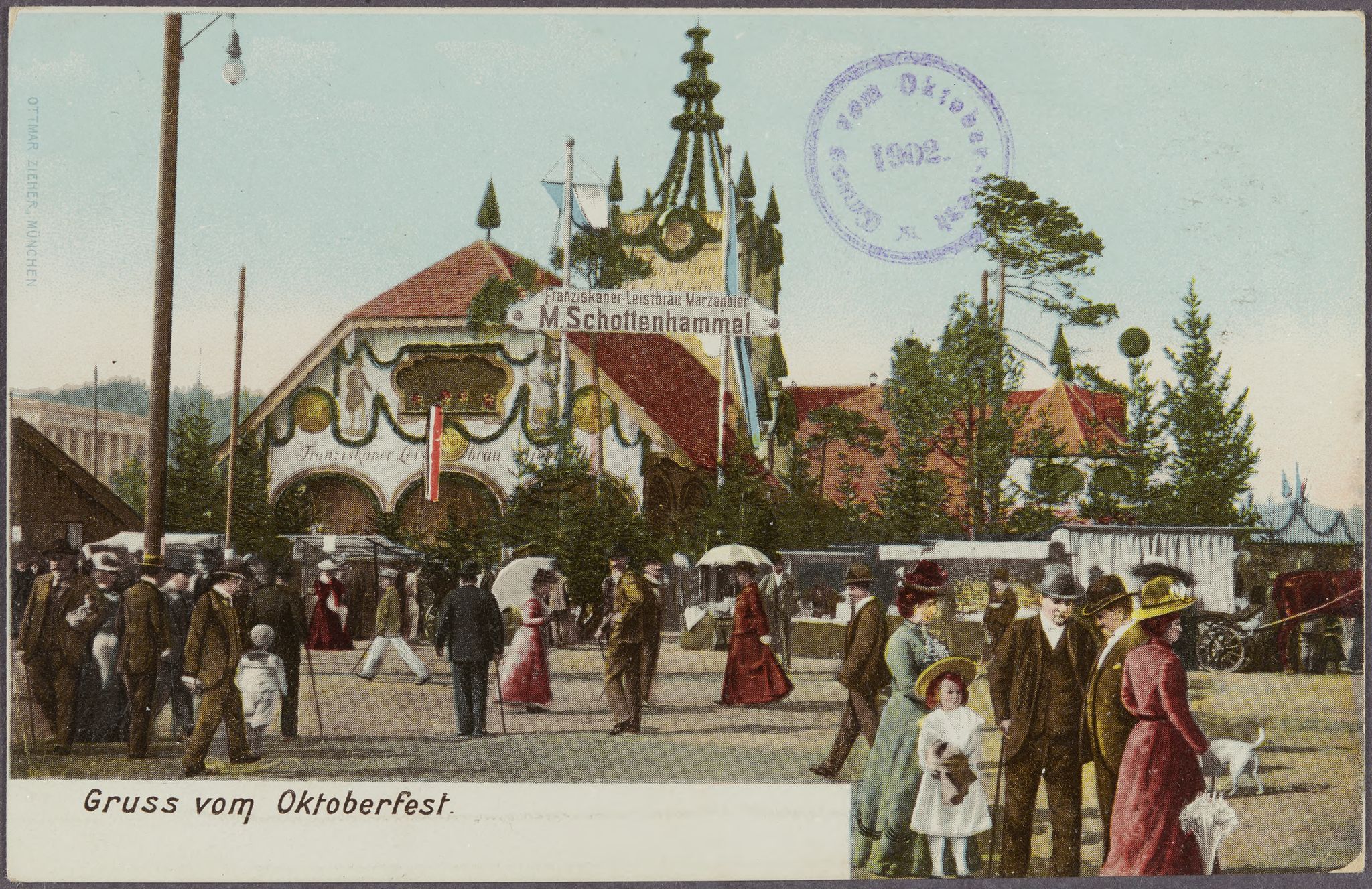
The Schottenhammel tent at Oktoberfest advertising Franziskaner-Leistbräu Märzenbier, ca. 1902 (source; CC0 license)

Early Vienna Lagers not from Vienna

This whole Vienna Lager topic still somehow has me captivated, even 11 years after I first looked into the historic beer style, and almost 6 years after I released my book about the (mostly) complete history of Vienna Lager.

As some of you probably already know, the Oktoberfest Märzen style started out as a strong “pale Viennese” style lager beer brewed by Josef Sedlmayr’s son Gabriel at Franziskaner-Leistbräu in 1871, after he had returned from vocational training at the Dreher brewery in Kleinschwechat. Because of a beer shortage in Munich due to the hot weather, Michael Schottenhamel, who operated a beer stall at Oktoberfest, approached Josef Sedlmayr, who could promptly offer him this Vienna-style lager. It required a permit to sell this stronger-than-normal beer, but once that went through, it was branded as “Märzenbier”, reviving an old term that had been applied to any lager or “summer” beer in Munich until 1799. The rest is history.

Prior to that, Vienna Lager had already been fairly popular in Southern Germany. In my 2020 book, the examples I mentioned were Vienna Lagers by Munich breweries Hackerbräu and Löwenbräu, as well as one from Würzburger Hofbräuhaus and another one from Mainzer Aktien-Bierbrauerei.

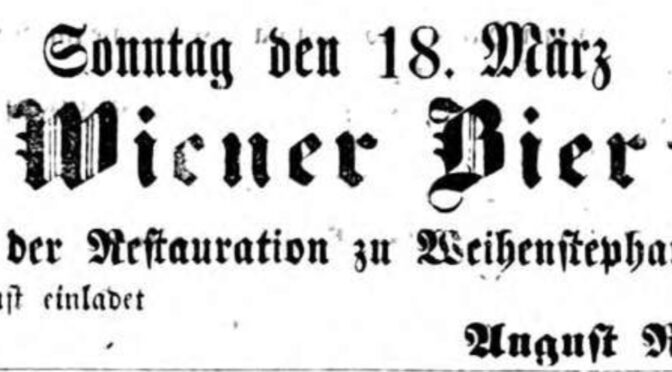
What I hadn’t looked into in detail at the time was which one was the first “Vienna Lager” brewed outside of Austria. At least the German-speaking sources that I’ve been able to consult point towards two breweries that successfully brewed the style quite early on. One was brewed at Weihenstephaner brewery in Freising, during the 1865/1866 brewing season. A first report about that was published on 25 March 1866, mentioning that the brewery had also brewed beer according to the “Viennese method”, and that experts who had recently tried the beer could confirm that it was equal to Vienna Lager in terms of purity, taste and colour.

Very similar news were reported on 6 April the same year about the brewery of Mr. Müller in Drachselsried in the Bavarian Forest, who had also used the Viennese method and also produced a beer equal to the original. And Kemptner Zeitung on 4 April 1866 noted that Viennese beer is slowly gaining acceptance in Bavaria, mentioning Weihenstephaner brewing both Bavarian and Viennese-style beer for this first time.

On 15 December 1867, an ad for Vienna Lager at Hackerbräu was published in a Munich newspaper. In the 1867/1868 brewing season, Vienna Lager really seemed to have taken off in Munich. The Münchner Anzeiger newspaper on 1 January 1868 contained a page half of which were just ads for Vienna Lager. The beers mentioned on the page were Spatenbräu Bock (2 ads, 1/3 of the page) and Löwenbräu “Vienna Beer”, “Vienna Lager” or “Vienna Export Beer” (4 ads, 2/3 of the page).

In 1870, Vienna Lager was also served (and presumably brewed) at the Jagenlauf brewery in Stadtamhof, nowadays a district of Regensburg. And by 1872, a “Mainzer Wiener-Lagerbier” (that’s one way of fitting two place names into a name) was sold in Mainz.

So was Weihenstephan-brewed “Viennese-style lager” the first Bavarian-brewed Vienna Lager, probably even in all of Germany? We can’t know for sure, but it’s at least it’s the first one for which I’ve been able to find hard evidence. The style itself definitely caught on when at least two Munich-based breweries started brewing the style, and by the 1870s, it had spread to other parts of Bavaria and Southern Germany, when a strong version of Vienna Lager became the template for Oktoberfest-Märzenbier that is nowadays internationally mainly known as “Märzen” and was served at Oktoberfest until the 1980s when the paler Festbier took over in popularity.

(Some) Beers at the Oktoberfest in the 1960s

This is going to be my last Oktoberfest post for a while, I swear! But I got some good stuff: I stumbled upon Schmankerl Time Machine, a project of Digital Humanities Virtual Laboratory at Munich University from a few years ago to digitise historic restaurant menus from Munich, from 1855 until the 1980s, and make them available online. This of course also contains menus of some of the Oktoberfest tents, which also mentioned beer types, and I quickly wanted to list.

Bräu-Rosl lists all the Pschorr beers on their 1965 menu (Edel-Hell, Export-Dunkel, Märzen, Bock, Stern-Weiße, Animator, St. Hubertus, Pschorr-Malz-Bier), but I don’t think all of those were actually sold there. The menu does have two beer names at the very top, though, Bräurosl-Wiesn-Märzen and Pschorr-Edel-Hell, so I assume that’s what was actually served. Hacker-Pschorr (in 1965, Hacker and Pschorr hadn’t merged yet) nowadays still serve an Edel-Hell from wooden cask at some of their beer halls.

The menu the same year at Fischer Vroni contains lots of advertising , including one for Augustiner Brauerei, listing some of the beers: Export-Bier dunkel, Edelstoff hell, heller Augustiner-Bock, St. Augustin-Maximator, and Oktoberfest-Märzenbier. Augustiner was served at the Augustiner Festhalle and Fischer Vroni, but it’s not clear which exact beers. So this did not give us much insight beyond the general Augustiner portfolio at the time.

Hippodrom in turn had two beers on their menu: Spatenbräu helles Wiesenbier, and Spatenbräu Champagner Weißbier. The latter would nowadays be called Kristallweizen, but this was 1965, before PGI and PDO, around the time when French winemakers only started complaining about the misuse of what they thought exclusively described sparkling wine from the Champagne region.

Hofbräuhaus only started participating at Oktoberfest in 1955. Ten years later, they served two beers: helles Festbier and Wies’n Märzen.

Löwenbräu served two beers in 1961: Wies’n Märzen and Export hell. They also have a bold warning text on their menu that if your Maß was under-poured, you’re kindly asked to have it properly filled up to the line. I’m not sure that would have been exactly popular with the waitresses.

Ochsen Braterei in 1965 unfortunately only had the logos of two brands on their menu, Paulaner and Thomasbräu, but in reality both of them were brewed by the same brewery. So maybe they had beers of both brands? I can’t say for sure.

Winzerer Fähndl, also known as the Paulaner-Thomasbräu-Festhalle, made this a bit clearer: they at least mention concrete beers next to both brands’ logos, namely Paulaner Märzen and Thomasbräu Hell-Urtyp.

And that’s it. Far from all the breweries or tents at Oktoberfest at the time, but we still see a general trend: a lot of them served more than just one beer, quite often both a Märzen and a Helles Export or Festbier. In the case of Hippodrom, wheat beer was also served. All very different from Oktoberfest nowadays.

The Scandal of Oktoberfest’s First Giant Tent

As I showed in my previous blog post, Oktoberfest didn’t feature massive tents, only moderate stalls. From the 1888 Bayerische Gastwirths-Zeitung we learn that the maximum measurements that year were 4.4m height, 7.3m width and 10m length. Compared to nowadays, very small in size.

This changed in 1898, when Georg Lang managed to establish the very first Riesenhalle at Oktoberfest, to the displeasure of the other traditional Oktoberfest restaurateurs. Interestingly, the 1898 issues of the Bayerische Gastwirths-Zeitung give a lot of insight into how the whole scandal unfolded in detail, and what the fallout of it was.

Like every year, the Oktoberfest stalls were all auctioned off by the city of Munich, on 10th August 1898 at 3pm at Circus Bavaria (page 256).

On 14th August, the auction winners were published in Gastwirths-Zeitung (page 264). 3 stalls went to Löwenbräu, 1 to Zacherlbräu, 2 to Augustiner, 2 to Pschorrbräu, 2 to Spatenbräu, 1 to Dreher, 2 to Hackerbräu, 1 to Salvatorbrauerei, 1 to Eberlbräu, 1 to Thomasbräu, 1 to Kochelbräu, 2 to Bürgerliches Bräuhaus, 1 to Unionsbräu, and 5 to Münchner Kindl Brauerei.

On 28th August, Gastwirths-Zeitung reported (page 282) that 5 restaurateurs had applied for a permit to combine their stalls into a single large tent, to be able to serve the same beer together, Münchner Kindl. This request was denied.

On 4th September, it was reported (page 288) that the 5 petitioners from the week before had submitted a complaint that they’d have financial damages if they had to run the 5 stalls themselves instead of combining them into a single tent. They claimed that administrative counsellor (Verwaltungsrat) Nagler had promised them that the magistrate would grant a permit for combining their stalls, and that it was the reason why they even took part in the auction in the first place. They were nevertheless willing to compromise by combining their 5 stalls into 2 large stalls that are separated by a wide passageway. Counsellor Nagler denied any kind of promise and said that he had only mentioned that it depended on the magistrate’s decision.

At the same time, Nagler found it strange that the other restaurateurs did not want to bid on the stalls that had gone to Münchner Kindl Brauerei, but now that there were rumours that the 5 restaurateurs were just strawmen of the brewery and that the whole operation should be handed off to someone entirely else, they suddenly started complaining. Counsellor Heindl in the meanwhile pointed out that the change to 2 large stalls on the site of the 5 stalls was against the rules of the auction. Nagler also insisted that if he had known that a “stranger”, Georg Lang from Nuremberg, would get involved, he would have entirely been against it from the beginning, especially since the rules of the auction stated that only someone with a local licence to trade could successfully bid on a stall, and Lang did not have such a licence.

Counsellor Hübler interjected and asked why Dreher then had gotten a stall. Nagler replied that Dreher at least owned a beer hall in Munich, and that it was not the brewery, but rather the tenant restaurateur at Dreher’s beer hall who would operate the Dreher stall at Oktoberfest.

In the end, it was decided that the 5 restaurateurs got the permit for 2 large stalls, with only one vote against it by counsellor Heindl.

In the same issue (page 290), it was announced that Georg Lang, restaurateur of “zum Krokodil” in Nuremberg would “visit” the Oktoberfest together with his house band, and that he would take over managing the stalls that were provided by “a local brewery”.

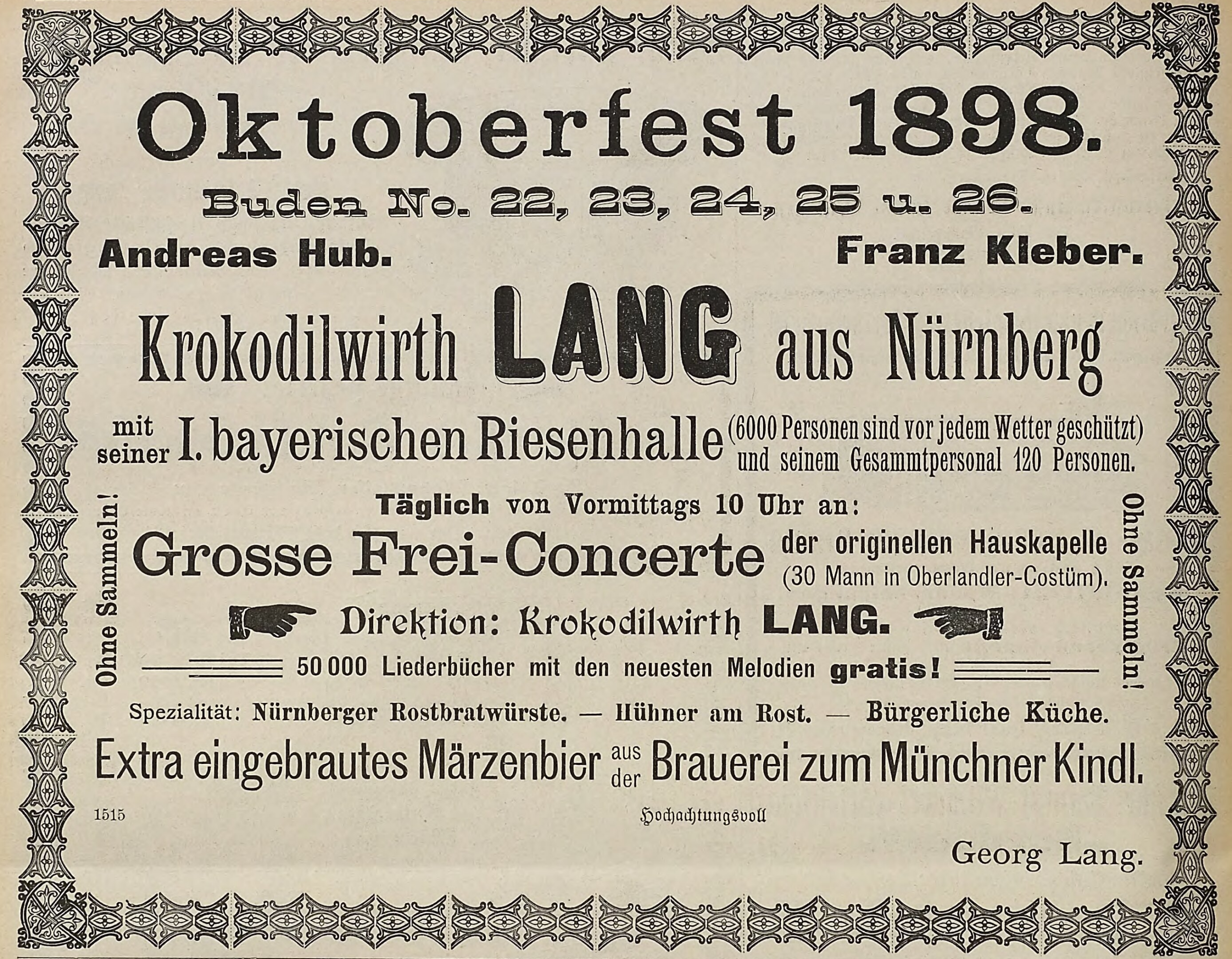
On 25th September (pages 314, 316) it was announced both as an ad and in a dedicated article that Georg Lang would officially operate a Riesenhalle, a giant hall with enough space for 6,000 guests, served by a total of 120 personnel, and entertained by his 30 musician house band. A total of 50,000 song books were printed and handed out for free to the guests. The ad even reveals that the giant tent span over the spaces of the stalls 22, 23, 24, 25 and 26, exactly the 5 that had been won by strawmen of Münchner Kindl Brauerei.

Half-page ad for Georg Lang's "first Bavarian giant hall" at Oktoberfest 1898, advertising the tent size, free concerts, the free song books, and food and drink: Nuremberg sausages, grilled chicken, traditional cuisine, accompanied by "specially brewed Märzenbier" from Münchner Kindl brewery. The ad also contains the names of two strawmen, Andreas Hub (stall 24) and Franz Kleber (stall 25).
Half-page ad for Georg Lang’s “first Bavarian giant hall” at Oktoberfest 1898, advertising the tent size, free concerts, the free song books, and food and drink: Nuremberg sausages, grilled chicken, traditional cuisine, accompanied by “specially brewed Märzenbier” from Münchner Kindl brewery. The ad also contains the names of two strawmen, Andreas Hub (stall 24) and Franz Kleber (stall 25).

A few weeks after the Oktoberfest, on 23rd October, the Wiesn restaurateurs formed a commission consisting of 3 of their peers, namely Ludwig Blößl (no. 10, Augustiner), Josef Fendt (no. 17, Unionsbräu) and Alois Wohlmuth (no. 19, Pschorrbräu), accompanied by a lawyer, to pursue the case they thought they had against the city (page 346). The plan was to initially try to find a way to settle with the city magistrate of Munich, but if that didn’t bring an acceptable result, they planned to sue for damages of an estimated 10,000 to 15,000 Mark (for comparison: the city’s total earnings from auctioning off all stalls were 37,500 Mark in 1898).

This was not very successful: the restaurateurs indeed went to court and sued for damages of 15,690 Mark, which was rejected on 24th April 1899. The Wiesn restaurateurs appealed, but also in appellate court in December that year, their appeal was rejected and they had to bear all court costs.

In the end, the big tents were here to stay, and they changed the Oktoberfest to what it is nowadays. But at the time, the whole thing was a big scandal for the Munich restaurateurs, while the Münchner seemed to have liked it.

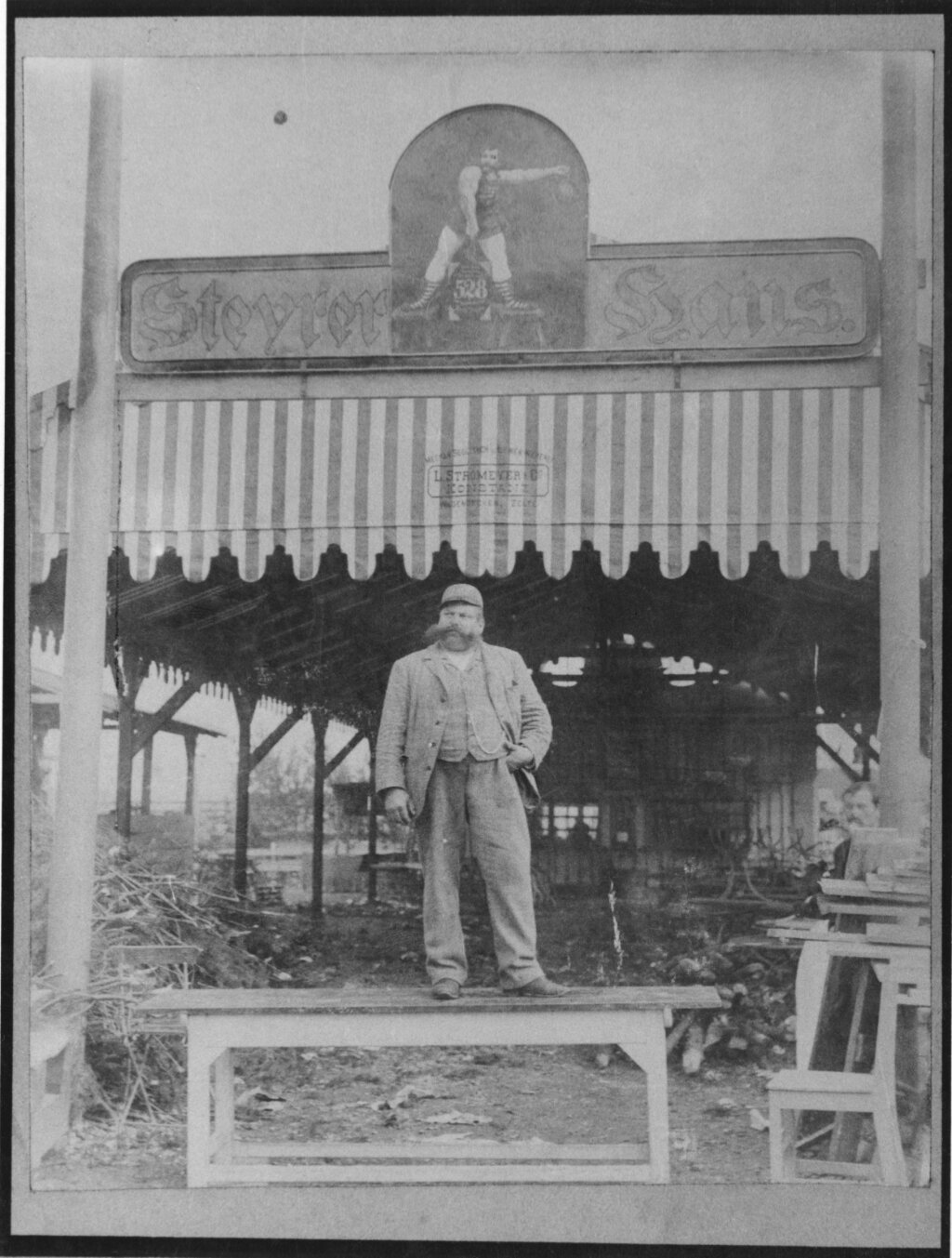
By 1900, Lang was fully accepted in Munich: that year, the Oktoberfest restaurateurs founded their own association of Wiesn restaurateurs, and unanimously elected Georg Lang to be their first chairman. Counsellor Nagler was made honorary president, while the illustrious Steyrer Hans became secretary.

Georg Lang died on 4th October 1904, just 38 years old, from bowel cancer.

Steyrer Hans, ca. 1895
Steyrer Hans, ca. 1895 (source; licensed under CC-BY-ND 4.0)
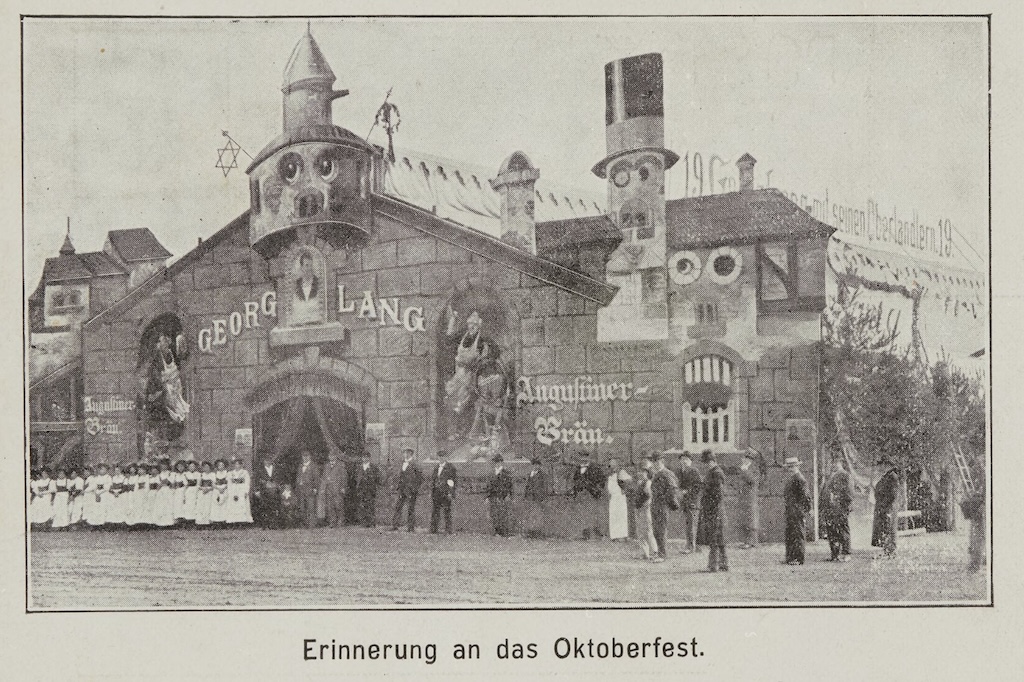
Postcard showing Georg Lang's tent, ca. 1900
A postcard depicting Georg Lang’s Oktoberfest tent, ca. 1900 (source; licensed under CC0)
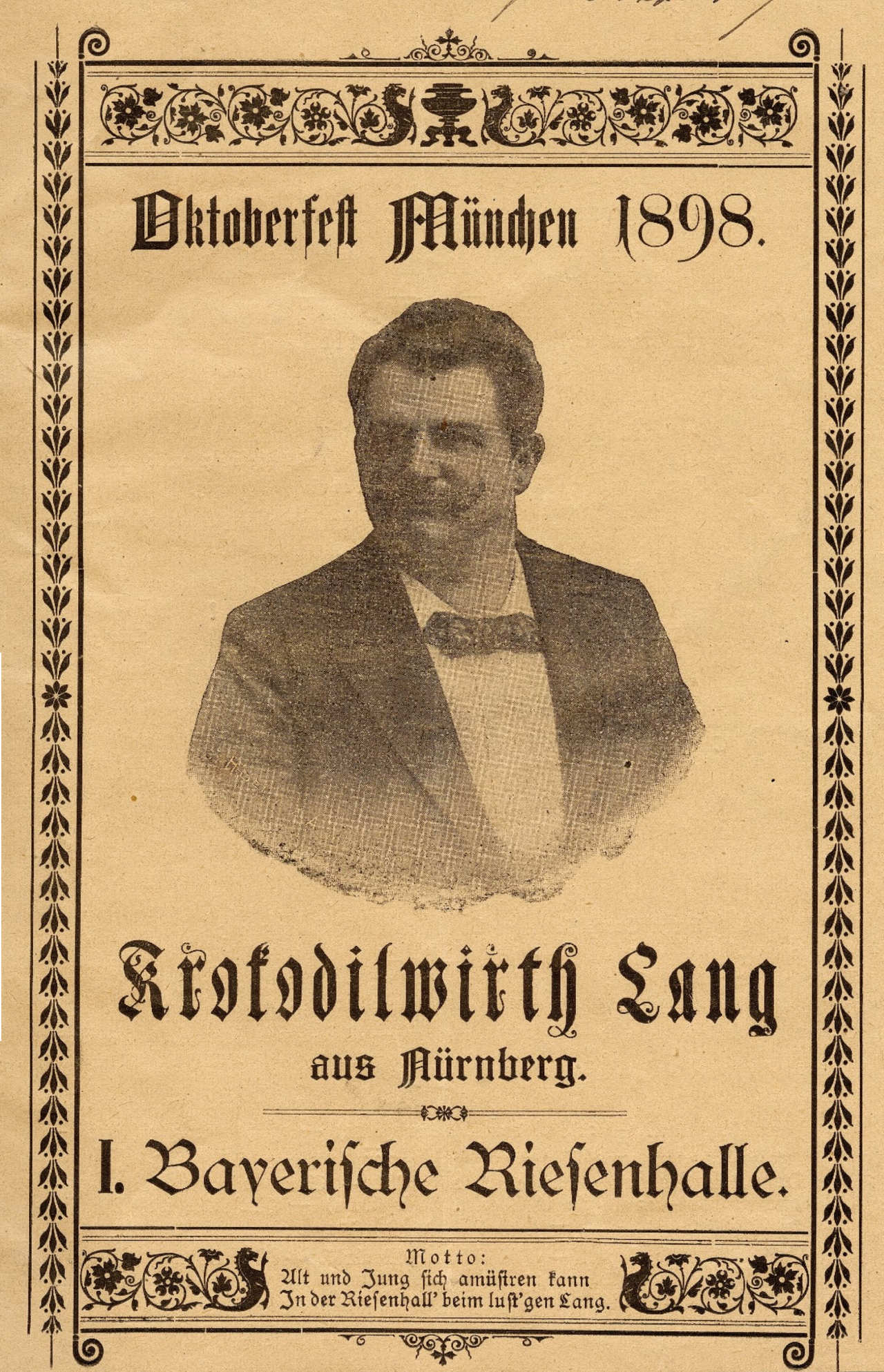
Cover of the song book handed out for free in his tent in 1898
Cover of the song book handed out for free in his tent in 1898 (source; licensed under CC0)

Beers at Oktoberfest 1895 and 1896

I’ve previously written about beer at Oktoberfest, like which breweries’ beers were served in 1843, or about various breweries and beers between 1882 and 1936 that we know of from Oktoberfest programmes and newspapers.

The whole question interests me for a particular reason: it shows that the current restrictions on beer at Oktoberfest, namely that it can only be from one of the “traditional” breweries from Munich whose beer conforms to the Oktoberfestbier PGI regulations, which requires them to have a well going several hundred metres deep down, are not rooted in the festival’s own history. It is essentially a form of regulatory capture to make it exclusive to Munich’s big 6 beer brands that has been successfully defended in court before. German online magazine Legal Tribune Online has criticised the restrictions of market access as a “cartel” in the past, and how the city of Munich may possibly be violating antitrust laws with the current practice.

The reality is that beer used to be much more diverse in the 19th and early 20th century than it is nowadays. But if you want to experience a traditional Volksfest with 20+ different beers available, you need to go to e.g. Forchheim for Annafest, because Oktoberfest is not that place anymore.

The two years 1895 and 1896 are in my opinion particularly interesting because there were quite a few really unusual und (at least from our modern perspective) unexpected breweries present in Munich:

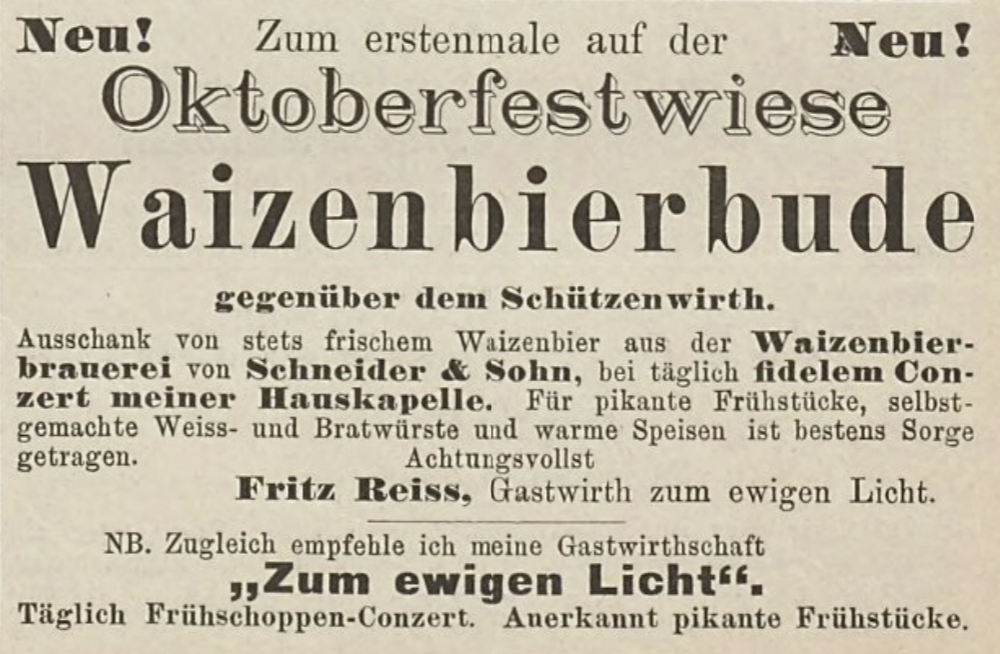
There was of course the Dreher brewery from Kleinschwechat, the original inventors of Vienna Lager, who were first able to serve their beer at the Wiesn’n in 1895. The same year was also the very first time a dedicated Weißbier stall was allowed, the rights for which were won in an auction by restaurateur Fritz Reiss, who then served wheat beer by G. Schneider & Sohn. And then there were specialities like Thomasbräu serving their Pilsner in addition to the regular Märzenbier.

An ad for the "Waizenbierbude" (wheat beer stall) in 1895.
An ad for the “Waizenbierbude” (wheat beer stall) in 1895. (Source)

As I’m still working on my upcoming book, I got a bit sidetracked today while researching a few details to tie up some loose ends, and came across a lot more detailed list about all the beer stalls at the Oktoberfest 1895 and 1896, and it shows how great the variety in beer and breweries was back then. So here’s the list of all breweries that were served at the beer stalls 1 to 26:

  1. Franziskaner Leistbräu
  2. Zacherlbräu
  3. Gambrinusbrauerei
  4. Löwenbräu
  5. Pschorrbräu
  6. Löwenbräu
  7. Münchner Kindl
  8. Spaten
  9. Dreher, Kleinschwechat near Vienna
  10. Bergbräu (Henninger), Munich-Giesing
  11. Münchner Kindl
  12. Salvator-Brauerei
  13. Kochelbräu
  14. Thomasbräu
  15. Hacker
  16. Bürgerbräu
  17. Augustiner
  18. Thomasbräu
  19. Pschorrbräu
  20. Pschorrbräu
  21. Pschorrbräu
  22. Pschorrbräu
  23. Pschorrbräu
  24. Pschorrbräu
  25. Pschorrbräu
  26. Pschorrbräu

In addition to that, there was also the wheat beer stall that was unnumbered and actually a bit away from the other beer stalls, that served G. Schneider & Sohn.

And yes, that’s a lot of Pschorrbräu stalls! The source with all beers as well as a list of all the restaurateurs and how much they paid at the auction can be found in the Bayerische Gastwirths-Zeitung issue dated 25 August 1895. At the time, the beer of some stalls was not known yet (such as stall no. 3 and 9), and for no. 25 the beer changed later. We know this from ads for these particular stalls that were published in the official Oktoberfest programme.

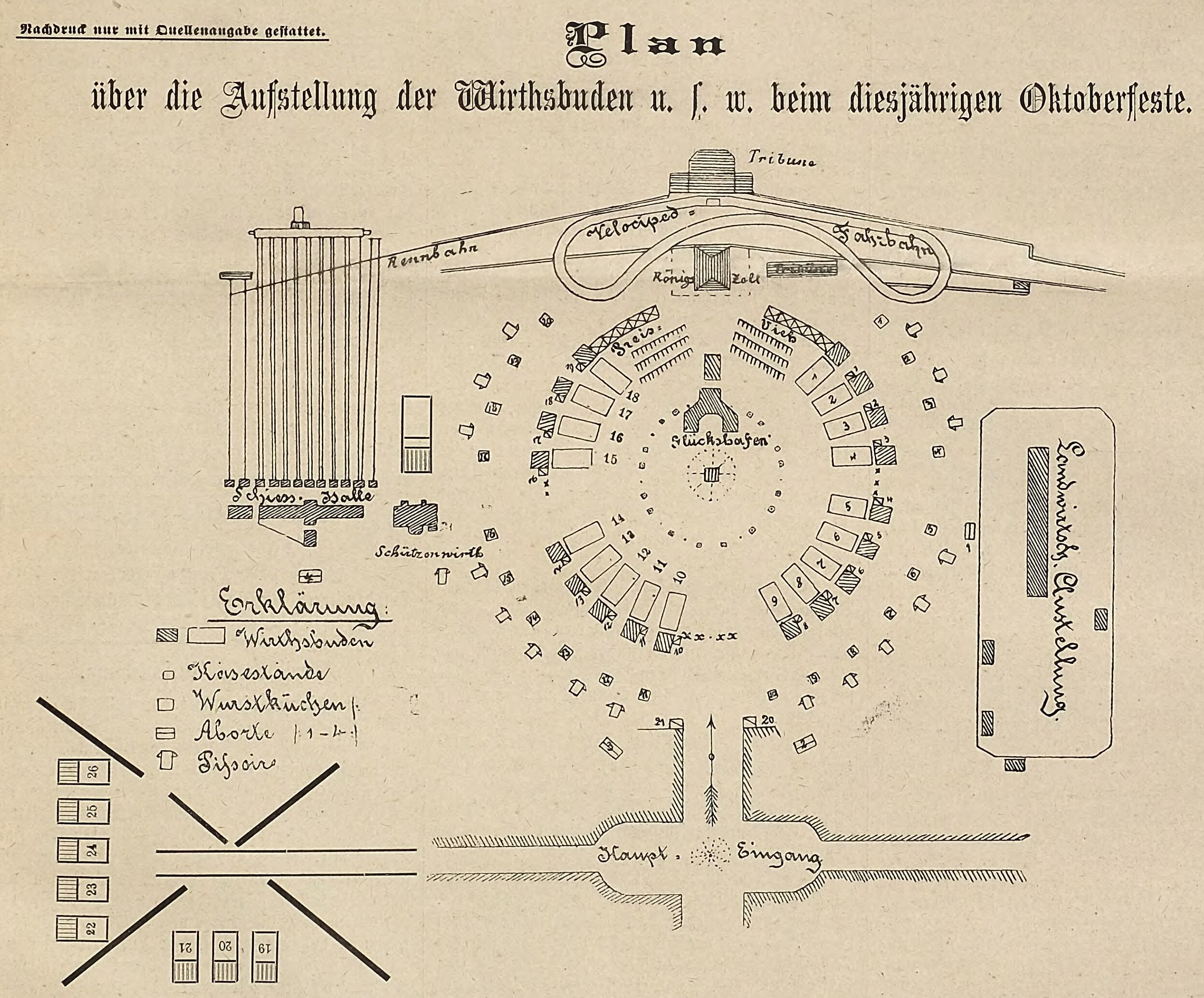
We even have a plan that shows the layout how all the stalls were laid out on Theresienwiese:

Map with the locations of all the stalls at Oktoberfest 1895, including all beer stalls, cheese stands, sausage stands, toilets and urinals.
Map with the locations of all the stalls at Oktoberfest 1895, including all beer stalls, cheese stands, sausage stands, toilets and urinals. (Source)

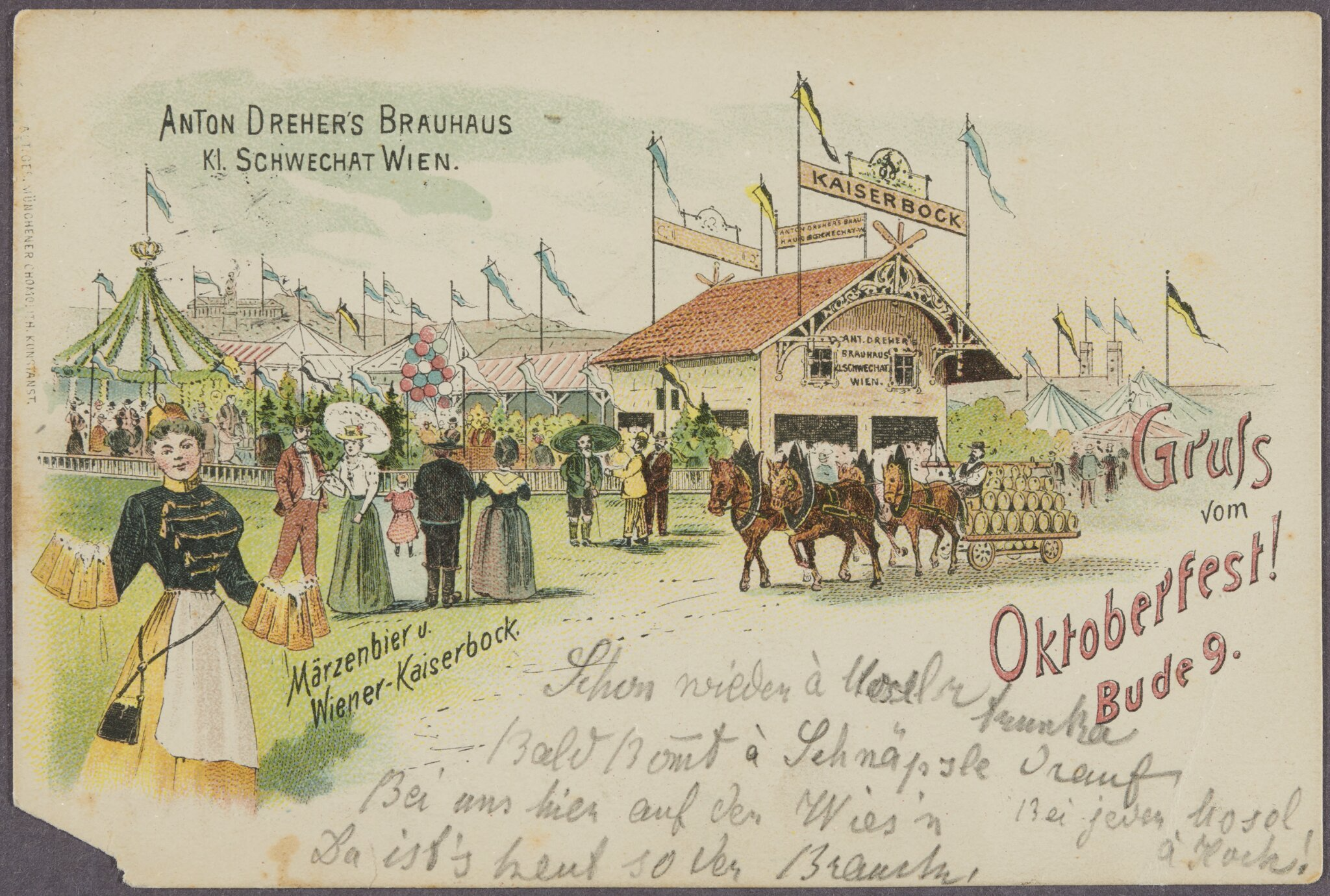
These stalls at the time were nothing like the modern massive beer tents. You can get a good idea what these beer stalls were like from this 1897 postcard of the Dreher beer stall:

1897 postcard showing the Dreher beer stall at Oktoberfest. It shows a waitress in black and yellow uniform carrying beers, a dray with beer casks, the beer stall itself with a beer geraden behind it, Oktoberfest visitors, and other tents in the background. The beers advertised were Märzenbier and Wiener Kaiserbock
1897 postcard showing the Dreher beer stall at Oktoberfest. It shows a waitress in black and yellow uniform carrying beers, a dray with beer casks, the beer stall itself with a beer geraden behind it, Oktoberfest visitors, and other tents in the background. The beers advertised were Märzenbier and Wiener Kaiserbock (Source)

In 1896, the choice in beers slightly changed compared to the previous year:

3. Kochelbräu
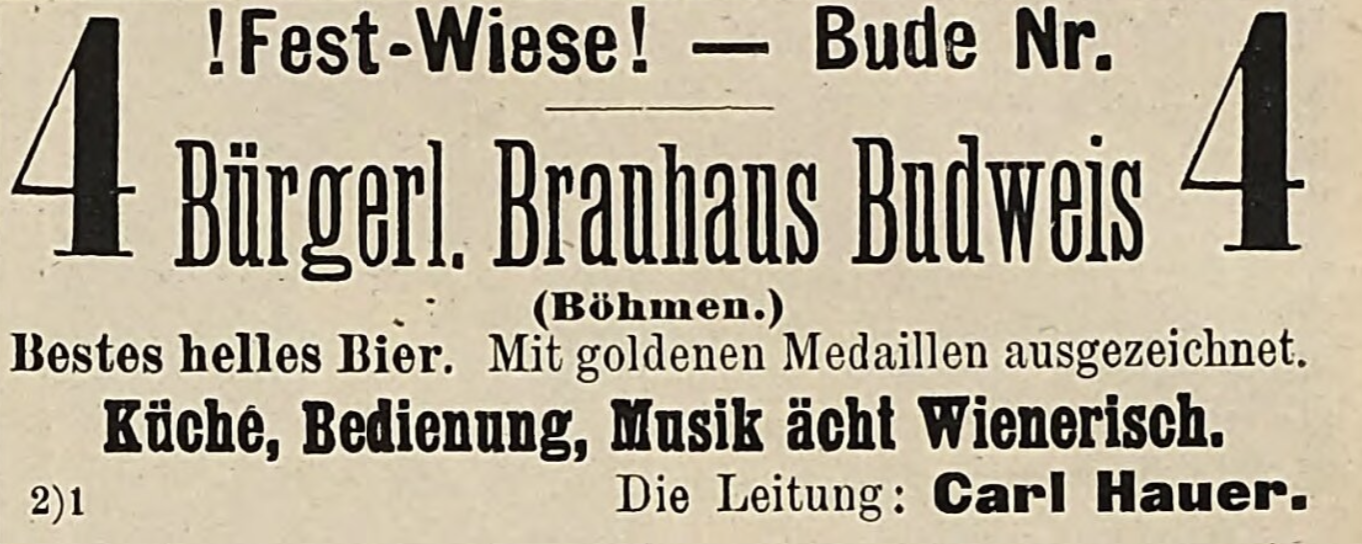
4. Bürgerliches Bräuhaus Budweis (yes, Bohemian beer at Oktoberfest!)
10. Augustiner
11. Hackerbräu
16. Pschorrbräu
17. Spatenbräu
19. Kulmbacher Export
20. Augustiner
21. Hackerbräu
22. Unionsbräu
24. Klosterbräu
25. Hackerbräu
26. Bürgerbräu
27. Pschorrbräu

(Source)

Interestingly, the wheat beer stall is not listed or mentioned anywhere, but still appears on the map of stalls in 1896 opposite the Schützenwirth, next to the shooting range.

1896 ad for Bürgerliches Brauhaus Budweis at stall no. 4 (Source)

At least in the years 1895 and 1896, it was not unusual to have “foreign” beer from outside Munich served at Oktoberfest, like Vienna Lager/Märzen from Dreher, pale lager beer from Budweis, or Franconian lager from Kulmbacher Export brewery.

Oktoberfest Beer at Oktoberfest: Does the Difference Even Matter?

Working for a Munich-based startup (though in my case, remotely from Berlin) comes with a few perks. One, travelling to Munich a few times a year for work, two, going to Oktoberfest with my work colleagues because that’s apparently what any respectable Munich company is meant to do.

2025 has been my third Oktoberfest in a row now, each year in a different tent serving a different beer brand, in particular Marstall Zelt (Spaten), Augustiner Festhalle (Augustiner) and Schützen-Festzelt (Löwenbräu). While I don’t have a comprehensive overview over all the beer brands, 3 different beers are still half of them.

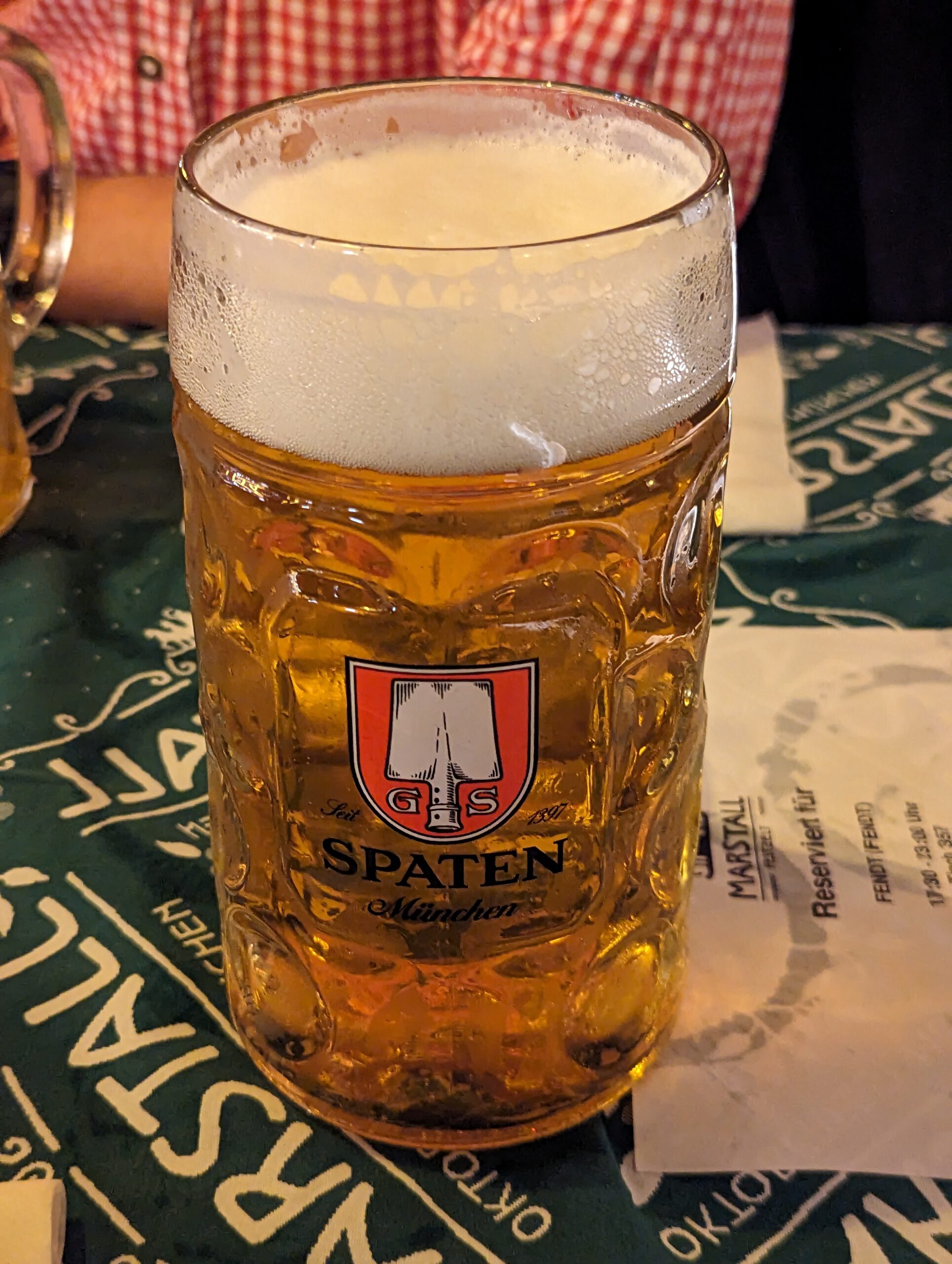
A Maß of Spaten Oktoberfestbier at Marstall Festzelt, 2023

Last year, in the weeks before Oktoberfest, I actually attended a guided Oktoberfest beer tasting, where I was able to try out all six beers (Augustiner, Spaten, Löwenbräu, Paulaner, Hacker-Pschorr, Hofbräuhaus) side by side. In previous years, I did similar taste tests together with my wife Louise and my friend Ben. In these tastings, there were always stark differences, and they weren’t always identical. Two years ago for example, I thought Löwenbräu was fairly good, and ranked it third on my list, while last year, it tasted really bad and I ranked it last. So let’s just say, I have opinions.

Every time I went to Oktoberfest, I had certain expectations about the beer quality, not just connected to my personal prejudice (let’s face it, everyone is somewhat prejudiced about major beer brands) and brand perception, but also informed by previous tastings. But every time, these expectations were shattered.

Spaten at Marstall? Excellent. Cool, fresh, not underpoured, and tasting great.

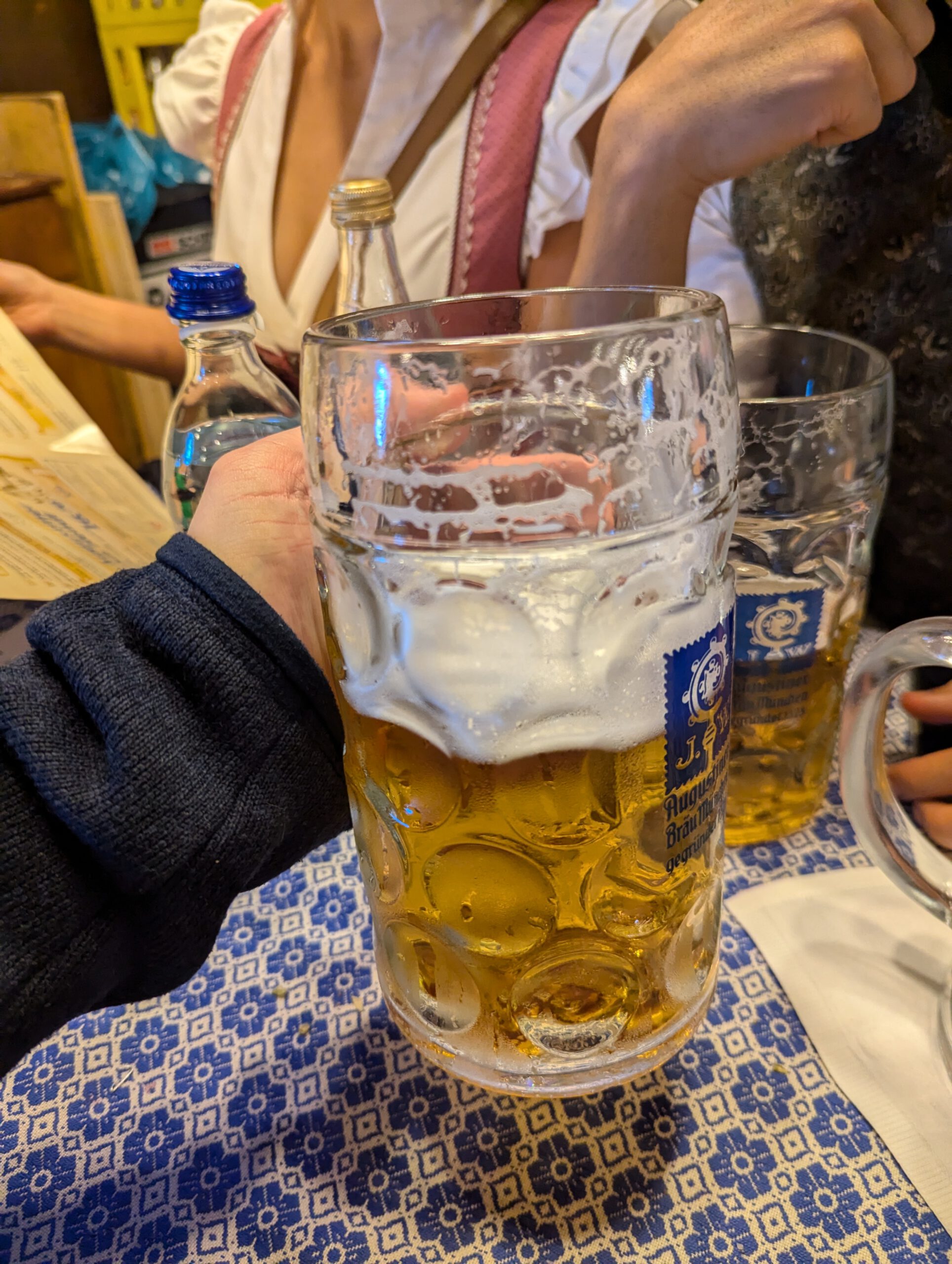
Augustiner at Augustiner Festhalle? Exactly as I expected and knew it.

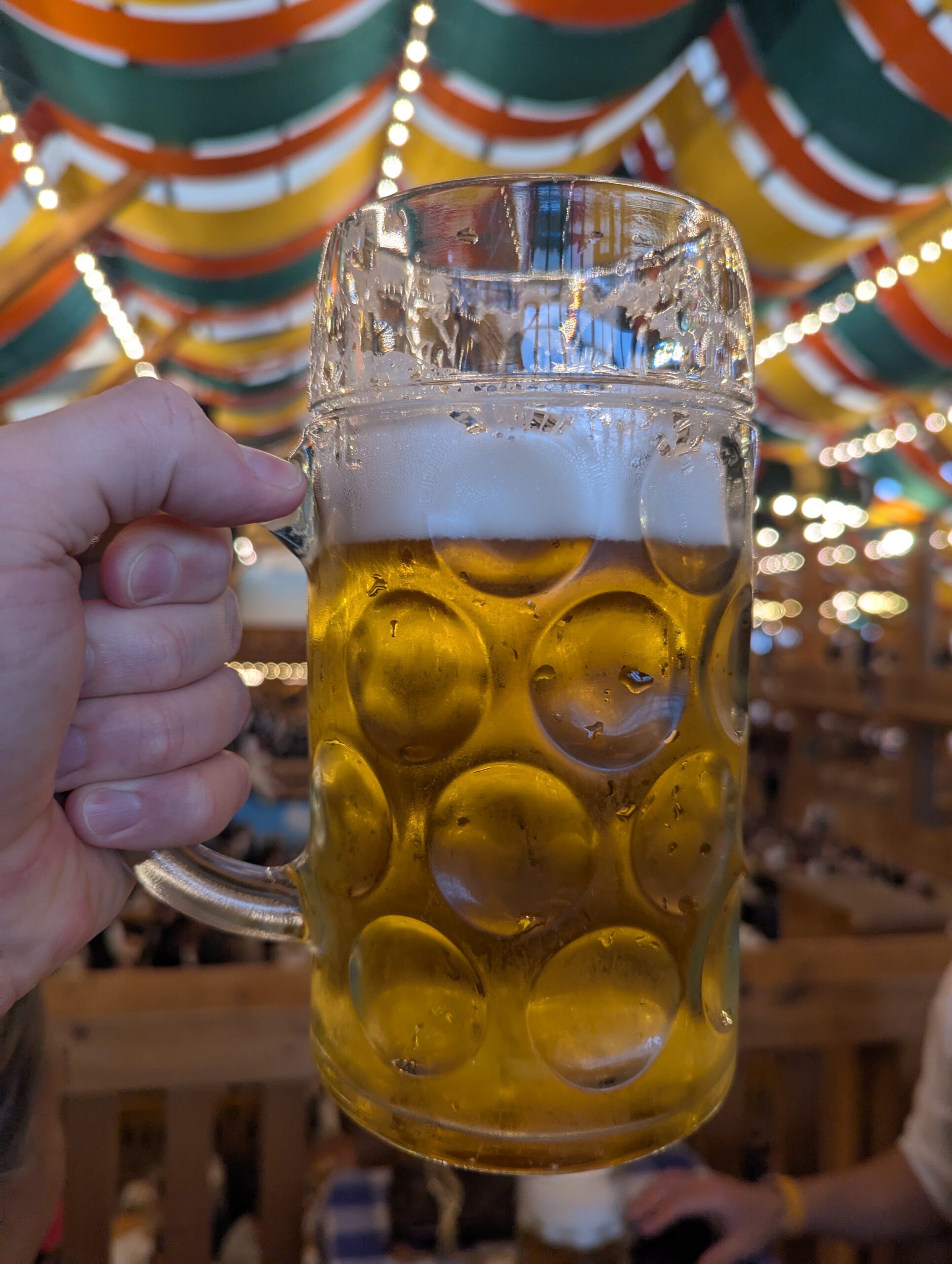
Most recently, Löwenbräu at Schützen-Festzelt? Whoa. Fresh, dry, crisp, entirely unlike what I had experienced in previous years.

A partially drunk Maß of beer at the Augustiner-Festzelt, 2024

When I came home after Oktoberfest, I actually went back into our beer fridge and tried a can of Löwenbräu Oktoberfestbier. And… it was not the same. It was solid, but nowhere near as good as just a few days before. And it tasted quite different from the Paulaner Oktoberfestbier (also from can) that I had afterwards, and also quite different from the bottled Oktoberfestbier I had had just a few days before.

But thinking back about all the Oktoberfestbier at Oktoberfest over the years, I don’t think I have would been able to distinguish them at all, unlike the ones at the beer tastings. The difference being of course that in all the taste tests, the beers under test were always from bottle or can, while at Oktoberfest, it’s always poured from tap, either as tank beer (for most brands) or from large 200 litre wooden casks (Augustiner only), the taps barely ever close, and the beer is properly cold (which probably doesn’t exactly help with tasting finer details in the beer).

So does the difference in beer at Oktoberfest even matter? To me, it doesn’t seem to, because I honestly don’t think I could taste the difference between Spaten, Löwenbräu and Augustiner. Is the preference of draught Oktoberfest beer at the festival itself just brand loyalty, and has nothing to do with the actual taste? To me, it seems like that at the moment, and it’s not just because people (including me) just get hammered and then nothing else matters. In fact, I never actually got drunk at any of my Oktoberfest visits because I like to pace myself by also drinking Radler and/or alcohol-free beer.

A Maß of Löwenbräu Oktoberfestbier at Schützen-Festzelt, 2025

And the latter is what actually matters in brand differentiation: at Marstall in 2023, they only had Radler as low-alcohol beery option, at Augustiner last year, they had their then new alcohol-free Helles on draught (which is otherwise only available in bottles, even in Augustiner restaurants and beer halls in Munich, so they must have been really sure about shifting a lot without developing microbiological issues in the draught system) which was excellent, and this year, the Schützen-Festzelt only had Löwenbräu’s alcohol-free beer which was a sugary, worty mess that I couldn’t even finish.

So at least for me, while the Oktoberfestbier brand doesn’t seem to matter, it does matter if you want to drink something other than the regular Festbier and explore some of the other options, like the non-alcoholic beers for pacing purposes.

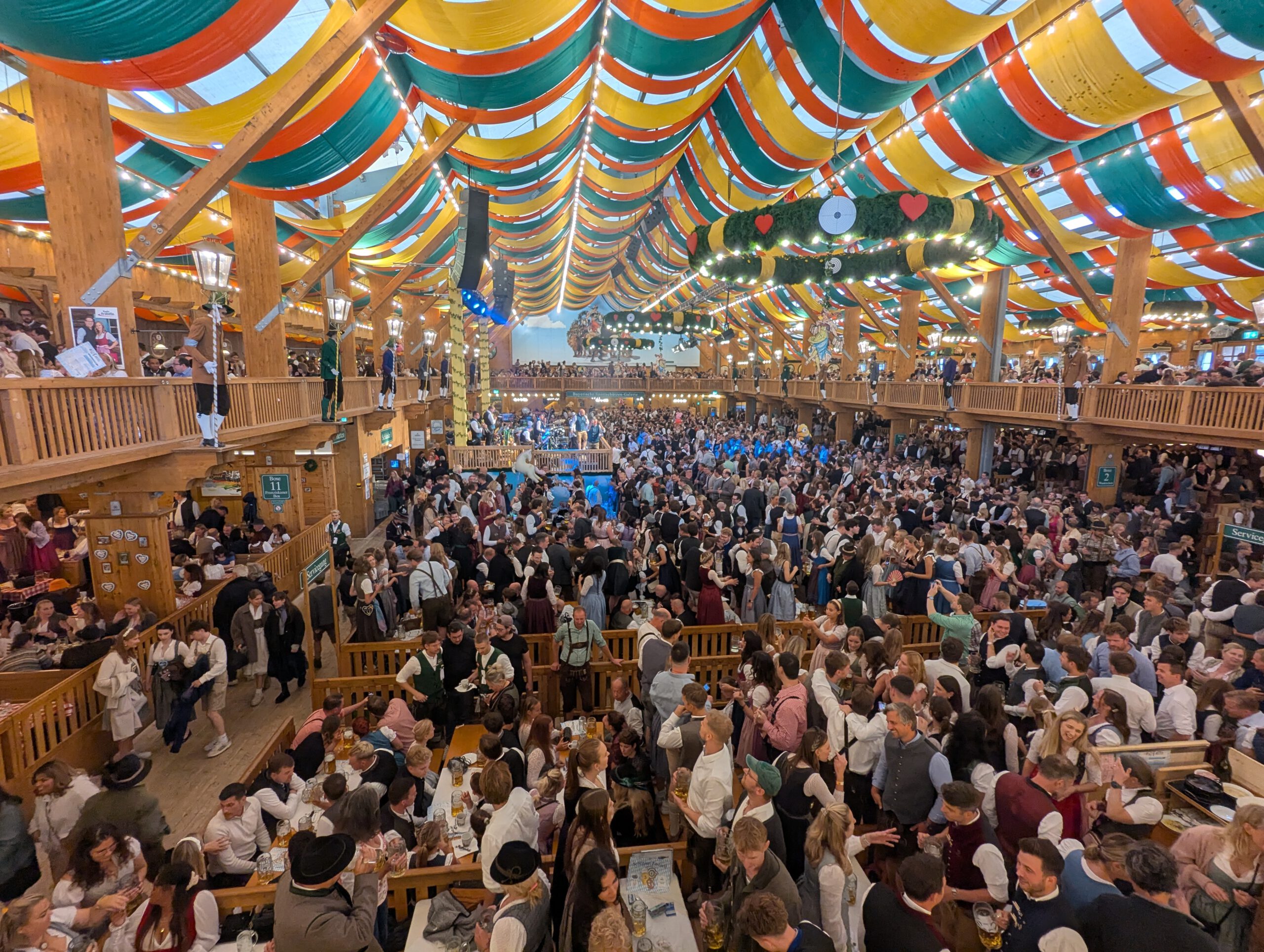
The crowd at Schützen-Festzelt, 2025

J.C. Jacobsen’s letter about pure yeast to Gabriel Sedlmayr

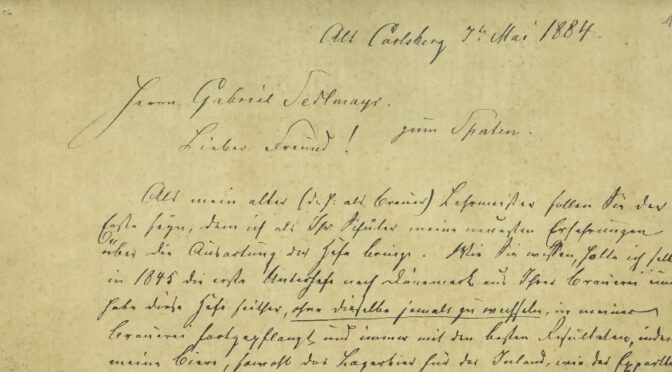
There is another letter from 1884 I came across in the J.C. Jacobsen archive of the Carlsberg Foundation, in which J.C. Jacobsen proudly tells Gabriel Sedlmayr of Spaten about his new pure yeast. I found it fantastic from a historic point of view because it gives insight into the circumstances, the background and what they thought was important about this new method of generating pure yeast. If you can read German, please directly read the original source, otherwise this is what J.C. Jacobsen had to say about this yeast:

J.C. Jacobsen called Gabriel Sedlmayr his “old master teacher” and thus should be the first one to learn about his new experiences in the deterioration of yeast.

Jacobsen brought his first bottom-fermenting yeast from Sedlmayr’s brewery (i.e. Spaten) to Denmark in 1845 and had used it since then without ever having to change it, all while producing excellent lager beer for the domestic market as well as export beer for export to India.

Only in last two years (i.e. since 1882) the brewery started having quality problems and their pitching yeast started getting contaminated by “wild cells”. So of course Jacobsen asked the question why he could keep the same yeast from 1845 until 1882, only for it to deteriorate since then? Nothing has changed in the brewhouse and the cellars, they are cleaner than ever, wort is always chilled rapidly and even the air is cleaned with a spray of ice cold salt water that filters it the point where it’s analytically clean. Even the malt is of fine quality.

The only change was that due to an unexpectedly high demand and insufficient capacity, he had to resort to brewing during more months of the week: until 1874, Carlsberg only brewed in 7 to 8 months “the old Bavarian fashion”, and until 1882, brewing was still limited to at most 9 months, from early October until late June. But from 1882 onwards, this had to be expanded to 12 months as the lagering cellars that were to be built weren’t finished yet.

And exactly these 3 more brewing months were the problem: in the gardens and fields in the wide vicinity of Carlsberg, lots of fruits were ripening during that time, in particular cherries, plums, pears and grapes, which came with a higher amount of fermenting microorganisms, some of them bacteria, others wild yeasts like Saccharomyces Pastorianius (sic!). These led to increased infections on the coolships, in particular since wild yeasts like S. pastorianus kept growing together with the other yeast.

The last few sentences are particularly interesting, as Jacobsen seems to use the “Saccharomyces Pastorianus” name to describe wild yeasts, not bottom-fermenting yeasts which would be the modern use of the name. Later in the letter, he uses “Saccharomyces cerevisiae” to describe the regular yeast at his brewery. This is something I’ve not came across, but seems to indicate how little the specific nature of bottom-fermenting yeast was understood at the time before single yeast cells were isolated and analysed.

Jacobsen then continues by explaining Hansen’s method of isolating single cells in Pasteur flasks (swan-necked flasks), and how Hansen had isolated one pure Saccharomyces cerevisiae as well as two wild yeasts, which, when propagated and used for fermentation, all produced very different-tasting beers.

The pure S. cerevisiae was then used as pitching yeast in the brewery and effected a “nice fermentation” that quickly clarified, with a suitable attenuation from 13.5% to 6-7% Balling and quickly clarification and the maturation casks. Jacobsen then proudly proclaimed that “from now on all the fermentation in my whole brewery will be done with this pure yeast, created from a single cell! Truly a triumph of scientific research!”

He also pointed out that because of these observations, he thought that the yeast in all breweries is somewhat infected with “more or less wild” yeasts, as at the time most breweries were brewing during the summer months, and even regular yeast changing brings no improvement to that.

Jacobsen also notes that “in the old days”, when no brewery in Bavaria would brew during the summer, changing yeast was also a rare occurrence. If breweries wanted to continue brewing during the summer, then at least a few breweries or research stations like Weihenstephan or Dr. Aubry in Munich should occasionally isolate Saccharomyces cerevisiae to create pure yeast.

He also announced to to Sedlmayr that he’d send him a sample of enough yeast for one fermenter as express freight so that he could get acquainted with it. Jacobsen hoped it would arrive in Munich in a good state, though he admitted he had no experience sending yeast on such a long journey, and would be happy to send him more of his surplus yeast in the future.

The yeast also came with information how it was used at Carlsberg: the yeast was pitched at 5°R (6.25°C). The temperature increased to 6.5 to 6.75°R (8.12-8.43°C), and then slowly subsided back to 4 to 5R° (5-6.25°C). A 13.5% Balling wort fermented down to an attenuation of 6-7% Balling within 10 to 11 days. Jacobsen also pointed out that Sedlmayr’s wort contained less maltose than his own, so Sedlmayr had to expect lower attenuation.

And finally, Jacobsen announced his travel plans (which he expected to be his last big journey): first he wanted to visit Johann Götz in “Oswiecim near Krakow” (he probably meant Okocim) and then travel from there to Vienna and Munich, and further on to West Germany and hopefully to Lyon and Marseille. He hoped to meet Sedlmayr in Munich, but if he didn’t meet him there, he’d try to catch him in his summer apartment to meet his “friend and master” once more.

I find this letter particularly fascinating for a few reason. First of all, it shows the great admiration Jacobsen had for Sedlmayr who considered to be his teacher from whom he learned about lager brewing and in particular about bottom-fermenting yeast, and how much he thought he owed Sedlmayr for his own success.

Second, it shows how durable repitching the same lager yeast was: as Jacobsen himself said, he never needed to change his brewery’s yeast, which he had gotten from Sedlmayr himself, in 37 years of brewery operation. He also knew that changing yeast, even though it was done, indeed used to be a relatively rare thing. That way, this new pure yeast was exactly the innovation the brewing industry needed, as more and more breweries were brewing beer all year long, and sooner or later other breweries also would have run into the problem of wild yeast contamination in their own pitching yeast. In retrospect, we now know how incredibly successful Hansen’s method of isolating single cells and growing pure pitching yeast really was, as the method was widely adopted by the brewing industry within just a few years.

Nowadays, only very few breweries repitch their house yeast without having purified it. Among lager breweries, all pitching yeast is grown from pure yeast strains, and having a choice in pure strains has become a commodity not just in the industry, but even for home-brewers.

And finally, we learn about the fermentation properties of the yeast itself, which is pretty close to what you’d expect from a bottom-fermenting yeast during the 19th century: relatively quick fermentation (just 10 days) at temperatures of at most 8°C, with a relatively poor apparent attenuation of 50-55%. At least in other beers of that time period, the attenuation only slowly improved during the lager period where the specific gravity dropped to 4 to 5°P and helped carbonate the beer. In my book about Vienna Lager, I put up the hypothesis that becuase of these properties, the lager yeasts at the time were most likely type 1 (“Saaz-type”) bottom-fermenting yeast strains, as they were better suited to the lower fermentation temperatures in fermentation and lagering cellars that could not be finely controlled yet.

J.C. Jacobsen’s letter to Gabriel Sedlmayr dated 7th May 1884 is a great example of what was new, innovative and exciting to brewers at the time that we now consider to be a given. It also shows how closely connected the European lager brewers were back then: Jacobsen and Sedlmayr communicating by mail, Jacobsen visiting Johann Götz and various people in Vienna, Munich and France, the recognition of Weihenstephan as an important beer research lab in Bavaria, etc. They were more than practitioners, but also innovators who were not afraid to share their findings with each other, all with the purpose of bringing the whole industry forward and lifting the overall quality of beer, but also improving efficiency within the industry.

Which Breweries’ Beers Were Served At Oktoberfest in 1843?

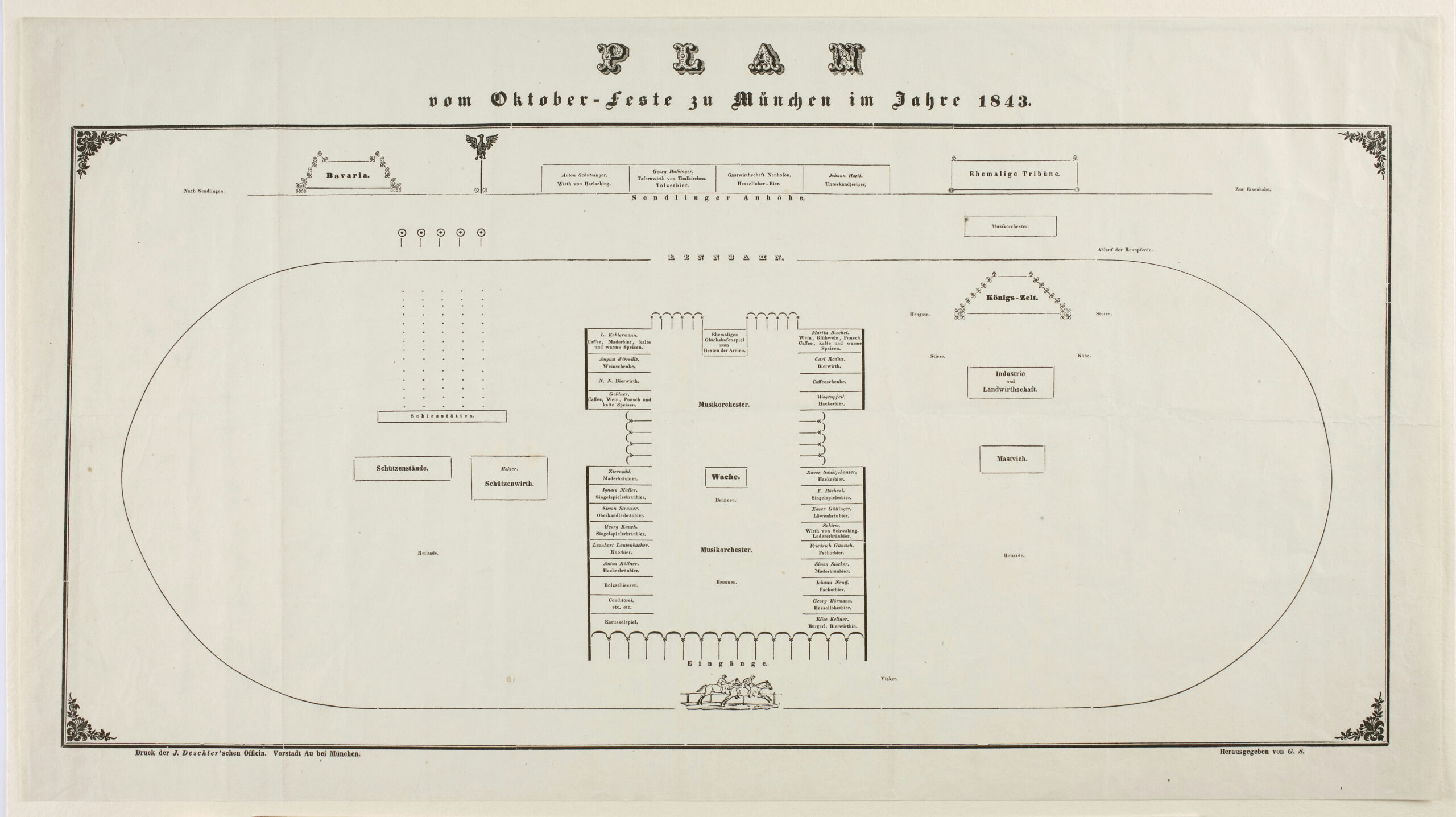
Bavarikon, Bavaria’s internal portal to present treasures, art and other things from its archives, libraries and museums, is an incredibly valuable platform, as you can find all kinds of random bits and pieces related to Bavaria in some shape or some. They of course have lots of digitalized material about Oktoberfest, like this map of Oktoberfest at Theresienwiese from 1843:

A map of Oktoberfest from 1843. Source. Public Domain.

This is great, because not only does it give us insight into the overall setup (basically, the horse racing course was on the outside of the field, while in the middle, most of the stands could be found, with more stands to be found on the hill on the Western side of Theresenwiese, just north of the Bavaria statue.

Of course, the King had his own tent, with the agricultural exhibition placed near it. On the South side, the shooting range was located, while in the center, the most was going on: lots of places serving beer, coffee, wine, punch, cold and hot food, or pastries, but there were also attractions like a carousel and crossbow shooting, and the Glückshafen, a lottery with the purpose that its profit be used to support the city’s poor. That attraction still exists today, and is the oldest operation at the Oktoberfest.

Most importantly though, we also learn which breweries’ beers were served in 1843:

  • Singelspieler
  • Mader
  • Oberkandler
  • Knor[r]
  • Hacker
  • Löwenbräu
  • Pschor[r]
  • Unterkandler
  • Tölzer (from Tölz; nowadays Bad Tölz)
  • Hesselloher (probably referring to the brewery in Großhesselohe in Pullach, just South of Munich)

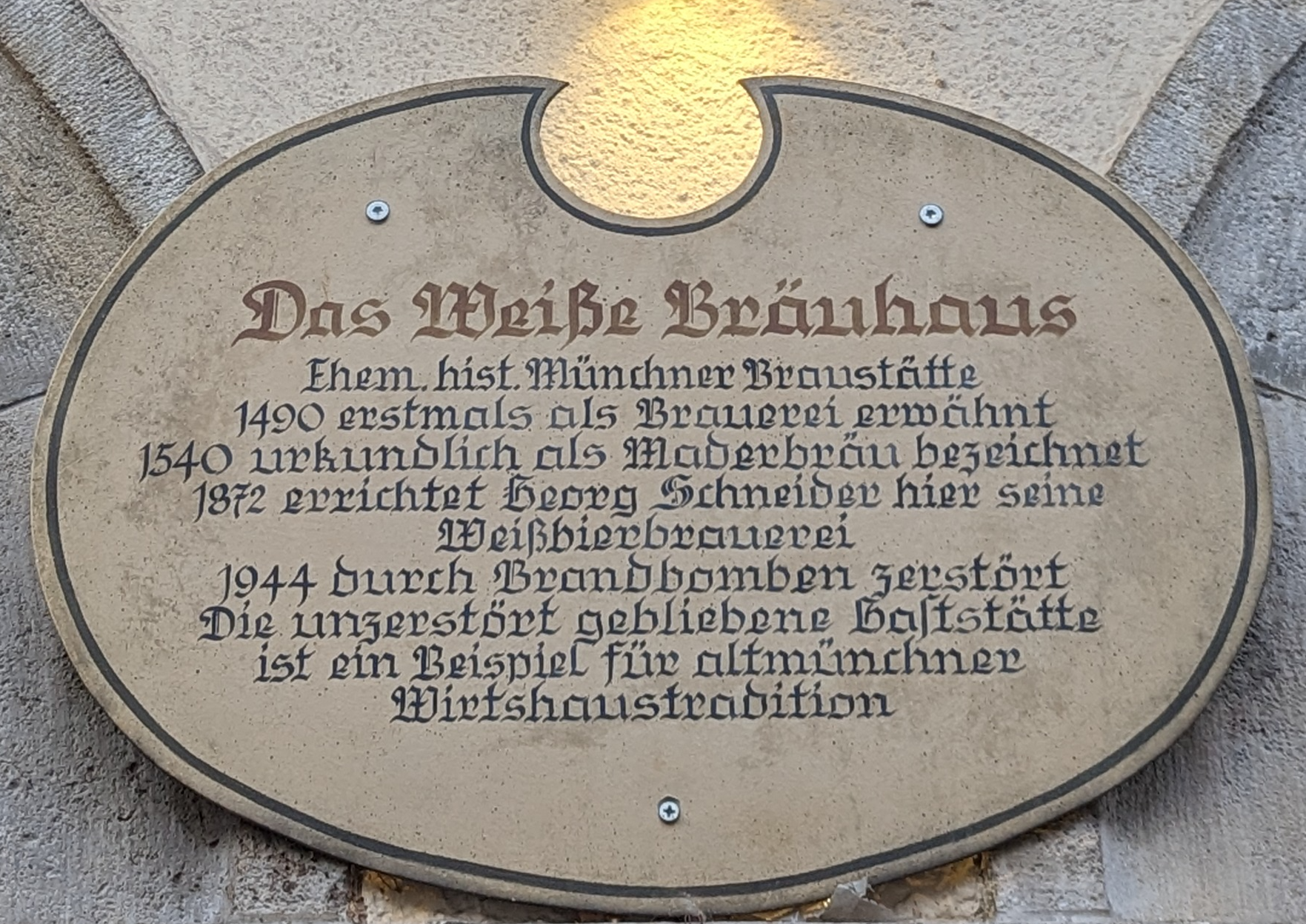
Some of these breweries resp. brands are still around, like Hacker and Pschorr in the Hacker-Pschorr brand, and Löwenbräu, while others are less known: Maderbräu is probably best known these day through Maderbräustraße, the little street next to Weißes Brauhaus in Munich: when Georg Schneider had to move out of the old Weißes Brauhaus (roughly where Hofbräuhaus is located nowadays), he managed to buy the defunct Maderbräu brewery building and relocate his brewery there. Only the street name and a sign on the wall of Weißes Brauhaus are reminders of this old Munich brewery.

Sign on the wall of Weißes Brauhaus, Munich. It says “The White Brewhouse. Former historischer Munich brewery. 1490 first mentioned as brewery. 1540 called Maderbräu in a document. 1872 Georg Schneider built his white beer brewery here. 1944 destroyed by incendiary bombs. The undestroyed restaurant is an example of the old Munich pub tradition.”

The other Munich breweries in this list are attested through an old map from the 1830s of Munich breweries: Knorrbräu on Briennerstraße, Oberkandler and Unterkandler, both on Neuhauser Straße, and Singelspieler on Sendlinger Straße. Even beer from further away was brought to Theresienwiese and served there, such as from Tölz, South of Munich, and Hesselloher Bier, which was likely from the brewery in Großhesselohe in Pullach just outside Munich, but that’s not entirely clear from the source.

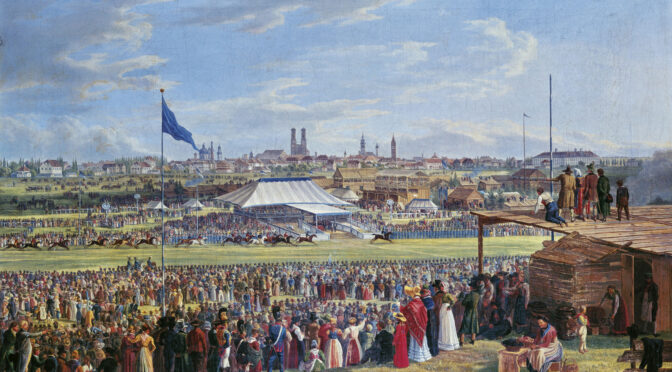
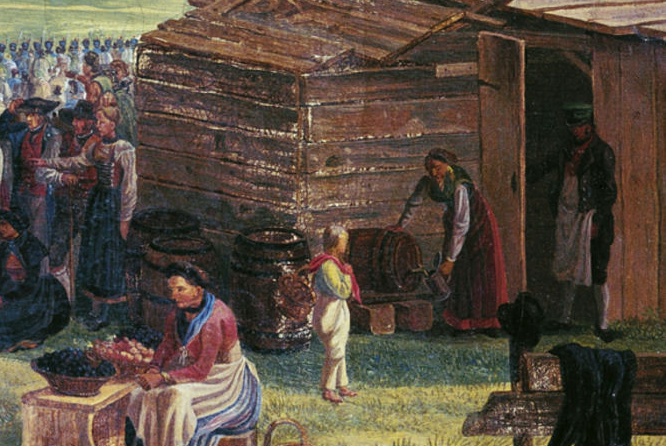
From an 1824 painting by Heinrich Adam, we can also get a rough idea how serving beer used to be organised like, on a much smaller scale than nowadays, from wooden shacks like this one:

Detail from an 1824 painting by Heinrich Adam, depicting beer getting served from a cask at Oktoberfest. License: CC BY-SA 4.0. Source.

(header image by Heinrich Adam, 1824, licensed under CC-BY-SA 4.0. source)

How the Hofbräuhäuser of Bavaria were established

Even if you’ve only ever dabbled a little bit in Bavarian beer, you will have stumbled upon the Hofbräuhaus in Munich, owned by the State of Bavaria, and with a beer hall in the heart of the city. But then you look further, and realise that there’s also a Hofbräuhaus Traunstein 75 minutes outside of Munich, and then there’s of course Weißes Bräuhaus. But how were these “court brew houses” established?

It all actually started with a bit of a brewing crisis. Starting from 3 September 1571, brewing in Munich was totally banned. That year’s rye harvest was rather poor, and barley was needed as a substitute to feed the population. Brewing white or brown beer was seen as a waste, and thus completely stopped through a Ducal order.

This brewing ban remained in place until 1580 when it was partially lifted. Of course, the Duke and his court still needed beer. So for the Duke, beer from Zschopau in Saxony was ordered, and the Nuremberg-based trading house Unterholzer facilitated the delivery of Ainpöckischpier from Einbeck from 1573 until 1589.

The court servants though got different beer: grain from the Duke’s storehouse was given to breweries, in particular the religious orders of the Franciscans and the Augustinians, and the brewer Georg Mänhart who held the title of “court brewer”. With that grain, these breweries were ordered to brew beer of the best quality to be delivered to the court.

Soon after Duke Wilhelm V. took office in 1579, he inquired about which breweries in the Bavarian Forest were brewing “white Bohemian beer” and where they got their brewing ingredients from. A commission of 4 people produced a report in 1581 that listed all the white beer breweries in the designated area as well as those that belonged to the Prince-Bishopric of Passau. In 1586, the Duke gave a brewing privilege to the Schwarzenberg family and their male descendants that allowed them to brew white wheat beer, a privilege that otherwise only the Degenberg family held. At the same time, he also inquired about the general profitability of white beer. An earlier report handed to him noted that brewing white beer was considered to be a waste, but could be turned into a profitable business.

In the end, Duke Wilhelm V. remained cautious and only founded one brewery in 1589, the Hofbräuhaus in Munich for brewing brown beer, but building works for it only started in 1591. When the new brew house started operating, the previous court brewer Mänhart lost much of his business and fell into poverty, but was compensated for it with an annual payment of 100 florin a year.

When the Degenberg family went extinct in 1602 through the death of Hans VIII. Sigmund of Degenberg, Duke Maximilian I. set a plan in motion to gain control over white beer brewing in Bavaria. He was much more ambitious and had already looked into white beer brewing before taking office in 1597, as Bavaria was close to bankruptcy and he saw white beer as a profitable way of making the Bavarian Duchy rich again.

Before even the Degenberg inheritance was settled, he immediately continued paying the brewers at the Degenberg brew houses to keep up brewing operation, even though he legally did not own them. Only in 1607, he came to an agreement with the heirs of the Degenberg family, in which he was allowed to purchase the Degenberg breweries for 82,000 florin while cancelling a debt of 20,000 florin of the heirs. Maximilian I. now owned 3 white brew houses, in Zwiesel, Schwarzach and Linden.

Already in 1602, brewers from the Schwarzach brewery were ordered to Munich to teach the Hofbräuhaus staff how to brew white beer and to brew the first batches. The first court-brewed white beer was then sold in Munich on 16 October 1602, directly from the Ducal cellar. A separate white brew house was finally built in 1607 and a dedicated brewmaster for white beer was hired.

A newly built brew house in Gossersdorf that opened in 1600 and interestingly had not been banned by the court (they only banned the brewer from using domestically grown wheat) was sold to Maximilian I. in 1602.

At that time, the court in Munich had already forgotten about the Schwarzenberg brewing privileges granted in 1586, but when their family was able to provide them with original documents, Maximilian I. offered to buy their brew house in Winzer which was finalized on 29 April 1603.

Now owning all the white brew houses of the Degenberg and the Schwarzenberg families, he was the exclusive brewer of white beer in Bavaria. Well, almost, because there were nine communal brew houses in Lower Bavaria (the remnants of the communal brew house system in parts of Bavaria are nowadays better known as Zoigl) that historically also had a customary right to brewing white beer. The Duke also managed to subjugate them and forced them to share their revenue through a duty they had to pay. These nine brew houses were located in Viechtach, Regen, Kötzting, Furth im Wald, Neukirchen bei Hl. Blut, Eschlkam, Schönberg, Grafenau and Hals.

On top of that, more white beer breweries were established: in Mattighofen, the brown brew house was converted to producing white beer in 1607. In the summer of the same year, building works started in Kelheim for a new brewery which started brewing white beer in April 1608, while in Traunstein, an existing building was bought and turned into a brewery in 1611.

By 1612, Duke Maximilian had established a formidable network of state-owned breweries: not only was there the Hofbräuhaus in Munich that produced brown beer, but he also directly owned nine white brew houses and received a passive income from nine more communal white brew houses. Technically speaking, these were all court brew houses, and a dense network of them stretched over Old Bavaria that only got extended with more breweries over the years.

Some of them are still around: the white beer brewery in Traunstein was destroyed in 1704, rebuilt and eventually sold in 1820. Since 1896, it has been owned by the Sailer family and run as Hofbräuhaus Traunstein.

The “white brew house” in Munich kept operating next to the Hofbräuhaus and was leased to brewers. The last one was Georg Schneider. When the buildings of the white brew house were to be repurposed in the 1870s, he simply bought the rights for it from the court and moved to another building, the former Maderbräu building on Im Tal, just a few hundred metres away from the old brewery, which made it easy for his existing customers to visit the new place. The old Maderbräu building was renamed Weißes Bräuhaus (white brew house) and became the headquarters for the Schneider family brewer. In 1928, the Schneider family bought the white brewhouse in Kelheim, another formerly state-owned brewhouse which became their main brewery after World War II, and which they now claim to be the oldest white brew house in Bavaria.

What remains though is that the Hofbräuhaus is still around, even though ownership has changed, as the Bavarian King transferred it to the Bavarian State in 1852. The white beer privilege has long been broken, but even of these formerly privileged white brew houses, some are still in operation, the one in Kelheim even still dedicated to the production of white wheat beer.